
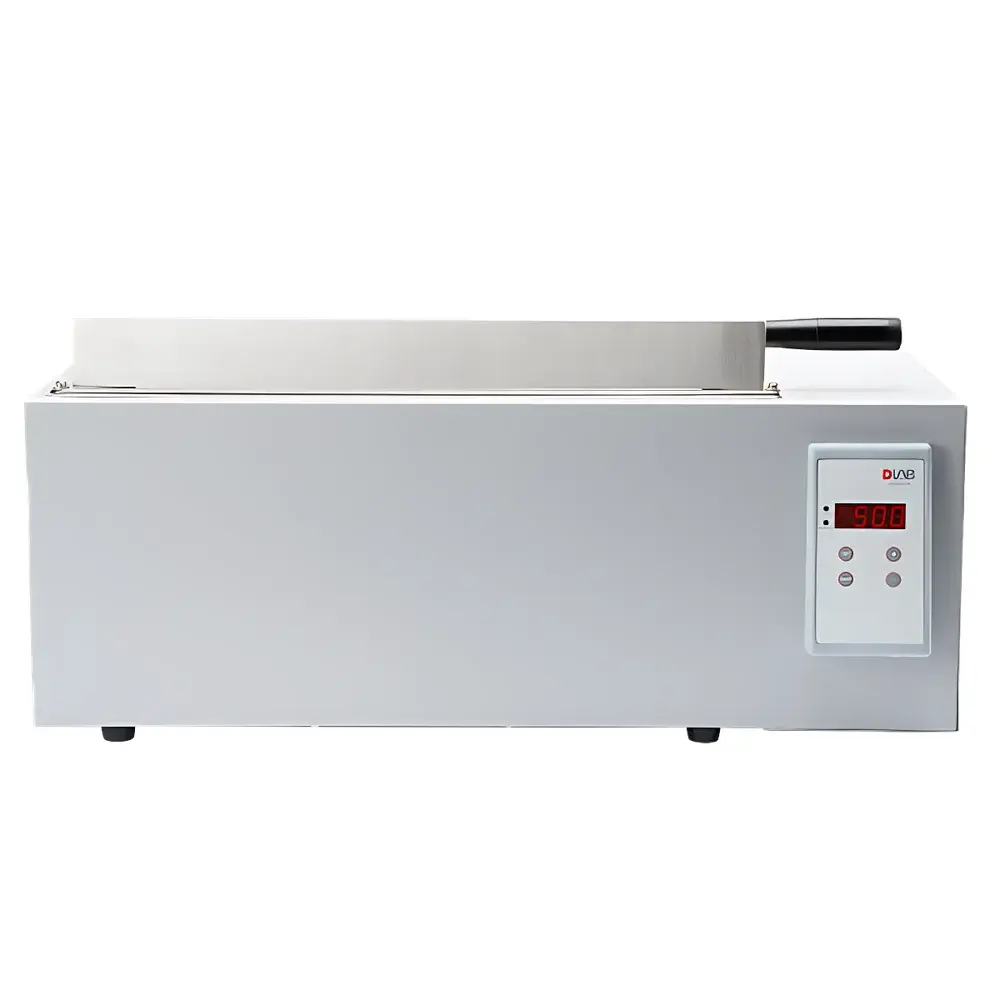
DLAB DWB20-S Precision Digital Water Bath
| Brand | DLAB |
|---|---|
| Model | DWB20-S |
| Temperature Range | Ambient +5°C to 100°C |
| Stability (≤37°C) | ±0.5°C |
| Accuracy (≤37°C) | ±0.3°C |
| Capacity | 20 L |
| Chamber Material | 304 Stainless Steel |
| Protection | Over-Temperature Cut-Off |
| Sensor | PT1000 Platinum Resistance Thermometer |
| Dimensions (L×W×H) | 667×349×357 mm |
| Net Weight | 16.2 kg |
| Power Supply | 220 V, 50/60 Hz |
| Heating Power | 1000 W |
| Operating Environment | 10–40°C, <80% RH |
| Housing | Q235 Steel Frame with Polymer Coating |
Overview
The DLAB DWB20-S Precision Digital Water Bath is an engineered thermal platform designed for reliable, repeatable temperature control in routine laboratory workflows requiring stable aqueous or liquid-phase incubation. Utilizing a microprocessor-based PID control system, the unit delivers rapid heating and precise thermal regulation across its full operating range—from ambient +5°C up to 100°C—with enhanced uniformity maintained throughout the 20-liter stainless steel bath chamber. The system employs a high-stability PT1000 platinum resistance thermometer for real-time feedback, enabling tight setpoint adherence and minimizing thermal drift over extended operation. Its robust construction integrates a corrosion-resistant 304 stainless steel inner tank and protective shroud—critical for longevity in environments involving frequent cleaning, saline solutions, or mild chemical exposure. Built-in over-temperature protection automatically deactivates the heating element if sensor readings exceed safe thresholds, supporting compliance with general laboratory safety protocols (e.g., ISO/IEC 17025 Annex A.3 on equipment safety) and reducing risk of sample degradation or operator hazard.
Key Features
- Microprocessor-controlled PID temperature regulation with LED digital display for intuitive setpoint entry and real-time monitoring
- High-uniformity thermal field: ±0.5°C stability and ±0.3°C accuracy at temperatures ≤37°C—validated per ASTM E1112 for liquid-bath performance
- 20-liter capacity chamber fabricated from medical-grade 304 stainless steel, resistant to oxidation and common lab reagents
- Dual-layer housing: Q235 structural steel frame with durable polymer coating, combined with integrated thermal insulation for energy efficiency
- Fail-safe over-temperature cutoff circuitry compliant with IEC 61010-1 requirements for laboratory electrical equipment
- 1000 W heating element optimized for rapid ramp-up without excessive overshoot; typical time-to-setpoint (25°C → 37°C) <12 minutes
- Low-maintenance design: no moving parts, sealed electronics compartment, and accessible drain port for easy cleaning and fluid replacement
Sample Compatibility & Compliance
The DWB20-S accommodates standard laboratory glassware including beakers (up to 2 L), flasks (Erlenmeyer, volumetric), test tubes, cuvettes, and enzymatic assay plates—provided external dimensions fit within the bath’s internal footprint (approx. 540 × 270 mm). Its non-reactive stainless steel surface ensures compatibility with aqueous buffers, PBS, Tris-HCl, sucrose gradients, and low-concentration ethanol/water mixtures. While not rated for organic solvent immersion, incidental contact with IPA or acetone during cleaning poses no structural risk due to material inertness. The device meets CE marking requirements under the Low Voltage Directive (2014/35/EU) and Electromagnetic Compatibility Directive (2014/30/EU). It supports GLP-aligned documentation practices through traceable calibration records and user-accessible service logs—though it does not include FDA 21 CFR Part 11-compliant audit trails as it lacks networked data export functionality.
Software & Data Management
The DWB20-S operates via embedded firmware only; no external software or PC connectivity is provided. All configuration—including temperature setpoint, hold duration (timer function), and alarm activation—is managed directly through the front-panel keypad and LED interface. The unit stores no historical temperature logs or event timestamps. For laboratories requiring electronic recordkeeping, integration with external data loggers (e.g., Omega OM-DAQPRO-5300 series) is supported via analog 0–5 V output (optional accessory port, not factory-installed). Calibration verification follows a two-point method using NIST-traceable reference thermometers, with procedures outlined in the included Operation & Maintenance Manual (Revision 3.1, EN/ES/FR versions available).
Applications
- Enzyme kinetics assays requiring strict thermal consistency across replicate reactions
- Cell culture media pre-warming prior to sterile handling in biosafety cabinets
- Standardization of viscosity measurements for Newtonian fluids per ASTM D445
- Hybridization steps in molecular biology workflows (e.g., Southern/Northern blotting)
- Stability testing of pharmaceutical formulations under accelerated conditions (ICH Q1A)
- Calibration of temperature-sensitive probes and sensors in metrology labs
- Sample thawing and gentle warming of cryopreserved biological specimens
FAQ
What is the recommended calibration frequency for the DWB20-S?
DLAB recommends annual calibration using a certified reference thermometer; more frequent verification (e.g., quarterly) is advised in regulated environments or after mechanical impact.
Can the bath be used with circulating pumps or external chillers?
No—the DWB20-S is a static water bath without inlet/outlet ports or pressure-rated fittings; it is not designed for recirculation or active cooling integration.
Is the stainless steel chamber suitable for saltwater applications?
Yes—304 stainless steel provides adequate resistance to NaCl solutions up to 3.5% w/v at ≤60°C; prolonged exposure above 70°C may accelerate pitting corrosion.
Does the unit support programmable ramp-soak profiles?
No—only single-setpoint temperature control with manual timer activation is available; multi-step thermal programming requires external controllers.
What maintenance is required beyond regular cleaning?
Inspect heater element continuity annually; verify PT1000 sensor resistance (1000 Ω at 0°C ±0.1%) using a calibrated multimeter; replace bath fluid every 3–6 months depending on usage intensity and water quality.



