
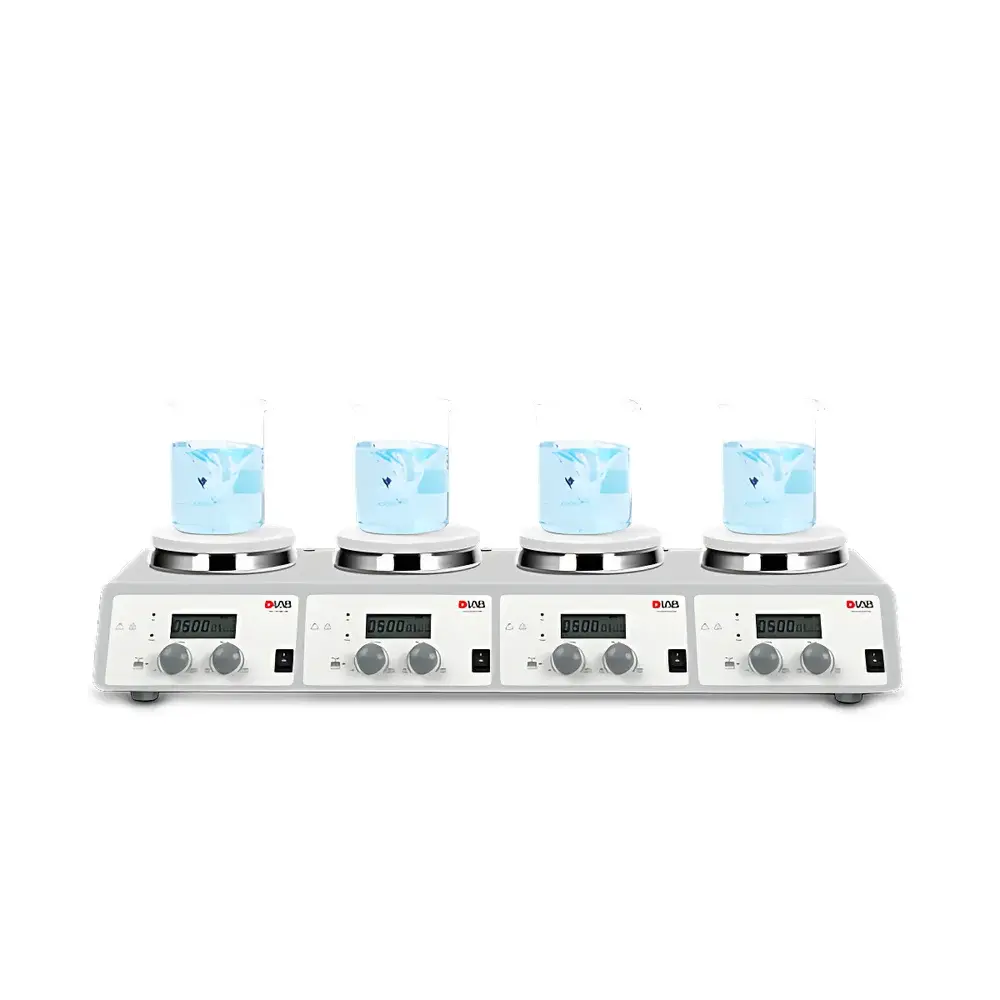
DLAB MS-H340-S4 Four-Channel LCD-Controlled Heated Magnetic Stirrer
| Brand | DLAB |
|---|---|
| Origin | Beijing, China |
| Manufacturer Type | Direct Manufacturer |
| Product Category | Domestic (China-Made) |
| Model | MS-H340-S4 |
| Instrument Type | Magnetic Stirrer |
| Max Stirring Volume per Position | 10 L (H₂O) |
| Speed Range | 200–1500 rpm |
| Temperature Control Range | 25–340 °C |
| Plate Diameter | Φ135 mm (5 in) |
| Plate Material | Stainless Steel with Ceramic Coating |
| Motor Input Power | 1.8 W × 4 |
| Total Power Consumption | 515 W × 4 |
| Heating Power | 500 W × 4 |
| Speed Display | LCD |
| Temperature Display | LCD |
| Speed Accuracy | ±20 rpm |
| Temperature Accuracy | ±0.1 °C (internal), ±0.2 °C (external PT1000 sensor) |
| Over-Temperature Protection | 420 °C |
| IP Rating | IP21 |
| Dimensions (W×D×H) | 698 × 270 × 128 mm |
| Weight | 9.5 kg |
| Ambient Operating Temperature | 5–40 °C |
| Max Relative Humidity | 80 % RH |
Overview
The DLAB MS-H340-S4 is a precision-engineered four-channel magnetic stirrer with integrated heating and digital LCD control, designed for reproducible, parallel sample processing in analytical, pharmaceutical, and materials science laboratories. It operates on the principle of magnetic coupling—rotating permanent magnets beneath the ceramic-coated stainless steel plate generate a rotating magnetic field that drives PTFE- or glass-coated stirring bars immersed in vessels. Each of the four independent channels features fully decoupled speed and temperature regulation, enabling simultaneous operation under distinct process conditions. The unit is engineered for thermal stability across extended runs, with rapid heat-up kinetics and tight thermal uniformity (<±2 °C across the plate surface at 100 °C), making it suitable for applications requiring precise thermal management alongside mechanical mixing—such as dissolution testing, catalyst activation, polymerization initiation, and buffer equilibration.
Key Features
- Four independently controlled stirring/heating positions with full parameter isolation—no cross-channel interference in speed or temperature setpoints.
- Ceramic-coated stainless steel plates (Φ135 mm each) offering high corrosion resistance, thermal shock tolerance, and non-reactive surface compatibility with acidic, alkaline, and organic media.
- LCD dual-display interface showing real-time rpm and temperature for each active channel; intuitive rotary encoder + push-button navigation for parameter entry and recall.
- Integrated PT1000 external temperature probe input (±0.2 °C accuracy) enabling vessel-bottom or solution-phase feedback control—critical for GLP-compliant thermal validation studies.
- Over-temperature safety cutoff at 420 °C with audible alarm and automatic heater deactivation, compliant with IEC 61010-1 safety requirements for laboratory equipment.
- Robust power architecture: 500 W heating per channel (2000 W total) and low-noise brushless motors delivering stable torque up to 10 L aqueous loads with 40 mm stir bars.
Sample Compatibility & Compliance
The MS-H340-S4 accommodates standard laboratory glassware including beakers (50 mL–2000 mL), Erlenmeyer flasks, and jacketed reactors up to 10 L volume per position. Its IP21 ingress protection rating ensures operational safety in typical lab environments with limited dust exposure and no direct water contact. The instrument meets CE marking requirements under the Low Voltage Directive (2014/35/EU) and Electromagnetic Compatibility Directive (2014/30/EU). While not inherently 21 CFR Part 11–compliant, its parameter logging capability (via optional RS232/USB data export) supports audit-ready documentation when integrated into validated workflows adhering to ISO/IEC 17025, USP , or ASTM E2500-22 guidance.
Software & Data Management
The MS-H340-S4 operates as a standalone instrument with no embedded operating system. However, it supports serial (RS232) and USB virtual COM port connectivity for integration with third-party Lab Information Management Systems (LIMS) or custom Python/NI LabVIEW scripts. Real-time speed and temperature values from all four channels can be streamed at 1 Hz resolution, timestamped, and logged to CSV or database formats. Optional firmware updates—distributed via DLAB’s secure customer portal—introduce enhanced calibration traceability and user-defined protocol storage (e.g., ramp-hold-cool sequences), facilitating repeatable method execution across shifts and operators.
Applications
- Parallel synthesis screening in medicinal chemistry, where discrete reaction temperatures and agitation rates must be maintained across multiple vials.
- Preparation of homogeneous standards and reference solutions for ICP-MS or HPLC calibration—ensuring complete solute dissolution without localized overheating.
- Accelerated stability testing per ICH Q1A(R2), using synchronized heating/stirring to simulate long-term degradation kinetics under controlled thermal stress.
- Cell culture media pre-warming and pH equilibration prior to sterile filtration, minimizing thermal gradients and CO₂ loss during transfer.
- Viscosity-sensitive processes such as nanoparticle dispersion in surfactant systems, where shear rate consistency directly impacts aggregate size distribution.
FAQ
Can the MS-H340-S4 be used with aluminum or plastic containers?
No—magnetic coupling requires ferromagnetic or diamagnetic conductive base materials. Aluminum blocks magnetic flux; most plastics are non-magnetic and thermally insulating. Use only glass, ceramic, or stainless steel vessels.
Is the PT1000 sensor included with the unit?
Yes—the external PT1000 probe is supplied as standard equipment and connects via a dedicated 4-pin DIN port on the rear panel.
What is the minimum recommended stir bar length for optimal performance at 1500 rpm?
For stable vortex formation and minimal wobble at maximum speed, use stir bars ≥25 mm in length and ≥6 mm in diameter, matched to vessel geometry and fluid viscosity.
Does the unit support programmable temperature ramps?
Not natively—the front panel allows only fixed-point temperature control. Ramp profiles require external scripting via RS232/USB interface and host software.
How often should the ceramic coating be inspected for micro-cracking?
Visual inspection is recommended before each high-temperature (>250 °C) run. Any visible chipping or discoloration warrants replacement of the plate assembly to prevent uneven heating or metal leaching.



