
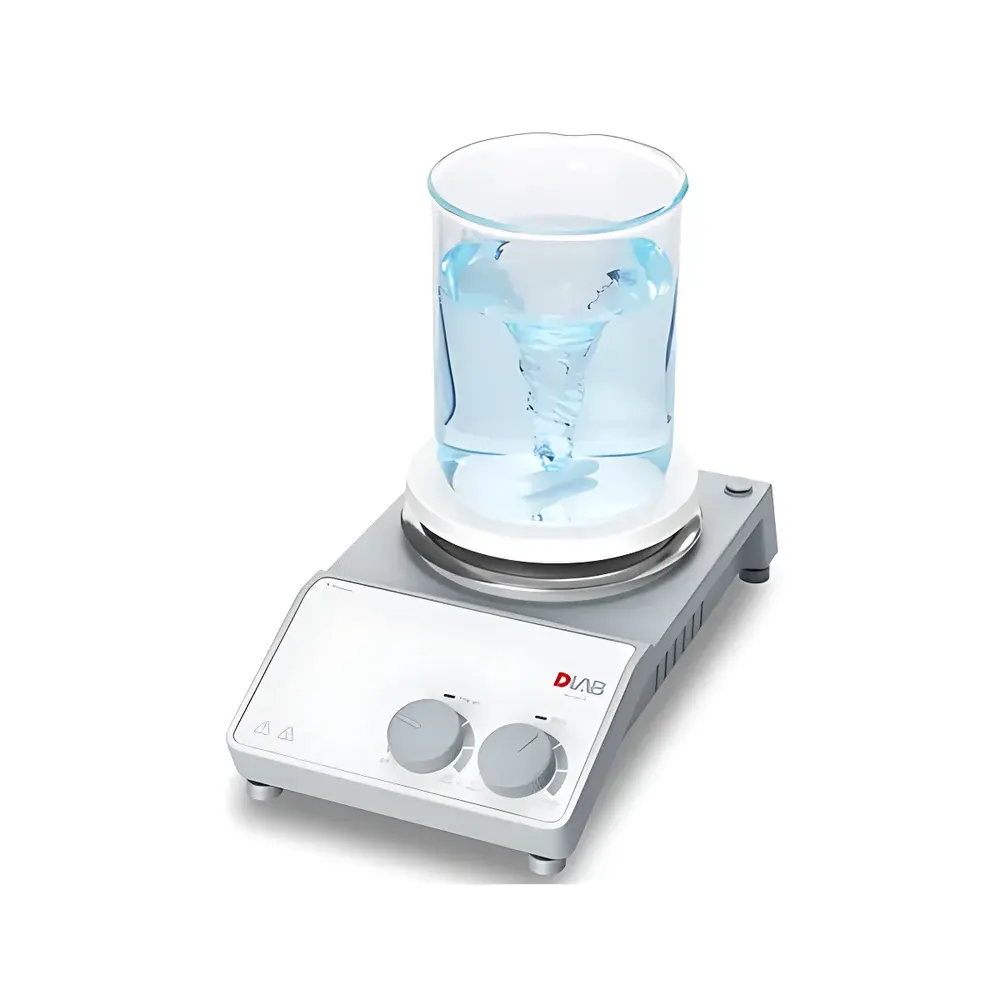
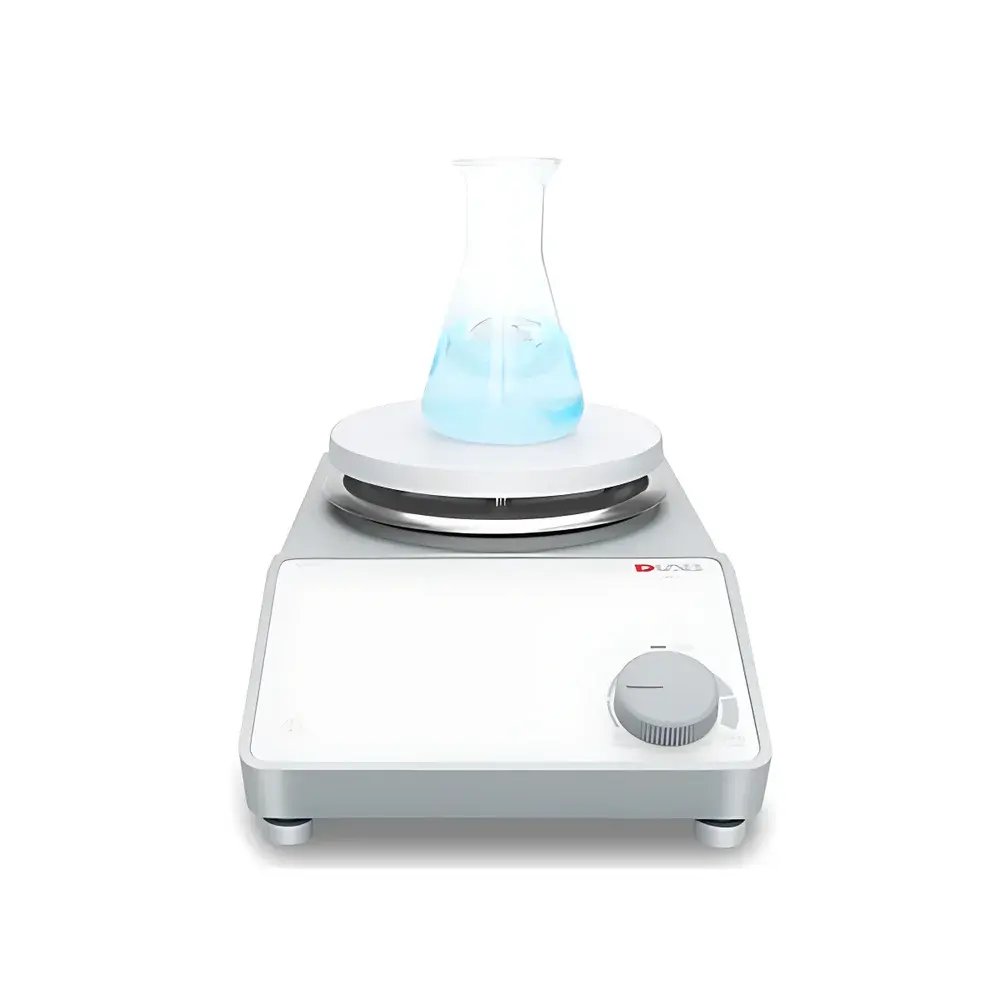
DLAB MS-H-S / MS-S Standard Magnetic Stirrer (Heated & Non-Heated Models)
| Brand | DLAB |
|---|---|
| Origin | Beijing, China |
| Manufacturer | Yes |
| Type | Magnetic Stirrer |
| Max. Stirring Volume | 20 L (H₂O) |
| Speed Range | 0–1500 rpm |
| Heating Temp. Range (MS-H-S only) | RT to 340 °C |
| Power Supply | 100–240 VAC, 50/60 Hz |
| Motor | Brushless DC |
| Display | LCD (MS-H-S), Analog Scale (MS-S) |
| Plate Material | Ceramic-coated Stainless Steel |
| Plate Size | 135 mm Ø |
| Protection Rating | IP21 |
| RS232 Interface | Yes |
| Weight | 2.8 kg |
| Dimensions (W×D×H) | 280 × 160 × 85 mm |
| Ambient Operating Conditions | 5–40 °C, ≤80% RH |
Overview
The DLAB MS-H-S and MS-S are precision-engineered magnetic stirrers designed for routine and demanding laboratory applications requiring reliable mixing performance with or without integrated heating. Both models operate on the principle of rotating magnetic fields generated beneath a non-magnetic, thermally stable work surface—inducing synchronous rotation of PTFE- or glass-coated magnetic stir bars immersed in the sample vessel. The MS-H-S variant integrates a high-efficiency resistive heating element beneath the ceramic-coated stainless steel plate, enabling precise temperature control from ambient up to 340 °C—ideal for solvent reflux, dissolution testing, and reaction kinetics studies where thermal activation is required. The MS-S model delivers identical stirring performance without heating, making it suitable for temperature-sensitive samples, long-duration mixing, or environments where heat generation must be minimized. Engineered for durability and operational consistency, both units feature brushless DC motors delivering smooth, low-vibration rotation across the full 0–1500 rpm range—even under variable load conditions—ensuring high reproducibility in QC workflows and research protocols.
Key Features
- Brushless DC motor architecture ensures maintenance-free operation, minimal electromagnetic interference, and consistent speed stability regardless of viscosity changes or flask size.
- Ceramic-coated stainless steel plate provides exceptional chemical resistance, thermal uniformity, and mechanical robustness—withstanding repeated exposure to acids, bases, and organic solvents.
- Independent safety cutoff circuitry (MS-H-S only) halts heating automatically if plate surface temperature exceeds 420 °C—compliant with IEC 61000-4-2 and EN 60529 requirements for thermal hazard mitigation.
- RS232 serial interface enables direct integration with LIMS or custom data acquisition software for audit-trail-capable parameter logging (speed, temperature, runtime).
- IP21-rated enclosure protects internal electronics from vertically falling drips and solid objects ≥12.5 mm—supporting use in general-purpose lab environments per DIN EN 60529.
- Calibrated analog speed scale (MS-S) and backlit LCD display (MS-H-S) provide intuitive, glare-resistant readouts under varied lighting conditions.
Sample Compatibility & Compliance
The MS-H-S and MS-S accommodate standard laboratory glassware—including round-bottom flasks (up to 5 L), beakers (up to 20 L H₂O equivalent), and crystallization dishes—when paired with appropriately sized stir bars (max. 80 mm length). Their compact footprint and low electromagnetic emission profile allow safe co-location with sensitive instrumentation such as pH meters, balances, and spectrophotometers. From a regulatory standpoint, these instruments support GLP-compliant operations when used within documented SOPs; their RS232 output facilitates 21 CFR Part 11–compatible electronic record generation when interfaced with validated software platforms. While not intrinsically rated for hazardous locations, their design aligns with ISO/IEC 17025 recommendations for equipment suitability verification in accredited testing laboratories.
Software & Data Management
Although standalone operation requires no software, the RS232 port supports ASCII-based command protocols for remote control and real-time parameter monitoring. Users may integrate the stirrer into automated workflows using Python, LabVIEW, or MATLAB via standard serial drivers. When deployed in regulated environments, timestamped speed and temperature logs (MS-H-S) can be archived alongside analytical instrument data to satisfy traceability requirements under ISO 17025 Clause 7.7 and FDA guidance on electronic records. No proprietary software is bundled—ensuring compatibility with site-specific IT security policies and legacy infrastructure.
Applications
- Preparation of homogeneous buffer solutions, culture media, and reagent stocks in molecular biology and clinical labs.
- Dissolution testing of pharmaceutical tablets per USP , where consistent agitation at controlled temperatures is critical for method validity.
- Accelerated stability studies involving thermal stress exposure (e.g., ICH Q1A guidelines).
- Extraction protocols in environmental and food testing labs requiring prolonged mixing at elevated temperatures.
- General-purpose mixing in teaching laboratories—where reliability, ease of use, and safety interlocks are pedagogically essential.
FAQ
What is the maximum recommended flask size for optimal stirring efficiency?
For consistent vortex formation and complete sample homogenization, use vessels with diameters ≤80% of the 135 mm plate diameter—typically 100–500 mL beakers or 250–1000 mL Erlenmeyer flasks. Larger volumes (up to 20 L) are supported with extended stir bars and optimized geometry but require empirical validation of mixing time and uniformity.
Can the MS-H-S be used for oil baths or sand baths?
No—the unit is designed exclusively for direct contact heating of containers placed on the ceramic-coated plate. External bath media introduce uncontrolled thermal gradients and risk damaging the sensor and heating element.
Is calibration certificate included with purchase?
DLAB provides factory-as-tested documentation for speed and temperature accuracy (±3% full scale). NIST-traceable calibration certificates are available upon request and subject to additional lead time and cost.
How often should maintenance be performed?
No scheduled maintenance is required due to the brushless motor design. Wipe the plate surface after each use with ethanol or mild detergent; inspect stir bars periodically for coating integrity and demagnetization.
Does the RS232 interface support USB adapters?
Yes—standard FTDI-based USB-to-RS232 adapters are fully compatible and widely used in laboratory automation setups. Ensure driver installation complies with institutional IT policies.



