
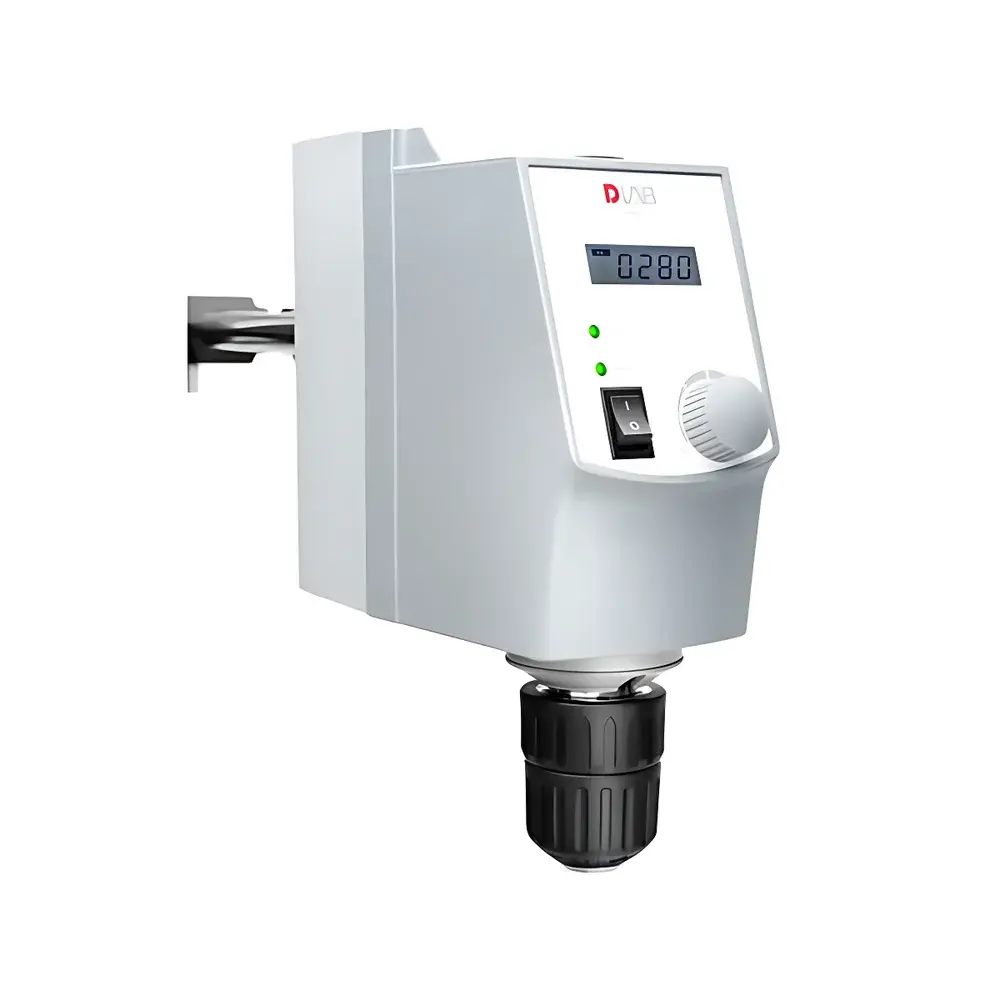
DLAB OS40(20)-Pro Overhead Electronic Stirrer
| Brand | DLAB |
|---|---|
| Origin | Beijing, China |
| Manufacturer Type | Direct Manufacturer |
| Product Category | Domestic |
| Model | OS40(20)-Pro |
| Instrument Type | Overhead Stirrer |
| Max. Stirring Volume (H₂O) | 20 L |
| Speed Range | 50–2200 rpm |
| Temperature Control Range | Ambient to 340 °C |
| Motor Input Power | 120 W |
| Motor Output Power | 100 W |
| Speed Accuracy | ±3 rpm |
| Speed Resolution | 1 rpm |
| Max. Torque | 60 N·cm |
| Max. Viscosity Handling | 50,000 mPa·s |
| Chuck Capacity | 0.5–10 mm |
| Support Rod | Ø14 × 220 mm |
| Dimensions (W×H×D) | 83 × 220 × 186 mm |
| Weight | 2.8 kg |
| Voltage | 100–240 VAC, 50/60 Hz |
| Power Consumption | 130 W |
| IP Rating | IP42 |
| Operating Environment | 5–40 °C, ≤80% RH |
| Remote Interface | RS232 |
| Safety Certifications | CE, cTUVus, FCC, DIN/EN 60529 compliant |
Overview
The DLAB OS40(20)-Pro Overhead Electronic Stirrer is an industrial-grade, brushless DC motor-driven mixing system engineered for precision, reliability, and operational safety in demanding laboratory and pilot-scale applications. Unlike magnetic stirrers, this overhead design employs a vertically mounted drive unit with a chuck-mounted impeller—enabling direct mechanical coupling to the stirring shaft. This architecture eliminates limitations associated with magnetic coupling (e.g., vessel bottom thickness, ferromagnetic compatibility, or heat-induced demagnetization), making it suitable for high-viscosity media, sealed reactors, jacketed vessels, and elevated-temperature operations up to 340 °C. The device operates on the principle of torque-controlled rotational actuation: real-time feedback from the motor enables dynamic adjustment of applied torque to maintain setpoint speed across varying fluid rheology—critical for reproducible homogenization, dissolution, emulsification, and suspension processes in QC, R&D, and GMP-aligned environments.
Key Features
- Brushless DC motor with integrated thermal and overcurrent protection—ensures maintenance-free operation, extended service life (>20,000 hr MTBF), and intrinsic spark-free performance compliant with Class I, Division 2 hazardous area considerations.
- Top-entry “through-the-lid” impeller mounting design—facilitates rapid vessel interchange without disassembling the drive head or repositioning support frames.
- High-resolution LCD interface displaying real-time speed (rpm), setpoint speed, and selectable torque (N·cm) with 1-rpm resolution and ±3-rpm control accuracy.
- Self-locking, tool-free drill chuck (0.5–10 mm capacity) with silicone-coated housing—resists solvent-induced corrosion and prevents rust formation on metal components.
- Dual-stage electronic safety: hardware-level overload cutoff (triggered by torque surge, stall, or short-circuit) plus audible/visual alarm and automatic power interruption.
- Stable acceleration profile and soft-start functionality—minimizes sample splashing, vortex instability, and container displacement during startup and speed transitions.
- IP42-rated enclosure—provides protection against solid objects >1 mm and vertically falling water droplets, supporting use in standard wet-lab environments.
Sample Compatibility & Compliance
The OS40(20)-Pro accommodates a broad range of vessel geometries—including round-bottom flasks, jacketed reactors, bioreactor vessels, and custom-engineered mixing tanks—when paired with compatible impellers (e.g., propeller, anchor, or paddle types). Its 60 N·cm maximum torque and 50,000 mPa·s viscosity handling capability support Newtonian and non-Newtonian fluids, including polymer melts, ceramic slurries, pharmaceutical suspensions, and high-concentration electrolyte solutions. The system conforms to DIN/EN 60529 (IP42), IEC 61000-6-3 (EMC emissions), and IEC 61000-6-2 (immunity). Certified to CE, cTUVus (UL 61010-1), and FCC standards, it meets essential requirements for electrical safety, electromagnetic compatibility, and lab equipment construction per EU Directive 2014/30/EU and 2014/35/EU. While not inherently GLP/GMP-certified, its RS232 interface and deterministic control logic enable integration into validated workflows requiring audit-trail-capable data capture.
Software & Data Management
Equipped with a standard RS232 serial interface, the OS40(20)-Pro supports bidirectional communication with host PCs running terminal emulation software or custom LabVIEW/Python-based control scripts. Users may remotely configure speed setpoints, initiate/stop operation, query real-time torque and rpm values, and log timestamped measurement sequences. Though no proprietary software is bundled, the ASCII-based command protocol (e.g., “SPEED=1800”, “READ_TORQUE”) allows seamless incorporation into LIMS, ELN, or MES platforms via middleware. All operational events—including fault codes (E01–E05), speed deviations >±5%, and thermal warnings—are recorded in volatile memory and retrievable via serial query, satisfying basic 21 CFR Part 11 data integrity prerequisites when paired with compliant host systems.
Applications
- Pharmaceutical formulation development: uniform dispersion of active pharmaceutical ingredients (APIs) in viscous ointment bases or sustained-release matrices.
- Chemical synthesis: controlled addition and mixing under reflux or inert atmosphere in sealed glass or stainless-steel reactors.
- Materials science: deagglomeration of nanoparticle suspensions, graphite dispersion in battery electrode slurries, and ceramic green-body homogenization.
- Food & beverage R&D: viscosity stabilization trials, emulsion testing (e.g., mayonnaise, dressings), and thermal processing simulation.
- Environmental testing: preparation of standardized sediment suspensions for TCLP or leaching studies per EPA Method 1311.
FAQ
Is the OS40(20)-Pro compatible with glass reactor lids equipped with standard NS29/32 or NS45/50 ground joints?
Yes—the vertical drive shaft and chuck assembly are dimensionally optimized for common laboratory reactor configurations; optional adapter sleeves are available for non-standard port diameters.
Can the stirrer maintain constant speed when viscosity increases during polymerization?
Yes—its closed-loop torque compensation algorithm continuously modulates motor current to sustain the programmed rpm within ±3 rpm tolerance, even during in-situ viscosity spikes.
Does the RS232 interface support Modbus RTU or only ASCII commands?
The interface uses a proprietary ASCII command set; Modbus implementation requires external protocol conversion hardware or software bridging.
What impeller materials are certified for USP Class VI biocompatibility?
DLAB offers 316 stainless steel and PTFE-coated impellers; while PTFE coatings meet USP extractables criteria, full USP implantation testing documentation is provided upon request for qualified applications.
Is firmware upgrade capability available via RS232?
No—firmware is factory-programmed and not field-upgradable; functional updates are delivered through hardware revision cycles aligned with ISO 13485 manufacturing controls.



