
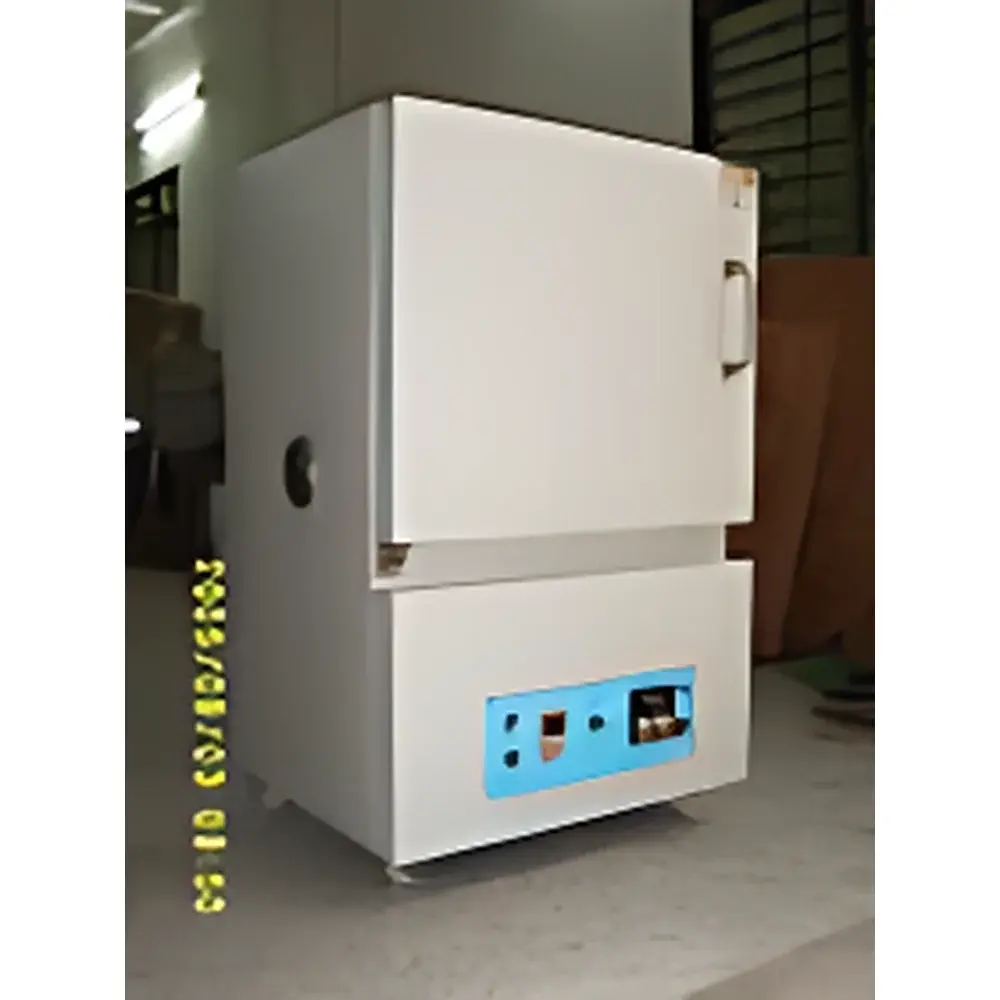
LabCompanion HH-1000 High-Temperature Aging Oven
| Brand | LabCompanion |
|---|---|
| Origin | Guangdong, China |
| Manufacturer Type | Direct Manufacturer |
| Country of Origin | China |
| Model | HH-1000 |
| Power Supply | 380 V, 50–60 Hz, 4 kW, 9.2 A |
| Heating Power | 380 V, 3.8 kW, 4.56 A |
| Internal Dimensions (W×D×H) | 900 × 500 × 600 mm |
| External Dimensions (W×D×H) | 1120 × 660 × 1300 mm (including casters and motor) |
| Operating Temperature Range | Ambient +10°C to 180°C (continuous), up to 260°C (intermittent) |
| Temperature Controller | RKC REX-C100 digital PID+R controller with independent over-temperature safety cutoff |
| Safety Features | Dual-stage thermal protection (ALM1 alarm lamp + audible buzzer), phase-loss & phase-sequence protection for motor drive |
Overview
The LabCompanion HH-1000 High-Temperature Aging Oven is an industrial-grade convection drying and thermal aging chamber engineered for precise, repeatable, and safe operation in quality assurance, materials testing, and R&D laboratories. Designed around a robust forced-air circulation architecture with axial-flow heating fan and optimized baffle system, the HH-1000 ensures uniform temperature distribution (±1.5°C at 180°C per ASTM E2207) across its 270 L internal workspace. Its core function is accelerated thermal aging—subjecting polymers, adhesives, coatings, electronic components, and packaging materials to controlled elevated temperatures to simulate long-term degradation mechanisms including oxidation, crosslinking, and volatilization. Unlike general-purpose drying ovens, the HH-1000 integrates dual-loop thermal management: a primary PID+R control loop for process stability and a fully independent mechanical/electronic over-temperature safeguard (ALM1) compliant with IEC 61000-4-5 surge immunity and EN 60519-1 electrical safety standards for heating equipment.
Key Features
- Independent over-temperature protection circuit with visual ALM1 indicator lamp and audible alarm—automatically de-energizes heaters when internal temperature exceeds preset safety threshold; resumes heating only after manual reset following cooldown below trip point.
- Dual-stage motor protection: integrated phase-loss and phase-sequence detection prevents startup or operation under unbalanced or reversed AC supply conditions—critical for maintaining fan integrity and airflow consistency.
- RKC REX-C100 digital temperature controller with PID+R algorithm, offering adjustable proportional band, integral time, and derivative gain for optimal transient response and steady-state accuracy (±0.5°C typical repeatability).
- Timed operation mode: user-selectable countdown timer initiates upon reaching setpoint; terminates heating and triggers alarm upon expiration—enabling unattended batch processing compliant with ISO 17025 calibration traceability requirements.
- Structural design includes heavy-duty stainless steel interior chamber (SUS304), double-wall insulated construction with high-density ceramic fiber insulation, and reinforced door gasket ensuring minimal thermal leakage and energy efficiency.
Sample Compatibility & Compliance
The HH-1000 accommodates standard laboratory sample trays (up to 300 mm × 300 mm footprint), crucibles, PCB assemblies, elastomer test strips (per ASTM D573), and encapsulated semiconductor packages. It meets essential regulatory prerequisites for thermal validation protocols—including compatibility with IQ/OQ/PQ documentation frameworks and alignment with FDA 21 CFR Part 11 data integrity expectations when paired with optional RS485/Modbus-enabled controllers. While not intrinsically rated for hazardous locations, its electrical architecture conforms to GB/T 14048.1 (equivalent to IEC 60947-1) for low-voltage switchgear and controlgear. All thermal safety functions are independently verified per UL 61010-1 Annex BB (temperature limiting devices).
Software & Data Management
The HH-1000 operates as a standalone instrument with local HMI-based control. For integration into centralized lab monitoring systems, optional communication modules support Modbus RTU over RS485, enabling real-time temperature logging, remote setpoint adjustment, and alarm event capture via SCADA or LIMS platforms. When used with validated third-party software (e.g., LabVIEW or custom Python-based DAQ), it supports GLP-compliant audit trails—including operator ID, timestamped parameter changes, alarm acknowledgments, and thermal profile exports in CSV or PDF format. Firmware updates are performed via USB interface with cryptographic signature verification to ensure firmware integrity.
Applications
- Accelerated aging of silicone rubber seals, polyurethane foams, and PVC cable jackets per ASTM D3045 and ISO 188.
- Pre-baking of printed circuit boards prior to conformal coating application (IPC-CC-830B).
- Thermal stress screening of solder paste flux residues and underfill materials.
- Moisture removal from hygroscopic powders (e.g., lithium battery cathode precursors) under inert gas purge (optional N₂ inlet port).
- Stability testing of pharmaceutical excipients and medical device packaging per USP and ISO 11607-1.
FAQ
What is the maximum continuous operating temperature?
The HH-1000 is rated for continuous operation up to 180°C. Intermittent use at 260°C is permitted for short-duration validation tests, provided chamber loading does not exceed 60% volume and cooling intervals between cycles are observed.
Does the oven support data logging out-of-the-box?
No—data logging requires optional RS485 communication module and external host software. The base unit provides only local display and alarm indication.
Is the RKC controller calibrated and traceable to NIST standards?
The controller is factory-calibrated using reference thermocouples traceable to national metrology institutes. Full calibration certificate (ISO/IEC 17025 accredited) is available upon request at time of order.
Can the HH-1000 be purged with inert gas?
Yes—an optional 6 mm BSP inlet port can be installed on the rear panel for nitrogen or argon purging, supporting oxygen-sensitive thermal aging per MIL-STD-883 Method 1008.
What maintenance is required for long-term reliability?
Quarterly inspection of fan bearings, annual replacement of door gasket, and biannual verification of over-temperature cutoff functionality using calibrated reference thermometer are recommended per manufacturer’s service schedule.



