
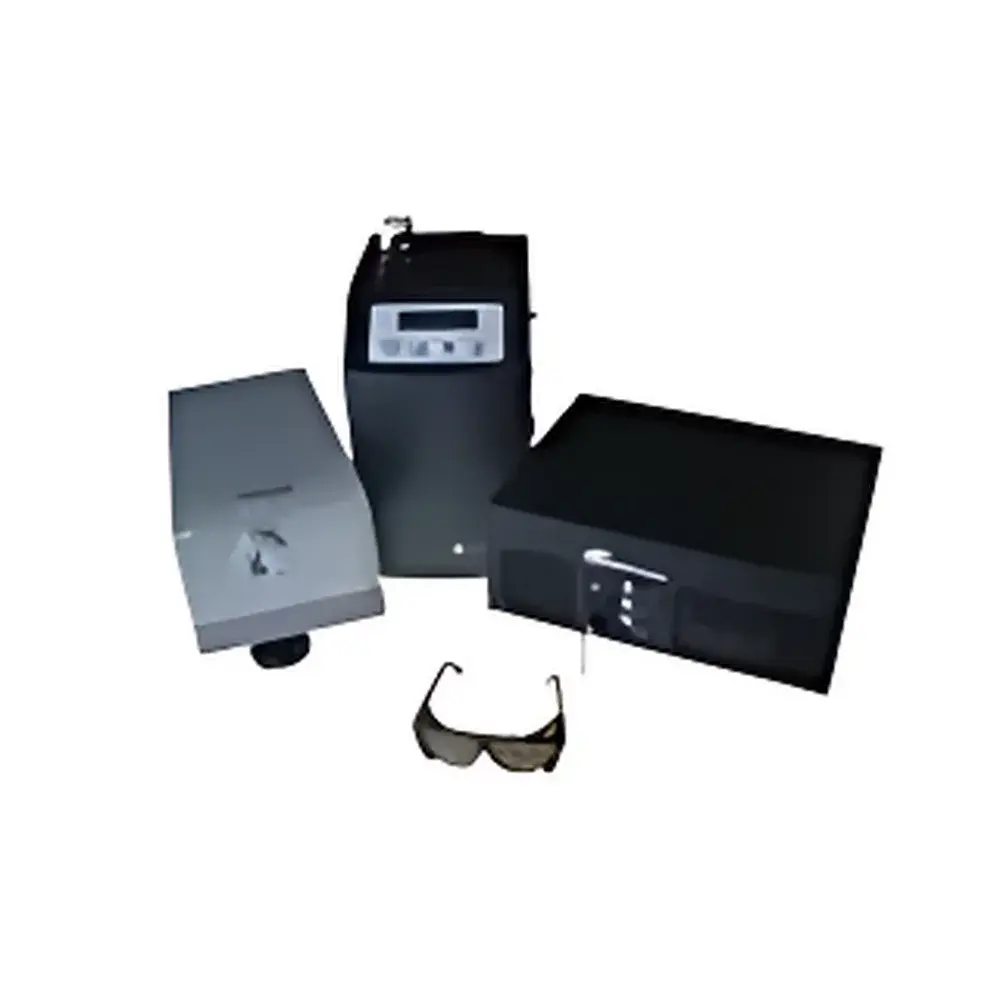
DPSS Lasers UV Laser Series 355 nm Pulsed Solid-State Laser
| Brand | DPSS Lasers |
|---|---|
| Origin | USA |
| Type | Diode-Pumped Solid-State (DPSS) Pulsed UV Laser |
| Wavelength | 354.7 nm |
| Average Power Range | 100 mW – 5 W |
| Pulse Width | <30–80 ns |
| Repetition Rate | 30–150 kHz |
| Pulse Energy | 1–166 µJ |
| Beam Mode | TEM₀₀ (M² < 1.3) |
| Beam Diameter (1/e²) | 1.5–2.0 mm |
| Beam Divergence (full angle) | <0.3–0.6 mrad |
| Polarization Ratio | >100:1 (linear, horizontal) |
| Pulse-to-Pulse Stability | <10–15% RMS |
| 8-hr Power Stability | <5% |
| Beam Pointing Stability | <50 µrad |
| Cooling | Integrated Chiller System |
| Input Voltage | 90–240 VAC |
| Max. Power Consumption | 500–900 W |
| Operating Temperature | 10–35 °C |
| Laser Head Weight | 15.9 kg |
Overview
The DPSS Lasers UV Laser Series 355 nm Pulsed Solid-State Laser is a high-performance, diode-pumped solid-state (DPSS) ultraviolet laser system engineered for precision industrial and scientific applications requiring stable, nanosecond-scale UV pulses. Operating at a fundamental wavelength of 354.7 nm—generated via third-harmonic generation (THG) of a 1064 nm Nd:YVO₄ or Nd:YAG oscillator-amplifier chain—the laser delivers excellent spectral purity and minimal thermal drift. Its TEM₀₀ spatial mode (M² < 1.3), low beam divergence (<0.3 mrad full angle), and sub-50 µrad pointing stability ensure diffraction-limited focusing critical for micromachining, lithography alignment, and time-resolved spectroscopy. Designed with robust thermal management via an integrated recirculating chiller, the system maintains long-term power stability (<5% over 8 hours) and pulse-to-pulse consistency (<15% RMS), meeting baseline requirements for ISO/IEC 17025-compliant optical calibration labs and GMP-aligned manufacturing environments.
Key Features
- Diode-pumped architecture enabling high wall-plug efficiency and reduced maintenance vs. flashlamp-pumped systems
- Multiple power configurations: scalable average output from 100 mW to 5 W, supporting both low-energy ablation and high-throughput marking
- Nanosecond pulse widths (down to <30 ns) optimized for minimal heat-affected zone (HAZ) in polymer, ceramic, and semiconductor processing
- High polarization extinction ratio (>100:1, linear horizontal) ensuring compatibility with electro-optic modulators and UV-grade polarizing optics
- Compact, modular design: laser head (521 × 254 × 129 mm³), separate power supply, and dedicated chiller—facilitating integration into OEM tooling and cleanroom-compatible enclosures
- Comprehensive interlock architecture compliant with IEC 60825-1:2014 Class 4 laser safety standards, including key-switch enable, emission indicator, and emergency stop interface
Sample Compatibility & Compliance
This 355 nm pulsed laser demonstrates broad material interaction suitability across photopolymer resins (UV curing), silicon wafers (defect inspection and trench ablation), copper-clad laminates (PCB depaneling), and thin-film oxides (e.g., ITO, SiO₂ removal). Beam parameters—including ellipticity <10%, astigmatism <0.3 µm, and near-diffraction-limited M²—enable reproducible spot sizes below 10 µm when coupled with F-theta scan lenses. The system conforms to key regulatory frameworks applicable to laboratory and production instrumentation: electromagnetic compatibility per FCC Part 15 Subpart B and CE EN 55011; mechanical safety per ISO 12100; and operational documentation aligned with ISO 9001:2015 quality management requirements. While not pre-certified for FDA 21 CFR Part 11, audit-ready software logs (see Software & Data Management) support validation under GLP/GMP protocols where electronic records are required.
Software & Data Management
Standard control is provided via RS-232 and USB 2.0 interfaces, compatible with LabVIEW™, MATLAB®, and Python-based automation frameworks. Optional OEM SDK enables real-time monitoring of internal diagnostics—including diode current, crystal temperature, cavity alignment status, and pulse energy feedback (via integrated photodiode)—with timestamped logging at up to 1 kHz sampling. All operational data is stored in CSV-compliant format with metadata headers (wavelength, repetition rate, average power, ambient temperature), facilitating traceability in regulated environments. Audit trail functionality—recording user login, parameter changes, and system errors—is available through optional firmware upgrade, satisfying ALCOA+ principles (Attributable, Legible, Contemporaneous, Original, Accurate, Complete, Consistent, Enduring, Available) for quality-critical workflows.
Applications
- UV Curing: Rapid photoinitiator activation in adhesives, coatings, and 3D-printed resins with minimal substrate heating
- Laser Micromachining: High-resolution scribing, drilling, and cutting of polyimide, FR-4, and thin-film solar cells
- Semiconductor Inspection: Dark-field illumination and fluorescence excitation for wafer-level defect mapping (e.g., particle detection on 300 mm wafers)
- Spectroscopic Pump Sources: Excitation of Raman-active modes in organic crystals and time-resolved fluorescence lifetime measurements
- Laser Marking & Engraving: Permanent, high-contrast marking on glass, ceramics, and medical-grade plastics without surface cracking
- Oxide Layer Ablation: Selective removal of native SiO₂ or Al₂O₃ layers prior to metallization or bonding processes
FAQ
What is the typical lifetime of the laser crystal and pump diodes?
The Nd:YVO₄ gain medium and frequency-conversion crystals are rated for >10,000 hours of operation under nominal conditions; pump diodes carry a 2-year warranty with MTBF exceeding 25,000 hours.
Is external water cooling required, or is the chiller self-contained?
The system includes a fully integrated, closed-loop recirculating chiller (dry weight 9.1 kg); no facility water connection is needed.
Can the repetition rate be externally triggered or modulated?
Yes—TTL-compatible external trigger input supports gated operation down to single-shot mode, with jitter <5 ns RMS.
Are beam expander or harmonic separation optics available as accessories?
DPSS Lasers offers factory-aligned UV-grade beam expanders (2×–5×), dichroic filters for residual 1064/532 nm suppression, and collimation kits optimized for 355 nm transmission.
Does the laser meet RoHS and REACH compliance for EU deployment?
Yes—all materials and manufacturing processes comply with Directive 2011/65/EU (RoHS 2) and Regulation (EC) No. 1907/2006 (REACH), with full declarations available upon request.



