

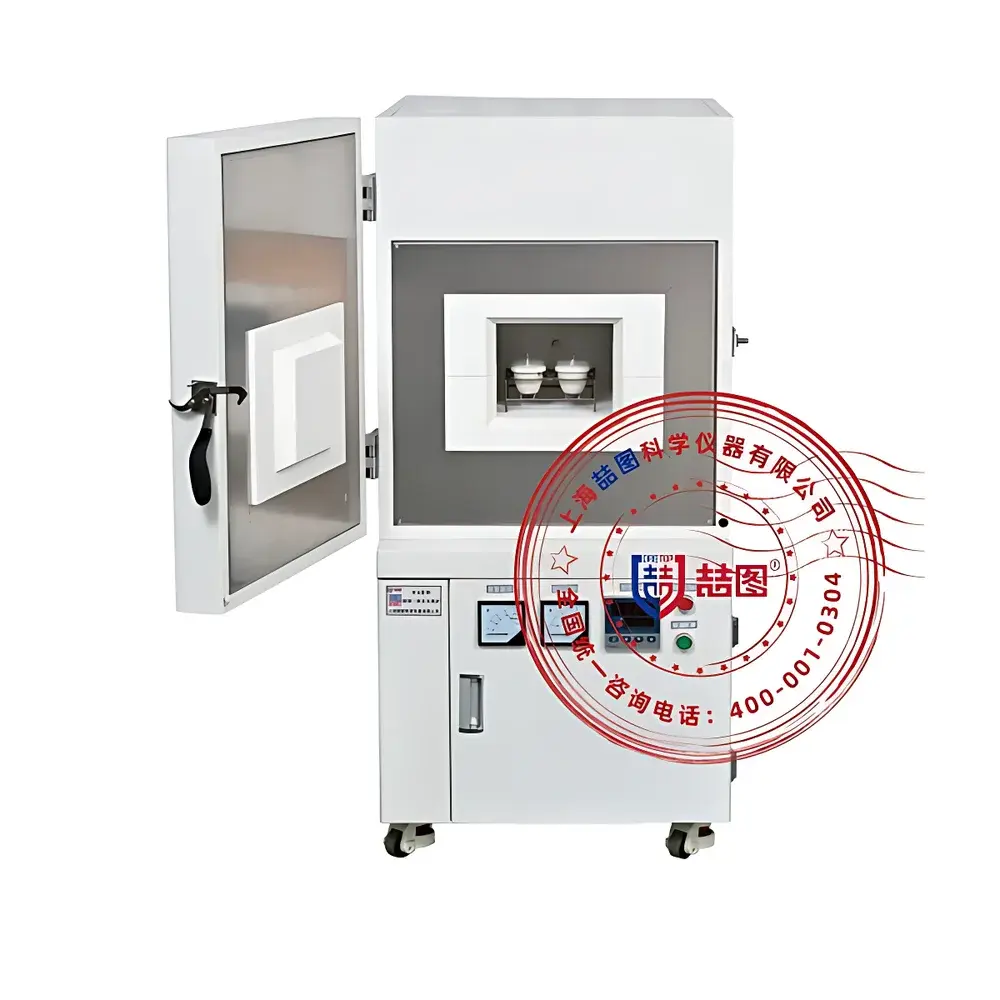
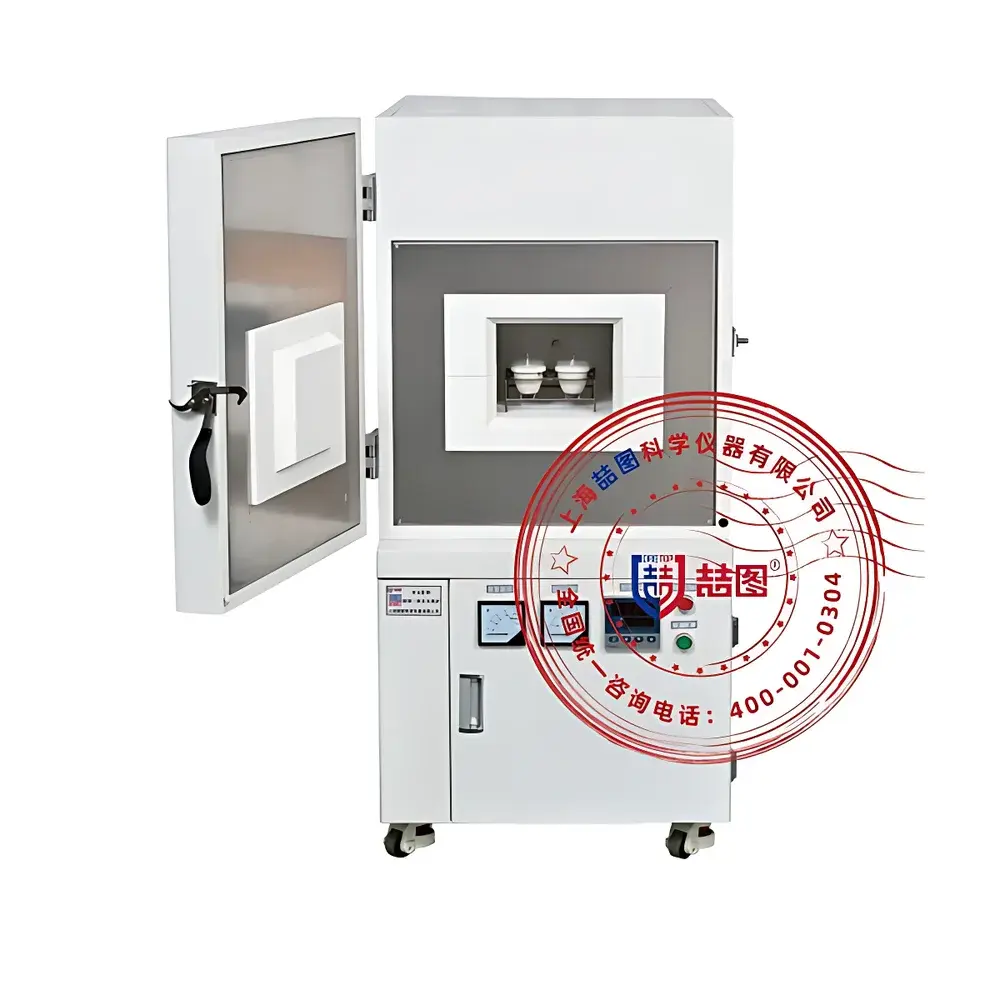
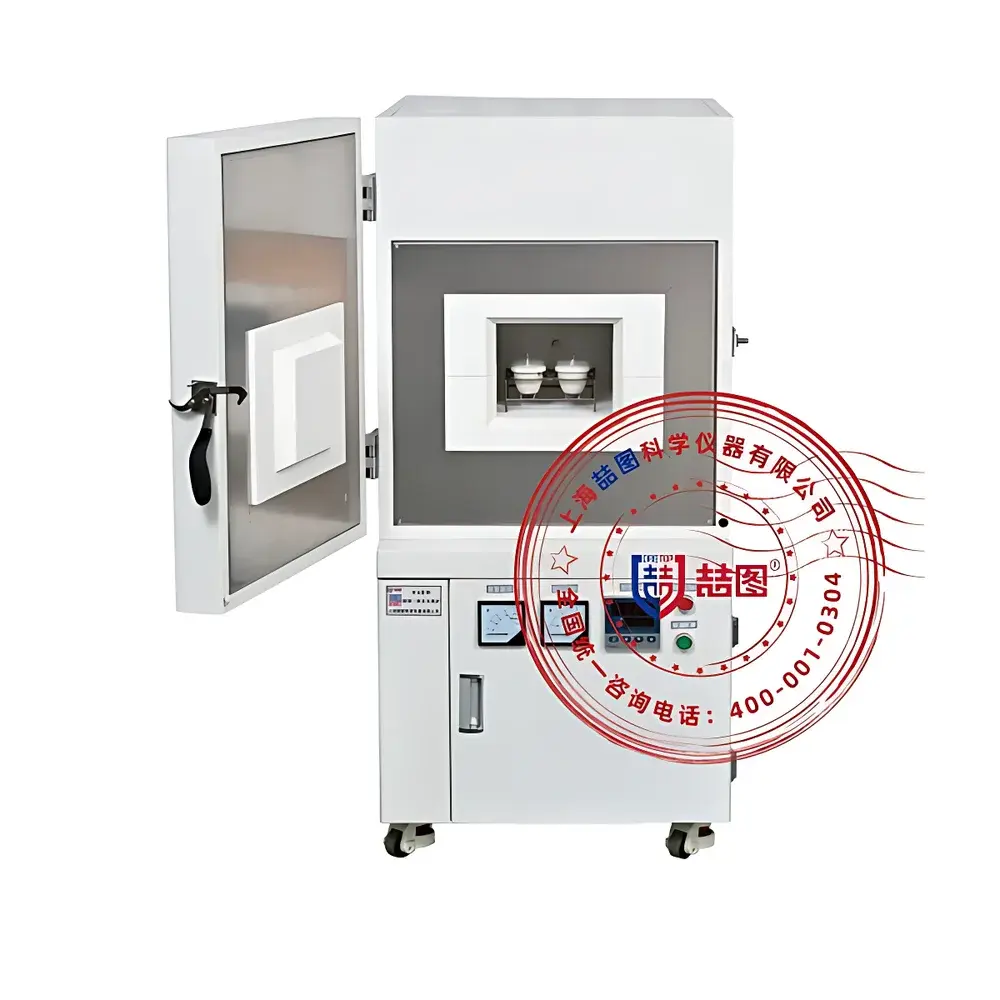
DRETOP B16-36AI Programmable Integrated High-Temperature Muffle Furnace
| Brand | DRETOP |
|---|---|
| Origin | Shanghai, China |
| Manufacturer Type | Direct Manufacturer |
| Instrument Type | Box-Type Muffle Furnace |
| Maximum Temperature | 1600 °C |
| Temperature Control Accuracy | ±1 °C |
| Rated Power | 15 kW |
| Heating Time to Max Temp | 70 min |
| Heating Element | Silicon-Molybdenum (MoSi₂) Rods |
| Internal Chamber Dimensions | 300 × 400 × 300 mm |
| Nominal Volume | 36 L |
| Control System | 7-inch Color Touchscreen Controller with AI-based PID Algorithm |
| Safety Features | Dual-stage Overtemperature Protection, Door-Interlocked Power Cut-off, Power Failure Memory, Phase Loss & Thermocouple Break Detection |
| Insulation | Vacuum-Microporous Ceramic Fiber Board |
| Chamber Lining | Polycrystalline Alumina Fiber |
| Transformer | Three-Phase Dry-Type Isolation Transformer |
| Compliance | Designed for GLP/GMP-aligned lab environments |
Overview
The DRETOP B16-36AI Programmable Integrated High-Temperature Muffle Furnace is a precision-engineered box-type resistive heating system designed for demanding thermal processes in research laboratories, materials science facilities, and quality control environments. Operating on Joule heating principles, the furnace utilizes silicon-molybdenum (MoSi₂) rods as heating elements—mounted in a triple-wall configuration—to generate uniform radiant heat across a 36-liter chamber. With a maximum operating temperature of 1600 °C and a certified control accuracy of ±1 °C, the B16-36AI meets stringent requirements for sintering, ashing, calcination, annealing, and high-temperature elemental analysis. Its integrated architecture incorporates a built-in three-phase dry-type isolation transformer, eliminating external power conditioning needs while minimizing electromagnetic interference and ensuring stable voltage delivery under dynamic load conditions. The furnace complies with foundational thermal process standards—including ASTM E1142 (for temperature uniformity verification), ISO 8573-1 (classifying thermal stability for cleanroom-adjacent applications), and USP (supporting thermal validation protocols for pharmaceutical excipient processing)—making it suitable for regulated environments where traceability and repeatability are mandatory.
Key Features
- Triple-wall MoSi₂ heating configuration ensures rapid, symmetrical heat distribution and minimizes axial and radial thermal gradients across the 300 × 400 × 300 mm chamber.
- 7-inch full-color touchscreen controller with AI-enhanced PID algorithm enables multi-segment programmable ramp-hold-cool profiles, including up to 30 user-defined steps per program, with slope control ranging from 0.1 to 30 °C/min.
- Door-interlocked safety circuit interrupts power within 100 ms upon lid opening, resuming pre-interruption parameters automatically upon resealing—critical for time-sensitive thermal treatments.
- Vacuum-microporous ceramic fiber insulation (density: 220 kg/m³) reduces standby heat loss by >40% compared to conventional refractory brick linings, contributing to energy efficiency and faster cooldown cycles.
- Dual-stage overtemperature protection includes primary digital cutoff at 1610 °C and secondary mechanical limiter at 1630 °C, both independently wired and fail-safe.
- Power segmentation logic restricts output during low-temperature phases (<300 °C) to prevent thermal shock to fragile samples and extend element service life.
- Three-phase dry-type isolation transformer (rated 15 kVA) provides galvanic separation, suppresses line noise propagation, and maintains stable current delivery even under unbalanced grid conditions.
Sample Compatibility & Compliance
The B16-36AI accommodates standard crucibles (up to Φ120 mm × 150 mm height), ceramic boats, quartz trays, and inert sample holders compatible with oxidizing or inert atmospheres (when used with optional gas inlet kits). Its polycrystalline alumina fiber chamber lining resists chemical attack from alkali metal oxides, halides, and transition-metal salts commonly encountered in metallurgical and geochemical workflows. For regulatory alignment, the furnace supports audit-ready data integrity: all setpoints, actual temperatures, power outputs, and alarm events are timestamped and stored internally for ≥30 days. Optional RS485 Modbus RTU interface enables integration into LIMS or SCADA systems compliant with FDA 21 CFR Part 11 requirements when paired with validated software and electronic signature protocols. The unit is CE-marked for EMC and Low Voltage Directive compliance and conforms to IEC 61000-4-30 Class A for harmonic emission limits.
Software & Data Management
The embedded controller firmware supports real-time graphical trend display (temperature vs. time), overlay of multiple historical runs, and export of CSV-formatted datasets via USB flash drive. All curves include metadata such as operator ID (via configurable engineer-level password tiers), ambient humidity/pressure tags (when connected to optional environmental sensors), and calibration certificate reference numbers. Firmware revision logs and parameter change histories are retained with immutable timestamps—enabling full traceability for GLP audits. Optional Ethernet/WiFi modules (sold separately) allow remote monitoring and push notifications for alarm conditions via SMTP or MQTT protocols. No cloud dependency is required; local network deployment ensures data sovereignty and avoids third-party hosting risks.
Applications
- High-temperature ashing of biological tissues, polymers, and environmental filter media per EPA Method 3010B and ASTM D5630.
- Sintering of advanced ceramics (e.g., ZrO₂, SiC, AlN) and solid-state battery cathode precursors requiring precise dwell-time control at 1400–1600 °C.
- Thermal gravimetric analysis (TGA) pre-conditioning of catalyst supports and activated carbon substrates.
- Metallurgical heat treatment of small-format alloy samples (e.g., Ni-based superalloys, Ti-6Al-4V) for microstructure stabilization prior to SEM/EBSD characterization.
- Calibration reference furnace operation for thermocouple verification against ITS-90 fixed points (e.g., Cu, Ag, Au freezing points) using secondary-standard platinum resistance thermometers.
FAQ
What type of thermocouple is used for temperature sensing?
Type S (Pt/Pt–10% Rh) thermocouples are factory-installed and calibrated to NIST-traceable standards; optional Type B (Pt–30% Rh / Pt–6% Rh) probes are available for extended-range verification above 1500 °C.
Is inert atmosphere capability built-in?
No—gas purging requires optional accessories: stainless-steel inlet valve with mass flow controller (0–5 L/min range), exhaust chimney with back-pressure regulator, and O₂ sensor port for residual oxygen monitoring.
Can the furnace be validated for GMP use?
Yes—the hardware design supports IQ/OQ/PQ execution per ASTM E2500 and ISPE Baseline Guide Vol. 5; DRETOP provides factory-assembled validation documentation packages (DQ, URS, FAT reports) upon request.
What maintenance intervals are recommended for MoSi₂ elements?
Under continuous operation at ≤1550 °C, elements typically retain >95% resistance stability for 1,200–1,800 hours; visual inspection every 200 h and resistance measurement every 500 h are advised.
Does the touchscreen support multi-language UI?
English and Simplified Chinese interfaces are standard; German, Japanese, and Korean language packs can be loaded via firmware update using authorized service tools.
Related Products



