

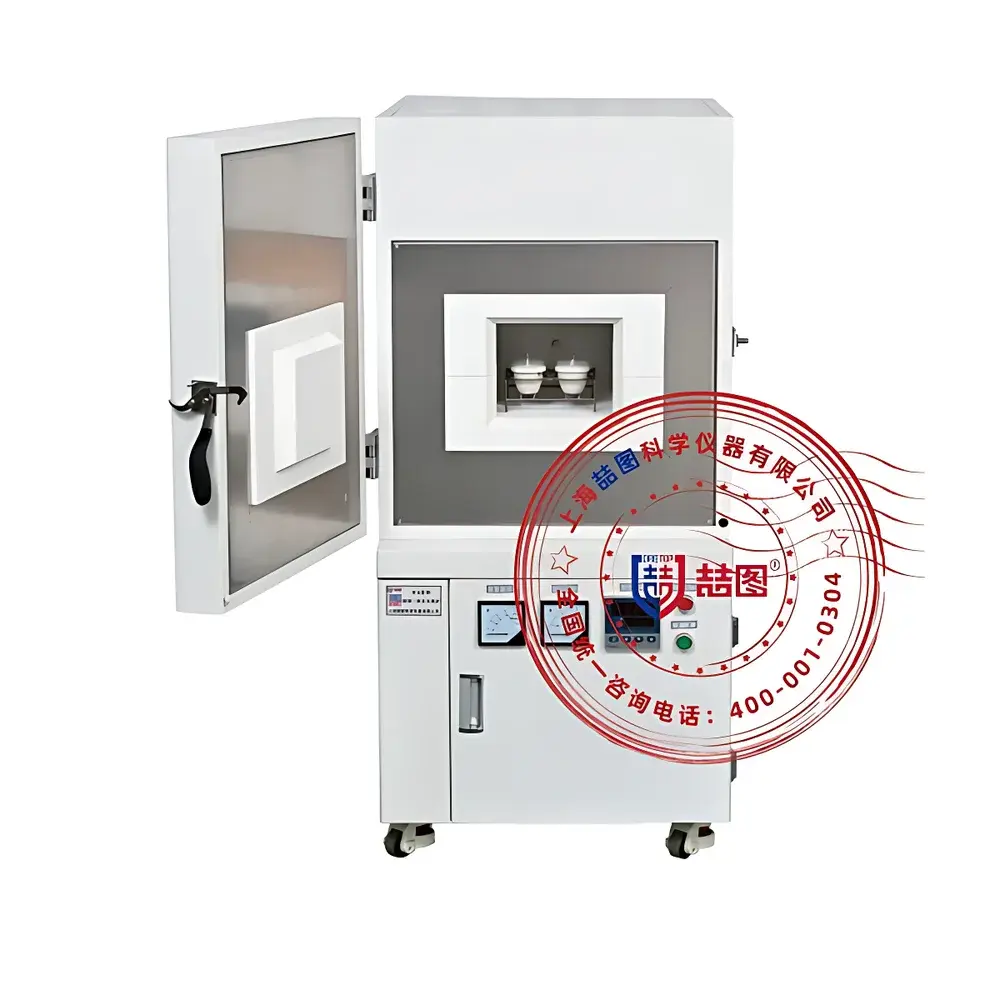
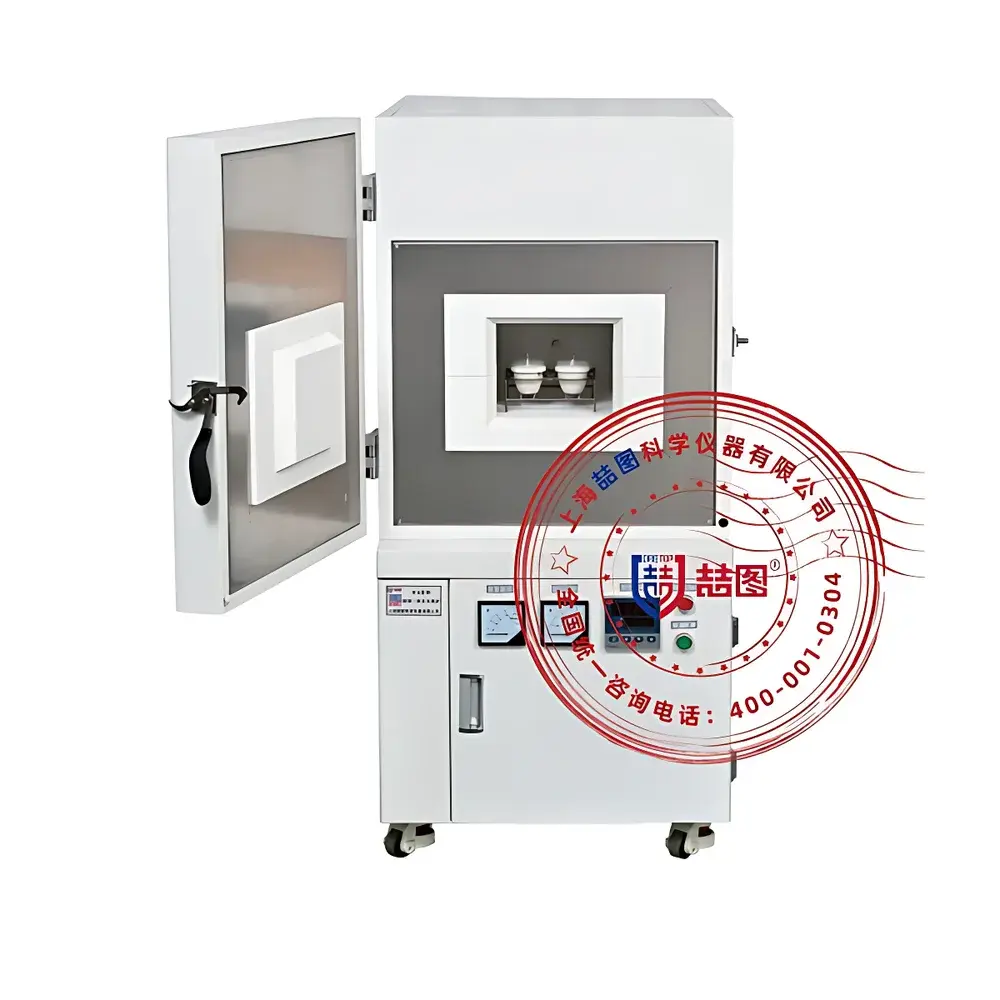
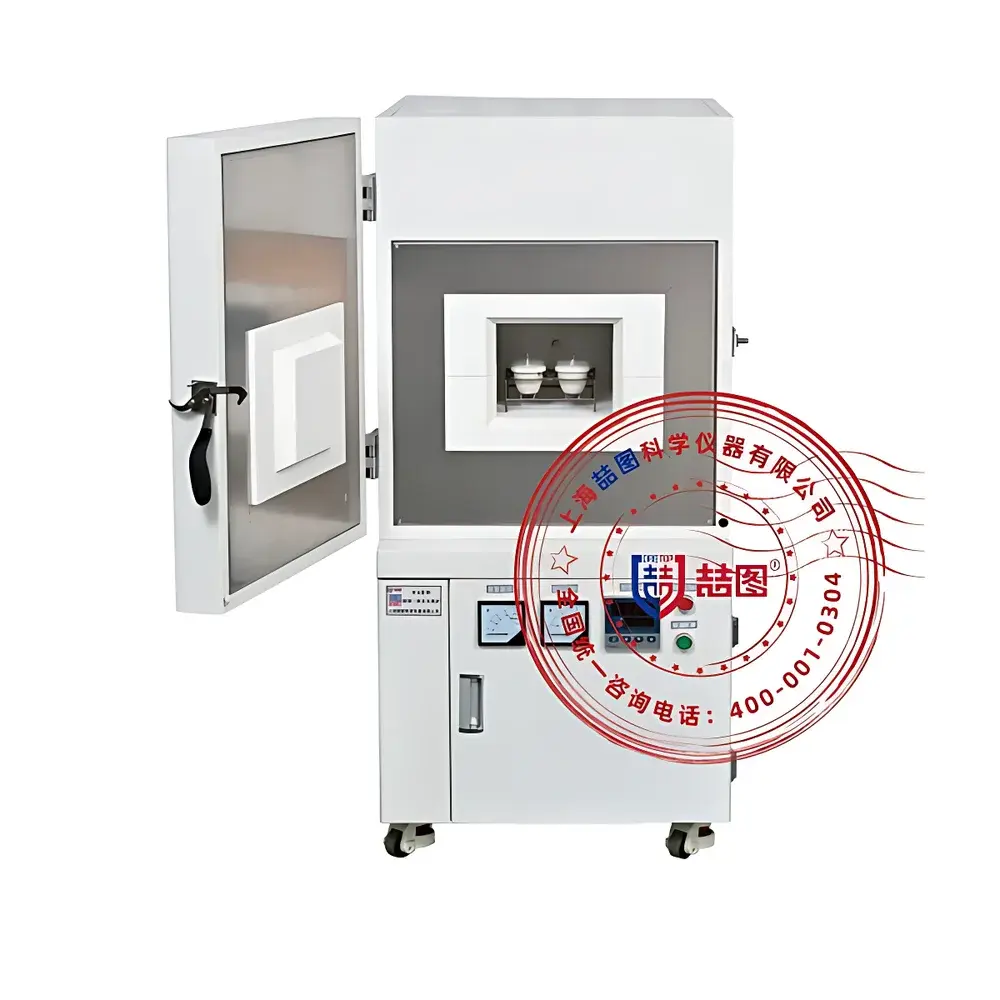
DRETOP B18-36AI Programmable Integrated High-Temperature Muffle Furnace
| Brand | DRETOP |
|---|---|
| Origin | Shanghai, China |
| Manufacturer Type | Direct Manufacturer |
| Instrument Type | Box-Type Muffle Furnace |
| Maximum Temperature | 1800 °C |
| Temperature Control Accuracy | ±1 °C |
| Rated Power | 18 kW |
| Heating Time to Max Temperature | 70 min |
| Heating Element | Silicon-Molybdenum Rods (MoSi₂) |
| Internal Chamber Dimensions | 300 × 400 × 300 mm |
| Nominal Volume | 36 L |
| Control Interface | 7-inch Full-Color Touchscreen HMI |
| Electrical Supply | AC 380 V, 50 Hz |
| Transformer | Built-in Three-Phase Dry-Type Isolation Transformer |
| Insulation Material | Vacuum-Microporous Ceramic Fiber Board |
| Chamber Lining | Polycrystalline Alumina Fiber |
| Safety Features | Dual-Stage Overtemperature Protection, Door-Interlocked Power Cut-off, Power Failure Memory, Phase Loss & Thermocouple Break Detection |
Overview
The DRETOP B18-36AI Programmable Integrated High-Temperature Muffle Furnace is a precision-engineered box-type resistance furnace designed for demanding thermal processing applications up to 1800 °C. It operates on Joule heating principles, where electrical current passes through high-stability silicon-molybdenum (MoSi₂) heating elements embedded in a triple-wall radiation configuration—ensuring rapid, uniform heat distribution across the 36-liter chamber. Unlike tubular furnaces, this unit features a fully enclosed, front-loading muffle architecture with optimized thermal mass distribution and low-thermal-conductivity vacuum-microporous ceramic fiber insulation. Its integrated three-phase dry-type isolation transformer minimizes electromagnetic interference and stabilizes voltage supply under variable load conditions—critical for reproducible high-temperature treatments in analytical chemistry, metallurgy, and advanced ceramics research. The furnace complies with fundamental safety and electromagnetic compatibility requirements per IEC 61000-6-2/6-4 and meets structural design expectations for laboratory-grade thermal equipment operating under ISO/IEC 17025-aligned environments.
Key Features
- Programmable AI-based temperature controller with adaptive PID tuning, supporting multi-segment ramp-hold-cool profiles—including linear, stepwise, and custom curve-fitted heating sequences.
- 7-inch full-color touchscreen HMI with real-time trend visualization, historical data overlay, and dual-mode display (numerical + graphical), enabling immediate interpretation of thermal behavior during operation.
- Triple-wall MoSi₂ heating configuration with spiral-wound elements mounted on all vertical chamber surfaces—enhancing radial and axial temperature uniformity (±3 °C at 1600 °C, measured per ASTM E220 calibration methodology).
- Integrated door interlock system that automatically de-energizes heating circuits upon door opening and resumes pre-interruption setpoints after resealing—ensuring operator safety and process continuity.
- Dual-level overtemperature protection: primary limit via independent thermocouple input and secondary hardware cutoff at 1850 °C, compliant with EN 60519-1 safety standards for industrial electroheating equipment.
- Robust mechanical construction: phosphate-treated steel enclosure with high-temp epoxy powder coating; polycrystalline alumina fiber muffle liner resistant to thermal shock and chemical erosion from alkali metal vapors or oxide fluxes.
Sample Compatibility & Compliance
The B18-36AI accommodates standard crucibles (alumina, zirconia, graphite, platinum) and refractory sample holders up to Ø120 mm × 100 mm height within its 300 × 400 × 300 mm chamber. Its inert atmosphere readiness—via optional inert gas inlet valve and exhaust chimney—supports controlled oxidation state experiments per ASTM C1171 (ceramic sintering) and ISO 11268 (soil thermal treatment). The furnace satisfies core functional prerequisites for GLP-compliant ashing (USP ), loss-on-ignition (LOI) analysis (ASTM D7348), and metallographic specimen preparation (ASTM E3). All electrical interfaces—including RS485 Modbus RTU output and optional 4–20 mA analog outputs—are compatible with centralized lab monitoring systems adhering to FDA 21 CFR Part 11 audit trail requirements when paired with validated software platforms.
Software & Data Management
The embedded controller supports CSV export of time-stamped temperature logs (sampled at 1 s intervals) directly to USB storage devices. Data includes setpoint, PV, power %, alarm status, and segment index—structured for post-processing in MATLAB, Python (pandas), or LIMS integration. Optional Ethernet/WiFi modules enable remote monitoring via secure HTTPS endpoints. Firmware implements deterministic timestamping synchronized to internal RTC with battery backup, ensuring traceability during extended soak cycles (>100 h). Audit log entries record user login/logout, parameter changes, and emergency stops—with tamper-resistant storage meeting ISO/IEC 17025 clause 7.7.1.2 for measurement data integrity.
Applications
- High-temperature ashing of biological, pharmaceutical, and environmental samples prior to elemental analysis (ICP-OES/MS).
- Sintering of advanced ceramics (e.g., SiC, YSZ, AlN) under air or nitrogen atmospheres with precise dwell control.
- Heat treatment of small-scale metallic specimens—annealing, normalizing, and austenitizing per ASTM A370 and ISO 6892-1 protocols.
- Calibration of thermocouples and reference materials using fixed-point cells (e.g., Pd, Ni, Co-C) within defined thermal gradients.
- Thermal gravimetric analysis (TGA) support via integration with balance enclosures and purge gas manifolds.
- Research-scale synthesis of battery cathode materials (e.g., NMC, LFP) requiring strict ramp-rate control and oxygen partial pressure management.
FAQ
What is the maximum recommended continuous operating temperature?
The furnace is rated for continuous operation at 1750 °C; 1800 °C is specified as the absolute upper limit for short-duration (<30 min) qualification runs.
Does the unit include thermocouple compensation for cold-junction reference?
Yes—the controller performs automatic cold-junction compensation using an integrated Pt100 sensor located at the terminal block, meeting IEC 60584-2 accuracy class.
Can the furnace be operated under vacuum or reduced pressure?
No. This model is not vacuum-rated; it is designed exclusively for atmospheric or inert-gas-purged environments. Vacuum-compatible variants require reinforced sealing and flanged access ports.
Is the touchscreen interface compatible with third-party SCADA systems?
Yes—Modbus RTU over RS485 is natively supported; register maps and communication protocols are documented in the technical manual for OPC UA gateway integration.
How is temperature uniformity verified and documented?
Uniformity mapping is performed at three load conditions (empty, 50% volume, full) per ASTM E220 Annex A3, with results provided in the factory calibration certificate included with each shipment.



