
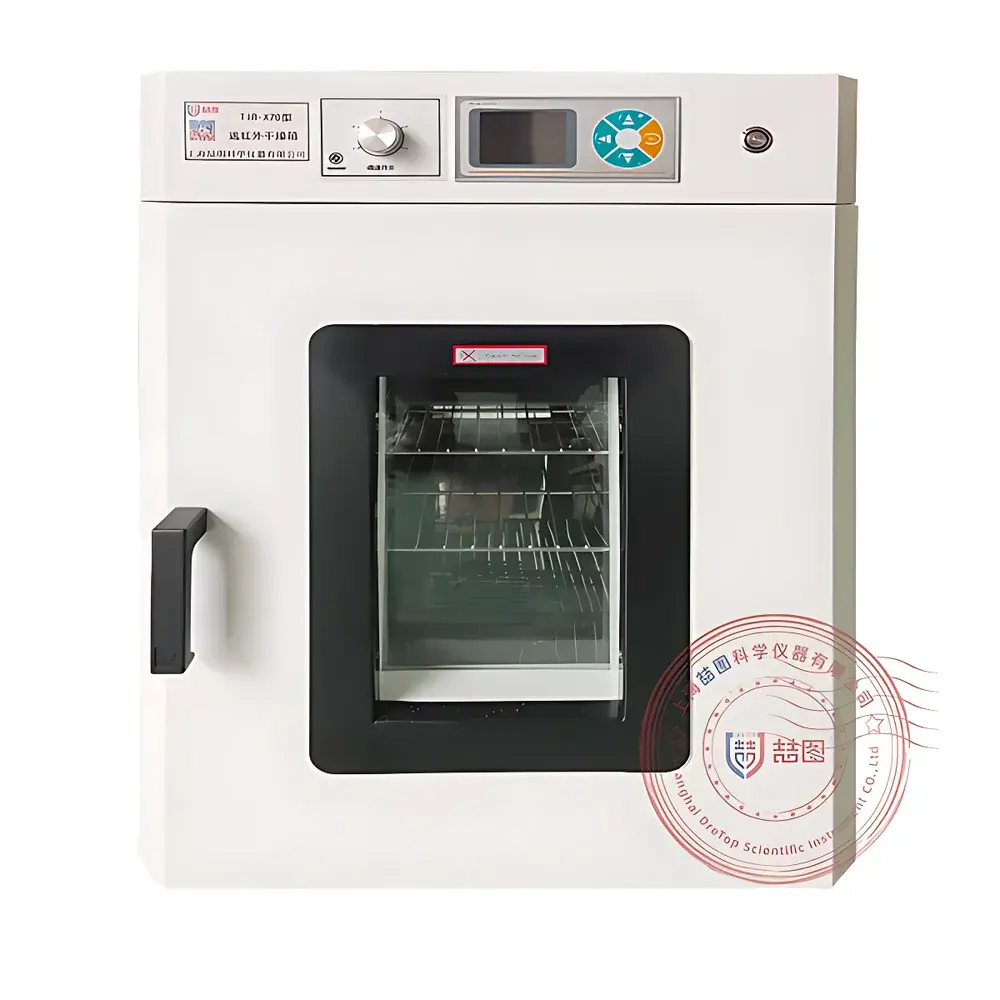
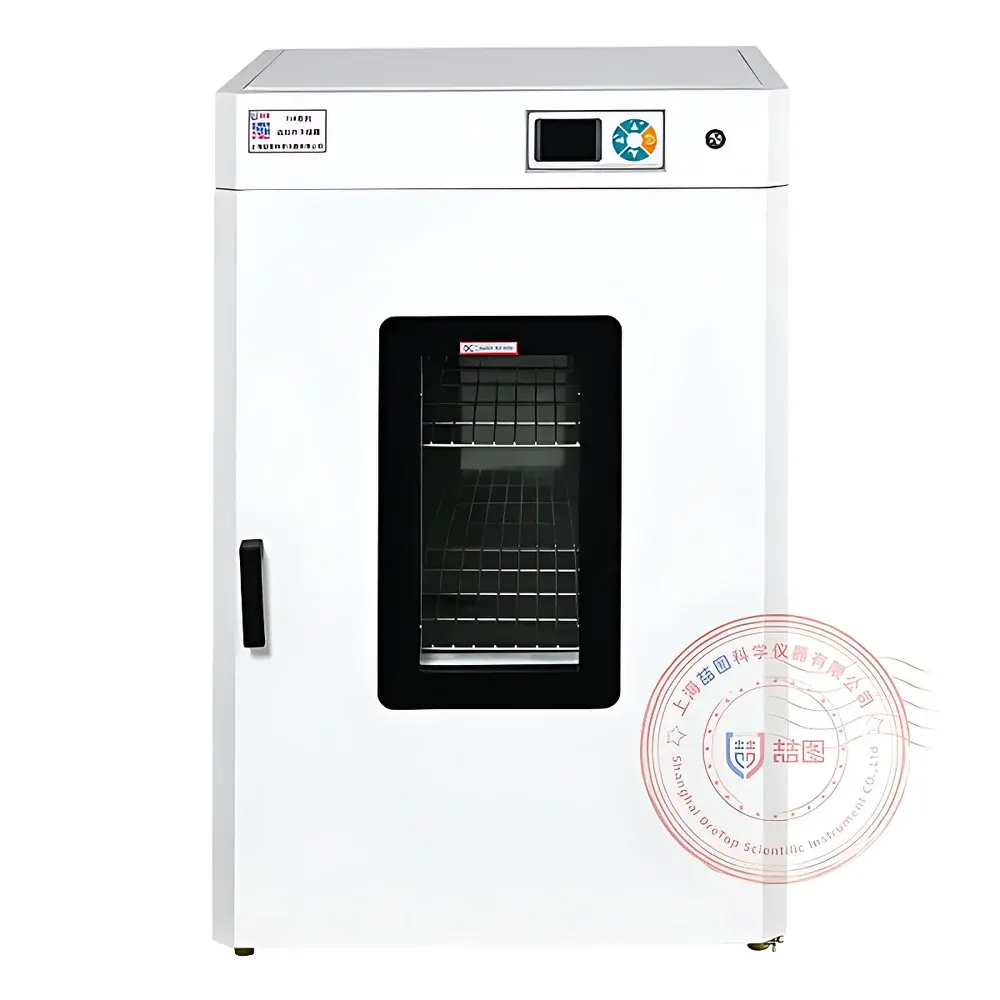
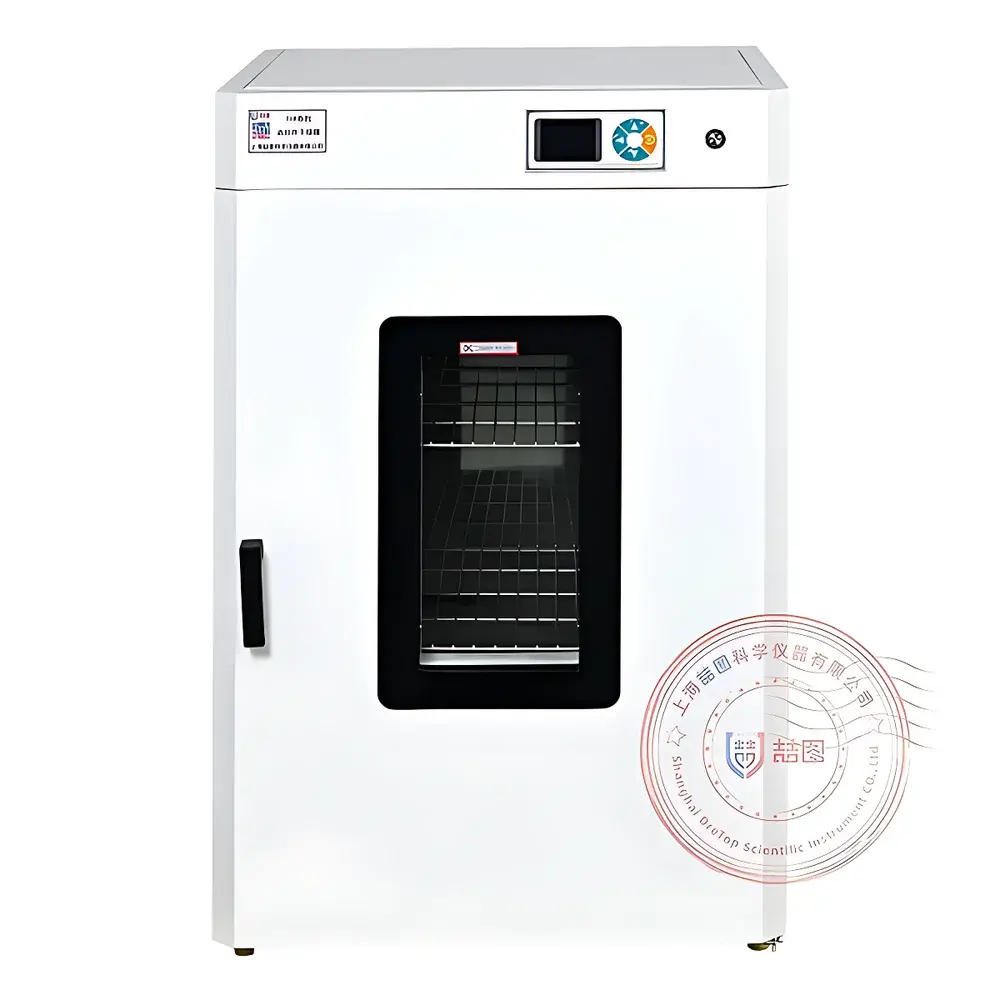
DRETOP TIR Series Far-Infrared Drying Oven
| Brand | DRETOP |
|---|---|
| Origin | Shanghai, China |
| Model | TIR Series |
| Temperature Range | RT+10°C to 300°C |
| Temperature Uniformity | ±1°C |
| Temperature Resolution | 0.1°C |
| Interior Dimensions (W×D×H) | 350×300×350 mm to 700×550×650 mm |
| Interior Material | Stainless Steel |
| Heating Method | Far-Infrared Radiant Heating |
| Power Input | 1000–4000 W (model-dependent) |
| Control System | Microprocessor-based PID Controller with LCD Display |
| Airflow Control | Continuously Adjustable Fan Speed (including zero-airflow mode) |
| Safety Features | Over-temperature Protection, Leakage Current Protection, Short-Circuit & Overload Protection, Parameter Memory Backup, Audible/Visual Alarm |
Overview
The DRETOP TIR Series Far-Infrared Drying Oven is an engineered thermal processing instrument designed for precise, uniform, and controllable drying, curing, and heat-treatment applications in regulated laboratory and industrial environments. Unlike conventional convection ovens that rely on forced air circulation—potentially disturbing fine particulates or powders—the TIR Series employs far-infrared (FIR) radiant heating as its primary thermal transfer mechanism. FIR radiation (wavelength range: ~3–1000 µm) penetrates sample surfaces more efficiently than convective heat, enabling rapid, volumetric energy absorption with minimal thermal inertia. This principle supports high reproducibility in moisture removal, solvent evaporation, and pre-conditioning of temperature-sensitive materials without mechanical disturbance. The integrated adjustable airflow system operates independently of the heating module, allowing users to select between zero-airflow mode (ideal for fragile or lightweight samples such as lyophilized powders, catalysts, or thin-film coatings) and low-velocity recirculation (for enhanced temperature homogeneity across large or multi-layered loads). All models comply with IEC 61010-1 safety standards for laboratory electrical equipment and are constructed to meet general GLP documentation requirements.
Key Features
- Far-infrared heating elements with fast thermal response and low thermal mass—enabling rapid ramp-up and reduced overshoot during setpoint transitions
- Microprocessor-controlled PID temperature regulation with 0.1°C resolution, ±1°C uniformity across working chamber, and programmable timer (1–9999 minutes)
- Adjustable-speed centrifugal fan with continuous (stepless) speed control—supports both static radiant heating and gentle convective redistribution
- 3D-refractive thermal field design: optimized internal reflector geometry and strategically positioned FIR emitters ensure spatially consistent irradiance distribution
- Double-layer insulated stainless-steel interior (SUS304) with electrostatically sprayed cold-rolled steel exterior—resistant to corrosion, thermal fatigue, and mechanical wear
- Large-view tempered glass observation window with high-temperature silicone gasket seal—enables real-time visual monitoring without compromising thermal integrity
- Modular, height-adjustable stainless-steel shelving system with tool-free installation—accommodates diverse sample geometries and load configurations
- Comprehensive safety architecture: dual-limit temperature cutoff, ground-fault circuit interruption, overcurrent protection, and non-volatile memory retention for operational parameters after power loss
Sample Compatibility & Compliance
The TIR Series accommodates a broad spectrum of sample types—including granular solids, ceramic precursors, polymer films, pharmaceutical excipients, botanical extracts, and analytical reference standards—without requiring specialized fixtures. Its zero-airflow capability makes it particularly suitable for ASTM D1654 (corrosion testing), ISO 5630-3 (paper aging), and USP (sterile product depyrogenation validation) workflows where airborne particle displacement must be minimized. The stainless-steel chamber meets FDA-recommended material compatibility guidelines for non-contact food-contact and pharmaceutical ancillary equipment. While not certified to UL 61010-1 or CE for standalone medical device use, the oven satisfies essential safety and electromagnetic compatibility (EMC) criteria per EN 61326-1 when operated within specified ambient conditions (temperature: 5–40°C; humidity: ≤80% RH non-condensing).
Software & Data Management
Standard configuration includes an embedded LCD interface with three-color status coding (green = normal operation, yellow = warning, red = alarm), fault-code diagnostics (e.g., E01 = sensor open-circuit, E03 = SSR failure), and real-time display of setpoint, chamber temperature, elapsed time, and remaining time. Optional upgrades include RS-485 Modbus RTU communication for integration into SCADA or LIMS platforms, USB data export (CSV format) for post-run analysis, and a color TFT touchscreen controller supporting up to 30 programmable segments (ramp-soak-hold profiles) compliant with ICH Q5C stability testing protocols. All digital interfaces support audit-trail functionality when paired with compliant host software—enabling full traceability of temperature logs, user actions, and system events per FDA 21 CFR Part 11 requirements (when validated in context).
Applications
- Residual solvent removal from API intermediates and final drug substances under controlled thermal stress
- Pre-drying of filter membranes and chromatography media prior to gravimetric analysis
- Conditioning of hygroscopic reference standards (e.g., potassium hydrogen phthalate, sodium chloride) per ISO/IEC 17025 calibration procedures
- Accelerated aging studies of packaging materials (e.g., blister foils, desiccant sachets) per ASTM F1980
- Moisture content determination in agricultural commodities (grains, herbs, tea leaves) via gravimetric loss-on-drying (LOD)
- Curing of epoxy-coated substrates and printed circuit board laminates under non-oxidizing thermal profiles
- Thermal stabilization of silica aerogels and metal-organic frameworks (MOFs) prior to BET surface area analysis
FAQ
What distinguishes far-infrared heating from conventional convection heating in drying applications?
Far-infrared radiation transfers thermal energy directly to molecular bonds via resonant absorption—bypassing air-mediated conduction/convection—and thus achieves faster, more uniform internal heating with negligible sample displacement.
Can the TIR Series be used for sterilization or depyrogenation?
No. It is not validated for microbial kill or endotoxin inactivation; users requiring such functions must employ autoclaves or dry-heat sterilizers meeting ISO 17665 or USP specifications.
Is the oven compatible with inert atmosphere purging?
Not natively—no gas inlet/outlet ports are provided. Custom modifications require third-party engineering validation and void standard warranty coverage.
How often should temperature uniformity mapping be performed?
Per ISO/IEC 17025 and internal SOPs, initial qualification and annual requalification are recommended; additional verification is required after major maintenance or relocation.
Does the optional USB interface support real-time data streaming?
No—it enables batch export of logged temperature/time records only; continuous streaming requires RS-485 integration with external acquisition hardware.
Related Products



