
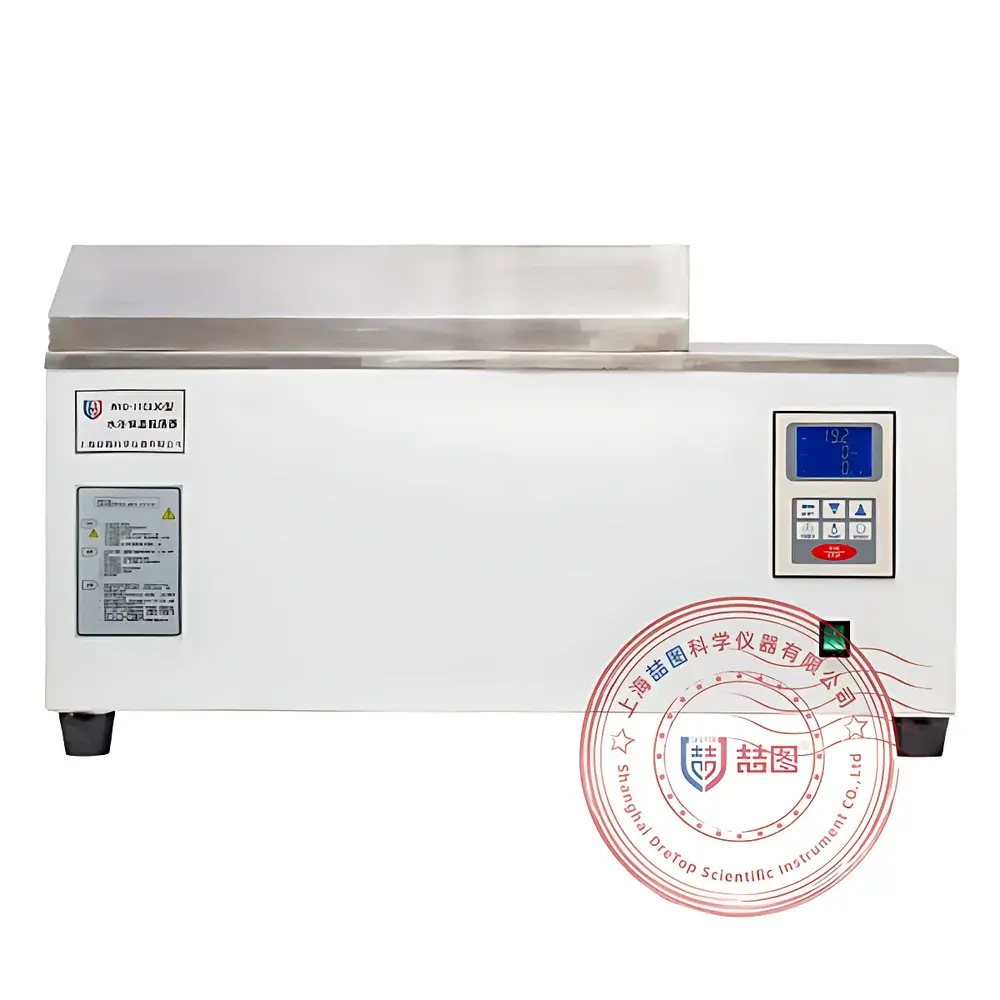
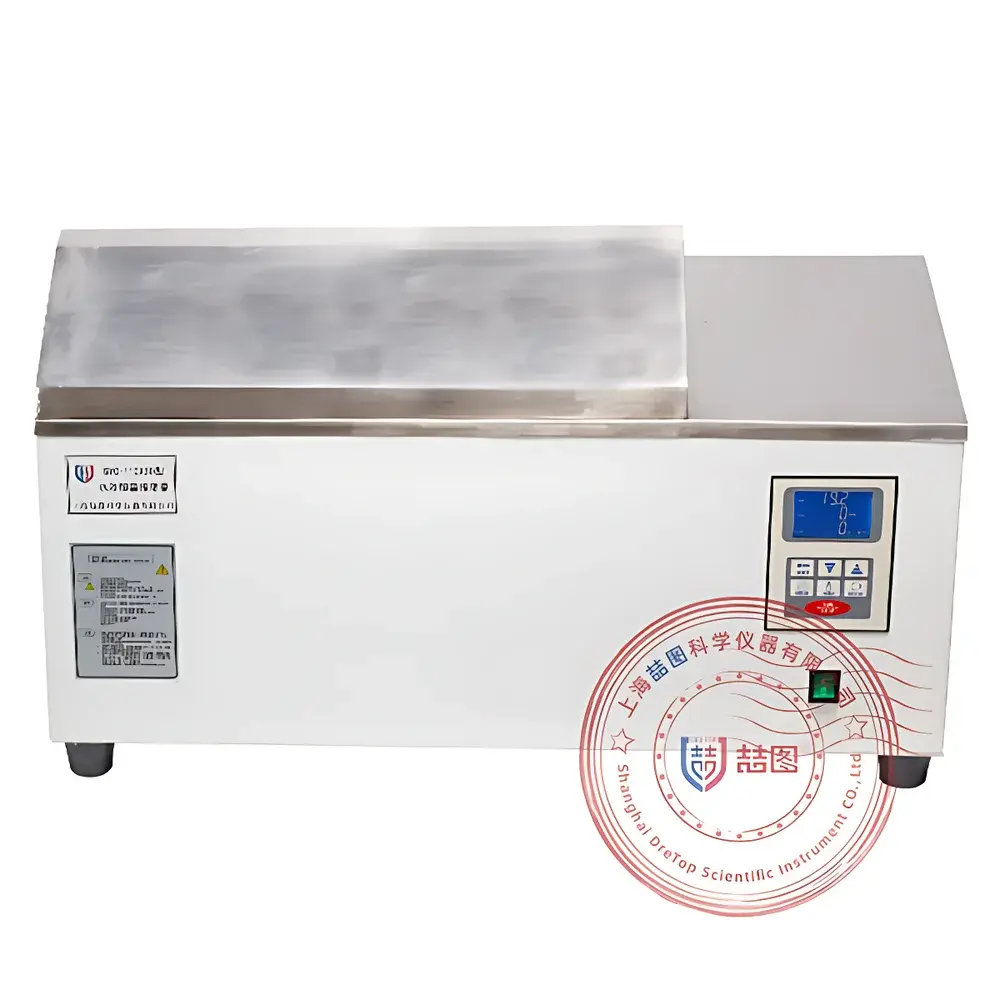
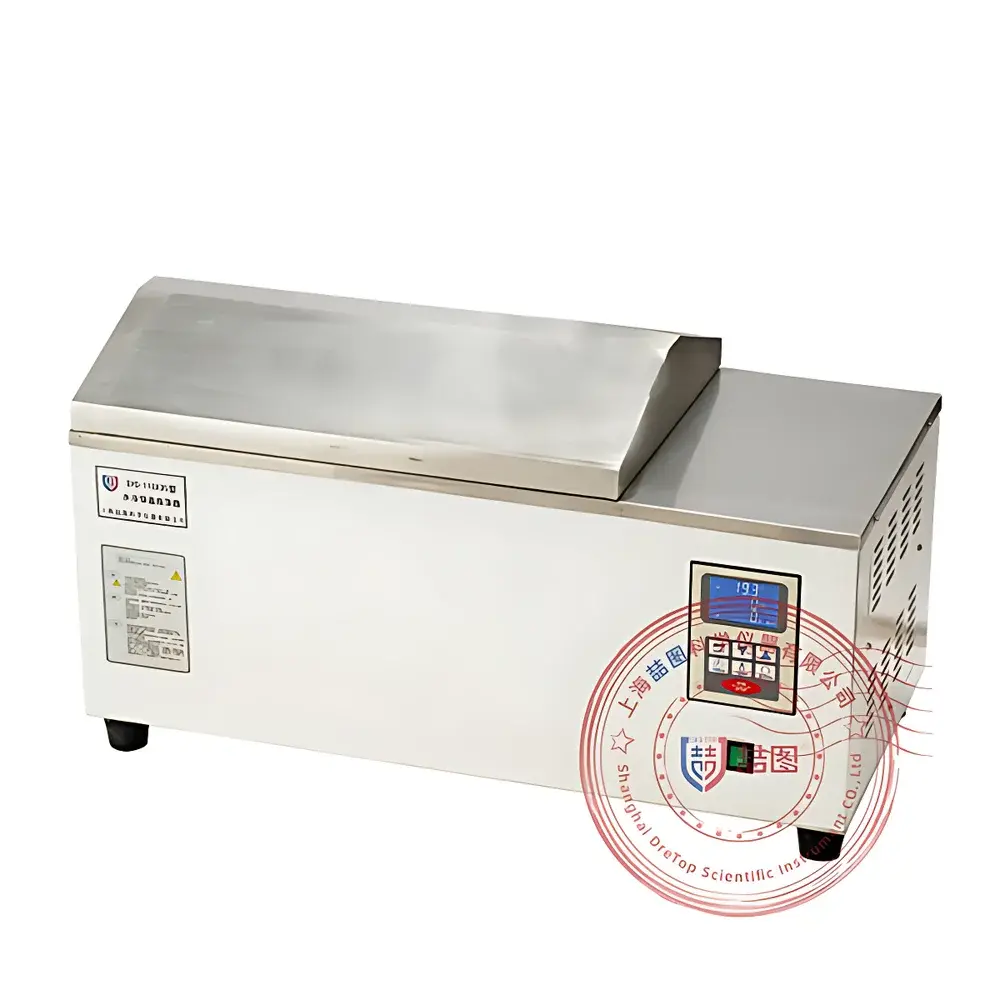
DRETOP WYC-110X50 Constant-Temperature Water Bath Shaker
| Brand | DRETOP |
|---|---|
| Origin | Shanghai, China |
| Manufacturer Type | Direct Manufacturer |
| Instrument Type | Constant-Temperature Water Bath Shaker / Orbital Shaker |
| Timer Range | 0–500 h |
| Oscillation Frequency | 0–200 rpm ±10% |
| Oscillation Amplitude | 35 mm |
| Temperature Control Range | Ambient +5°C to 100°C |
| Number of Shelving Plates | 1 |
Overview
The DRETOP WYC-110X50 Constant-Temperature Water Bath Shaker is an engineered platform for precise, reproducible incubation and agitation of biological and biochemical samples under controlled thermal and mechanical conditions. Designed around a water-jacketed bath architecture, it delivers uniform temperature distribution via liquid-phase heat transfer—ensuring minimal thermal gradients across the sample zone. The system operates on the principle of reciprocating linear oscillation (non-orbital), optimized for applications requiring gentle yet consistent mixing of suspension cultures, enzymatic reactions, solubility studies, and antigen-antibody incubations. Its integration of PID-based thermal regulation and closed-loop speed control enables stable operation across extended durations—from short-term kinetic assays to multi-day microbial growth experiments—making it suitable for GLP-compliant laboratories in academic research, pharmaceutical development, clinical diagnostics, and environmental microbiology.
Key Features
- Microprocessor-controlled PID temperature regulation with ±0.1°C accuracy and ±0.5°C temperature uniformity across the bath chamber;
- Real-time digital display of setpoint and actual values for temperature, speed (rpm), and elapsed time on a backlit LCD interface;
- Brushless DC motor drive ensuring maintenance-free operation, constant torque delivery, and speed stability within ±1 rpm deviation;
- Programmable timer supporting continuous or timed operation from 1 minute to 500 hours;
- Over-temperature protection with independent thermal cutoff and audible/visual alarm activation upon deviation exceeding user-defined thresholds;
- Soft-start acceleration profile minimizing sample splashing and tube displacement during initiation;
- Parameter lock function to prevent accidental modification during active runs;
- Power failure recovery mode: automatically resumes prior operating conditions—including temperature setpoint, speed, and remaining time—after grid restoration.
Sample Compatibility & Compliance
The WYC-110X50 accommodates standard laboratory vessels including Erlenmeyer flasks (up to 250 mL × 15), test tubes, microcentrifuge tubes, and custom-configured racks using stainless-steel universal spring clamps. Its 490 × 310 mm platform supports heterogeneous load distributions without compromising oscillation integrity. The unit complies with IEC 61010-1:2010 safety standards for electrical equipment used in laboratory environments. While not certified for ISO 13485 or FDA 21 CFR Part 11 out-of-the-box, its data logging capabilities (when paired with optional USB module) support audit-ready record generation aligned with GLP and GMP documentation requirements. Temperature calibration traceability can be established per ISO/IEC 17025 guidelines using external reference thermometers.
Software & Data Management
The base configuration includes embedded firmware supporting local parameter configuration and real-time monitoring. Optional accessories extend functionality: a USB data logger records timestamped temperature and speed values at user-selectable intervals (1 s to 60 min resolution); a color touchscreen controller enables multi-step protocol programming—allowing sequential execution of varying temperature ramps, speed profiles, and dwell periods within a single run. Wireless telemetry (via Wi-Fi or Bluetooth modules) permits remote supervision through secure web interfaces compatible with LIMS integration. All logged datasets export in CSV format for downstream analysis in MATLAB, Python, or statistical software packages.
Applications
- Microbial culture expansion under defined thermal and agitation conditions (e.g., E. coli, yeast, lactic acid bacteria);
- Protein solubilization and refolding studies requiring precise temperature ramping and shear-sensitive mixing;
- Antibody-antigen binding kinetics in ELISA plate pre-incubation steps;
- DNA hybridization and restriction enzyme digestion optimization;
- Suspension cell line maintenance in bioreactor seed train preparation;
- Environmental water sample enrichment for pathogen detection (e.g., Legionella, coliforms);
- Chemical dissolution rate testing of pharmaceutical excipients or polymer matrices.
FAQ
What is the maximum load capacity of the WYC-110X50 shaker platform?
The unit supports up to 15 × 250 mL flasks evenly distributed across the 490 × 310 mm tray; total mass should not exceed 12 kg to maintain mechanical stability and thermal homogeneity.
Can this instrument operate continuously for 7 days without interruption?
Yes—the 500-hour timer range and thermal overload safeguards enable unattended long-duration protocols, provided ambient room temperature remains within 15–30°C and ventilation clearance meets minimum 10 cm rear/side spacing requirements.
Is the water bath resistant to corrosion from saline or buffered solutions?
The inner chamber is constructed from high-grade 304 stainless steel with electropolished finish, offering resistance to common aqueous buffers (e.g., PBS, Tris-HCl) and low-concentration NaCl solutions; however, prolonged exposure to >5% NaCl or acidic media requires periodic descaling and inspection.
Does the device meet electromagnetic compatibility (EMC) standards for use near sensitive analytical instruments?
It conforms to EN 61326-1:2013 for laboratory equipment EMC performance, minimizing radiated emissions that could interfere with adjacent HPLC detectors, mass spectrometers, or electrophysiology rigs.
How is temperature calibration verified during routine maintenance?
Users may perform field verification using a NIST-traceable Class A platinum RTD probe inserted into the bath fluid at three spatial locations (center, front-left, rear-right); deviations >±0.3°C warrant adjustment via the service menu or factory recalibration.




