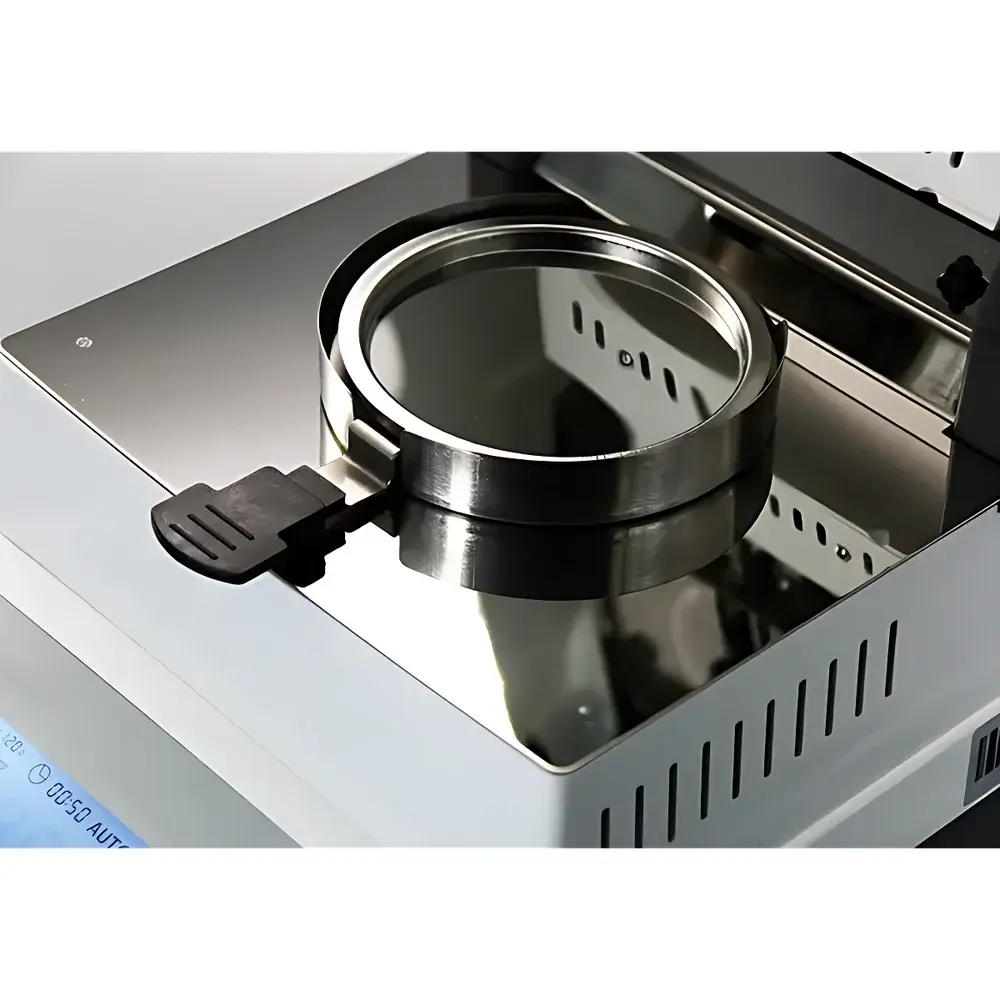
Drick DRK-610A Automatic Moisture Analyzer for Grains, Food, and Tobacco
| Brand | Drick |
|---|---|
| Model | DRK-610A |
| Max. Capacity | 120 g |
| Readability | 0.005 g |
| Moisture Resolution | 0.01% |
| Moisture Range | 0.01–100% |
| Heating Source | Circular Halogen Lamp |
| Temp. Range | RT–160 °C |
| Pan Diameter | Φ102 mm |
| Interface | RS232 |
| Net Weight | 4.3 kg |
| Dimensions (L×W×H) | 310×205×200 mm |
Overview
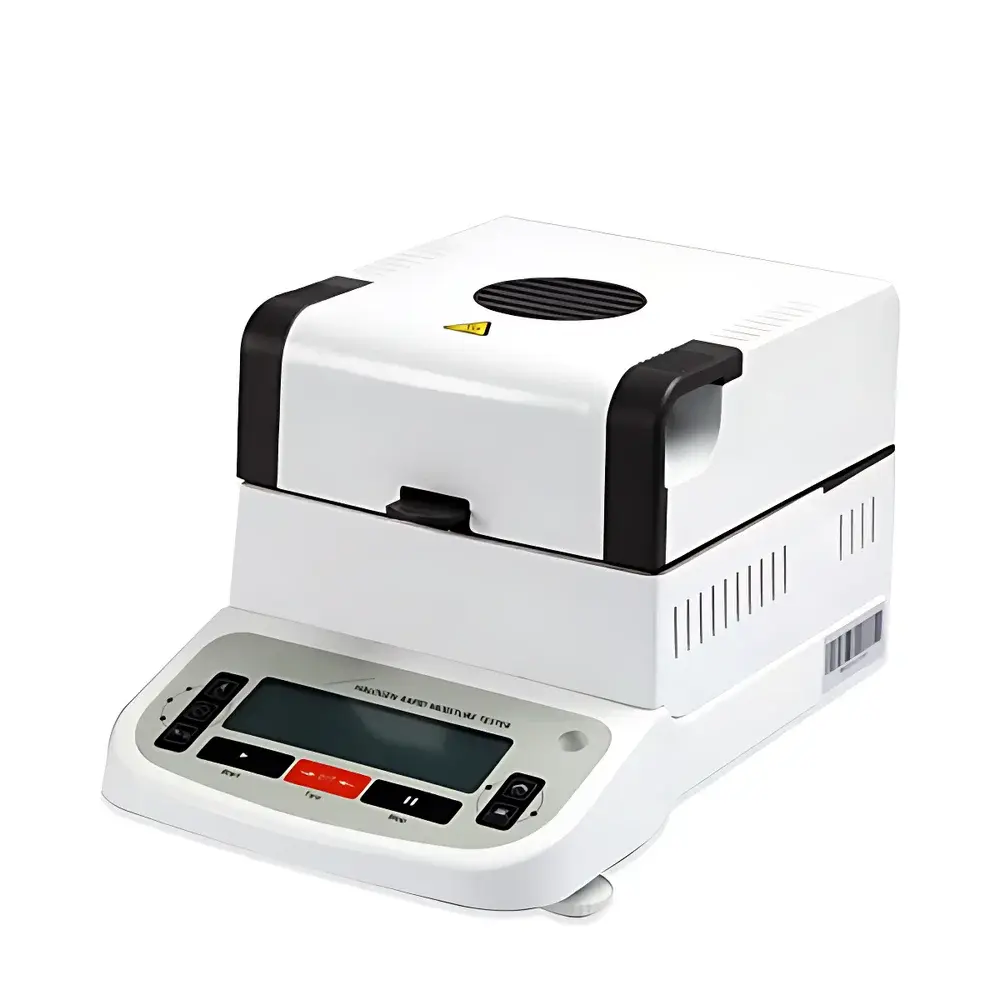
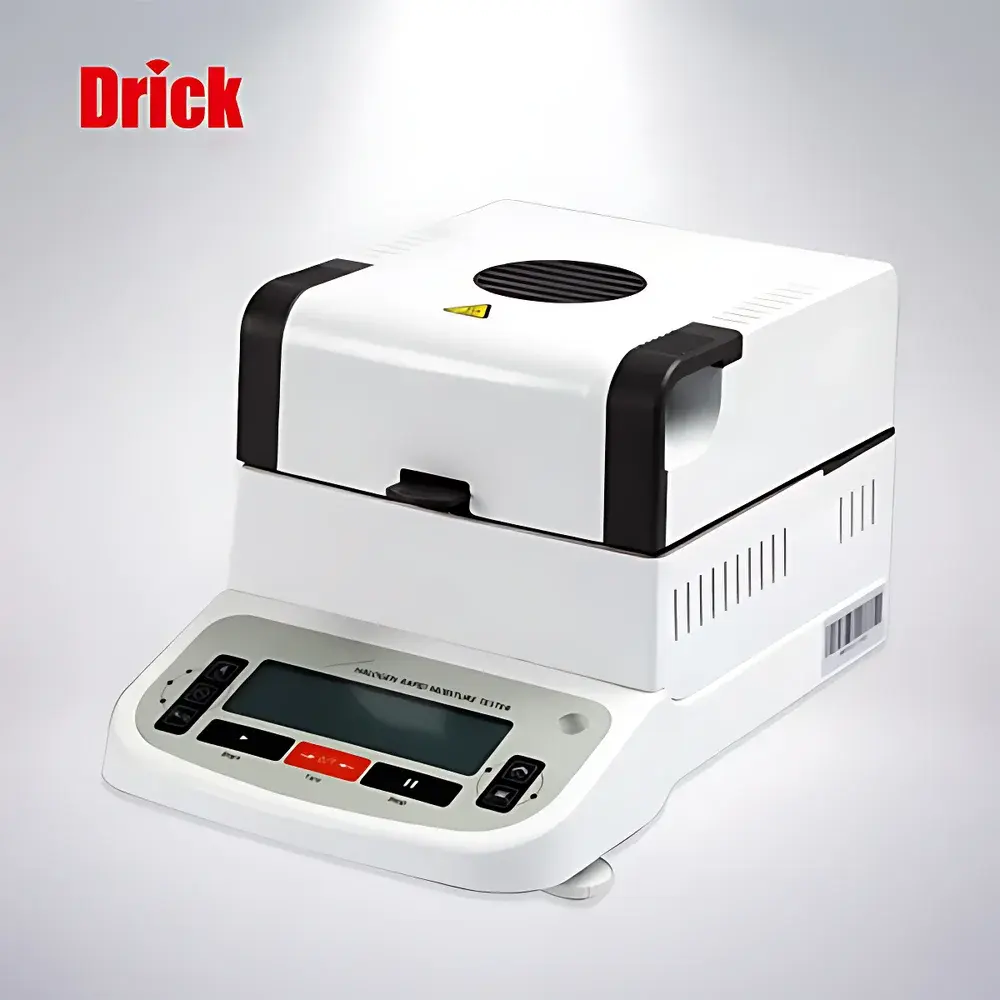
The Drick DRK-610A Automatic Moisture Analyzer is a precision thermogravimetric instrument engineered for rapid, reliable determination of free moisture content in solid and semi-solid organic materials. It operates on the principle of loss-on-drying (LOD), wherein a pre-weighed sample is subjected to controlled halogen heating under defined thermal conditions; the mass loss—attributable to evaporation of surface-adsorbed and loosely bound water—is measured in real time via a high-stability strain-gauge load cell. Unlike conventional oven-drying methods governed by ASTM D4442 or ISO 4471, the DRK-610A delivers results in minutes rather than hours, while maintaining traceable repeatability within ±0.01% RSD across replicate analyses. Its design complies with fundamental requirements for method validation under GLP and internal QC protocols, making it suitable for routine use in food safety laboratories, agricultural testing centers, tobacco quality assurance units, and pharmaceutical excipient control environments.
Key Features
- Halogen heating system with uniform circular geometry ensures consistent thermal distribution across the entire sample surface—minimizing edge effects and improving inter-sample reproducibility.
- Integrated draft shield enclosure eliminates air-current interference during weighing, enhancing stability of the 0.005 g readability sensor under ambient lab conditions.
- Real-time graphical display of temperature profile and moisture loss curve enables immediate visual assessment of drying kinetics and endpoint detection.
- Multi-parameter output includes moisture content (MC%), dry matter (DC%), residual weight (g), drying rate (%/min), and regain (for hygroscopic commodities such as tobacco leaf and tea).
- Programmable drying modes: automatic termination upon stabilization, user-defined time (0–99 min, 1-min increments), or manual stop—supporting both standardized and application-specific protocols.
- Stainless-steel heating chamber (grade 304) resists corrosion from acidic or saline samples (e.g., cured meats, fermented fish products, salted snacks) and facilitates rapid cleaning between runs.
- RS232 serial interface supports bidirectional data transfer to LIMS, Excel, or custom QA software; optional thermal printer provides auditable hard-copy records compliant with ISO/IEC 17025 documentation requirements.
Sample Compatibility & Compliance
The DRK-610A accommodates heterogeneous particulates and viscous matrices without grinding or homogenization: whole grains (wheat, rice, corn), milled flour, extruded pet feed, shredded tobacco lamina, dried herbs, roasted coffee beans, powdered dairy, and processed bakery goods. Its LOD methodology aligns with the conceptual framework of AOAC Official Method 950.46 (Moisture in Cereal Products) and USP <731> (Loss on Drying), though formal method equivalence requires laboratory-specific validation per ICH Q2(R2). The instrument’s temperature control accuracy (±2 °C over 50–160 °C range) and mass measurement uncertainty (<0.008 g at full scale) meet minimum performance criteria for Category II analytical balances per OIML R76.
Software & Data Management
No proprietary software installation is required—the DRK-610A functions as a standalone analyzer with embedded firmware supporting full audit trail functionality. All measurements store timestamped metadata (date/time, operator ID, method ID, final MC%, DC%, temperature max, duration) in non-volatile memory. When connected to a PC via RS232, raw data streams are ASCII-delimited for direct import into statistical analysis packages. Exported datasets include sequential mass readings at 1-second intervals, enabling post-hoc kinetic modeling (e.g., Page model, Henderson–Pabis equation) for process optimization in drying line calibration.
Applications
- Grain trading: Rapid verification of moisture compliance against national standards (e.g., GB 1351–2008 for wheat, GB 1353–2018 for maize).
- Food manufacturing: In-line QC of snack moisture prior to packaging to prevent microbial spoilage and texture degradation.
- Tobacco processing: Monitoring leaf moisture during fermentation and re-drying stages to ensure optimal enzymatic activity and cuttability.
- Feed mill operations: Validation of pelleted feed moisture to inhibit mold growth and preserve vitamin stability during storage.
- Research labs: Screening hygroscopicity of novel food powders, starch derivatives, or plant-based protein isolates under controlled humidity gradients.
FAQ
Is the DRK-610A compliant with FDA 21 CFR Part 11?
The device itself does not provide electronic signature or role-based access controls; however, when integrated with validated third-party data acquisition software that implements audit trails, electronic signatures, and secure user authentication, it can support Part 11–compliant workflows.
Can it measure bound water or total volatiles?
No—it quantifies only thermally labile moisture (free and weakly adsorbed water) below 160 °C. For total volatile solids (TVS) or chemically bound water (e.g., hydrates), higher-temperature furnaces (>500 °C) or Karl Fischer titration are required.
What calibration standards are recommended?
Certified anhydrous sodium tartrate (15.66% H₂O) and potassium dihydrogen phosphate (KH₂PO₄, 15.0% H₂O) are traceable reference materials used for performance verification per ISO 12099.
Does the stainless-steel pan require periodic recalibration?
No—the pan is a passive component; only the load cell and temperature sensor require annual metrological verification using NIST-traceable weights and calibrated thermocouples.
How often should the halogen lamp be replaced?
Typical service life exceeds 5,000 hours under standard operating conditions; output decay is monitored automatically via internal photodiode feedback—replacement is triggered when intensity falls below 90% of nominal value.