
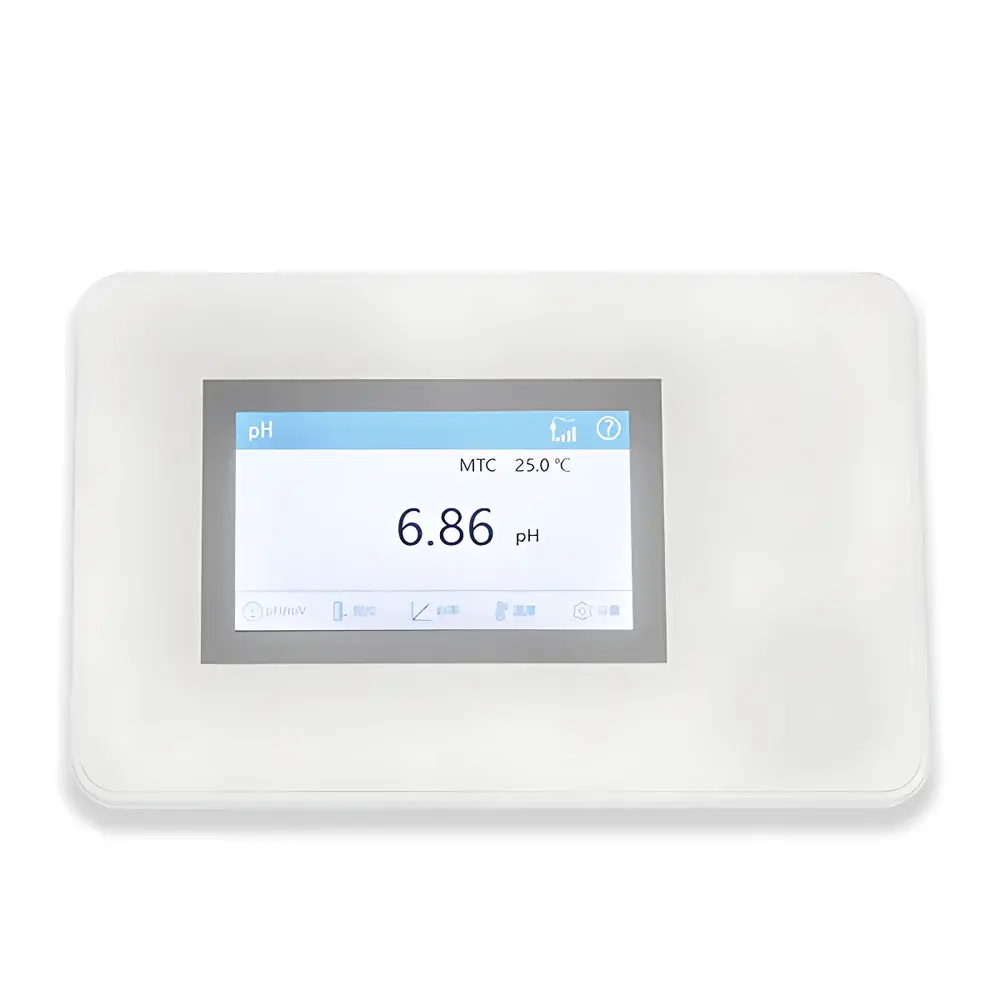
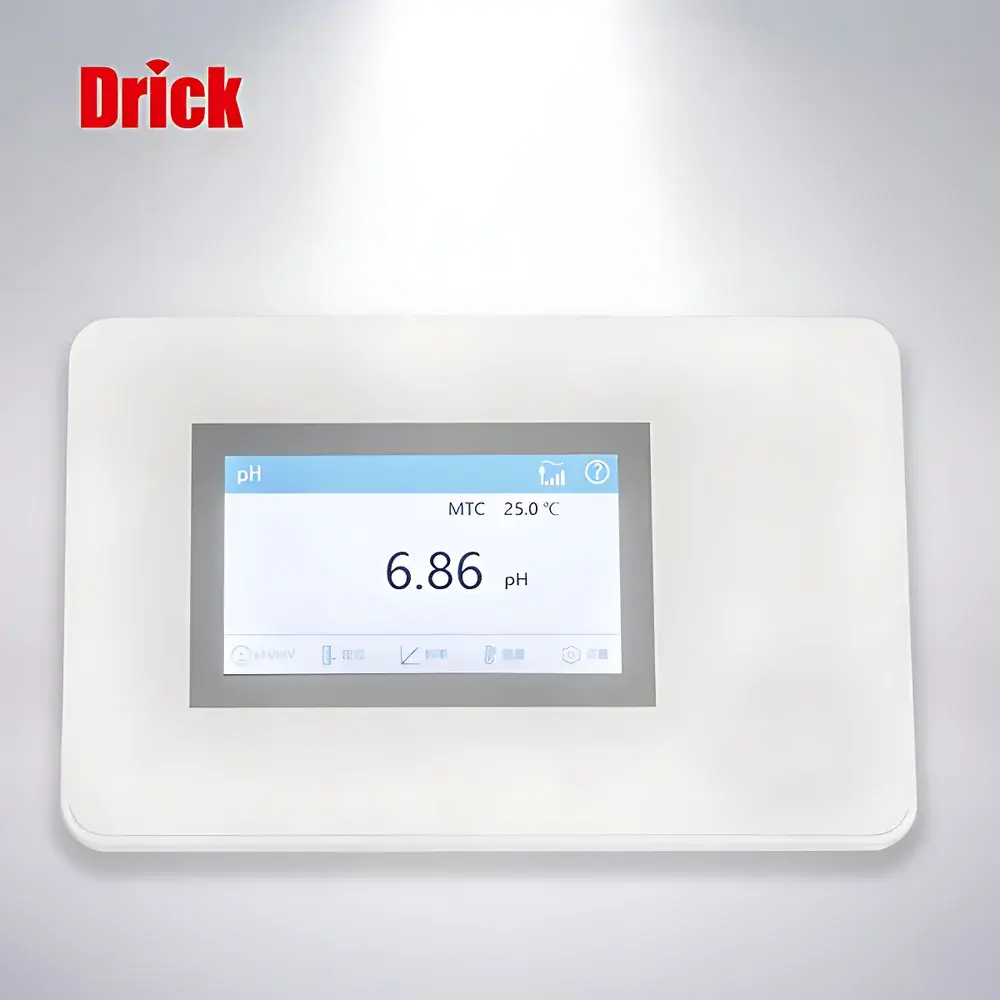
Drick DRK-pHS-3CT Benchtop pH Meter
| Brand | Drick |
|---|---|
| Origin | Shandong, China |
| Manufacturer Type | Manufacturer |
| Regional Classification | Domestic (China) |
| Model | DRK-pHS-3CT |
| Instrument Type | Benchtop |
| Parameter Type | Single-parameter (pH/mV/Temperature) |
| pH Range | –2.00 to 20.00 pH |
| mV Range | –1999.9 to +1999.9 mV |
| Temperature Range | –5.0 to 110.0 °C |
| Resolution | 0.01 pH / 0.1 mV / 0.1 °C |
| Accuracy | ±0.01 pH / ±0.05% FS (mV) / ±0.2 °C |
| Stability | ±0.01 pH ±1 digit / 3 h |
| Calibration | 1–3 point auto-calibration with automatic buffer recognition (JJG 119, DIN 19266/19267, USA NIST-traceable buffers, custom buffers) |
| Electrode Interface | BNC + RCA (banana) + screw-terminal |
| Display | 4.3″ TFT color touchscreen (8-level backlight) |
| Data Compliance | GLP-compliant data logging with timestamp, calibration history, and electrode status tracking |
| Power | DC 12 V, 4 W |
| Dimensions | 210 × 210 × 100 mm |
| Weight | 1 kg |
Overview
The Drick DRK-pHS-3CT is a precision benchtop pH meter engineered for routine and regulated laboratory applications requiring reliable, traceable, and repeatable electrochemical measurements. It operates on the potentiometric principle—measuring the potential difference between a pH-sensitive glass electrode and a stable reference electrode in aqueous solution—to determine hydrogen ion activity as pH. Designed to meet fundamental requirements of ISO/IEC 17025-accredited laboratories and quality control environments, the instrument supports both direct pH measurement and relative mV (redox) analysis across an extended range—from strongly acidic (–2.00 pH) to highly alkaline (20.00 pH) solutions—enabling versatility in chemical synthesis, environmental testing, pharmaceutical formulation, and wastewater treatment workflows.
Key Features
- 4.3-inch high-resolution TFT color touchscreen with eight-step adjustable backlight and responsive touch interface—optimized for glove-compatible operation and reduced visual fatigue during extended use.
- Metro-style UI architecture featuring intuitive icon-driven navigation, embedded contextual help (via “?” button), and built-in quick-reference manual—minimizing training overhead and supporting operator independence.
- Advanced electrode diagnostics: real-time signal strength indicator displays electrode health post-calibration, providing objective guidance on membrane integrity and electrolyte depletion.
- Intelligent auto-calibration engine supporting 1–3 point calibration with automatic recognition of standard buffers per JJG 119 (China), DIN 19266/19267 (Germany), and US NIST-traceable pH standards; also permits user-defined buffer entry with editable pKa values.
- Dual temperature compensation: automatic detection via integrated Pt1000 or thermistor probe (RCA interface), or manual input via virtual keypad—ensuring accurate pH correction across –5.0 to 110.0 °C.
- Hybrid electrode connectivity: triple-interface design (BNC, RCA, and screw terminals) accommodates combination electrodes (e.g., E-331D), separate indicator/reference pairs, and specialized sensors—including ion-selective or ORP electrodes—without adapter dependency.
- GLP-compliant data handling: all calibrations, measurements, and system events are timestamped and stored internally with audit-ready metadata (operator ID, electrode ID, buffer lot, ambient conditions).
Sample Compatibility & Compliance
The DRK-pHS-3CT is validated for use with aqueous and low-ionic-strength solutions typical in analytical chemistry, education labs, and process QC. It complies with general performance criteria outlined in ISO 3696 (Grade 3 water), ASTM D1293 (pH of water), and USP (pH Measurement). While not certified for FDA 21 CFR Part 11 out-of-the-box, its GLP-mode logging—featuring immutable calibration reports, electronic signatures (via optional external authentication), and exportable CSV/Excel records—supports validation under GMP/GLP frameworks when deployed with documented SOPs and periodic verification protocols.
Software & Data Management
Internal memory retains up to 500 measurement records and full calibration histories, including slope, offset, and asymmetry potential values. Data export is supported via USB host port (to flash drive) in plain-text or spreadsheet format. The instrument adheres to GLP principles through mandatory fields for calibration date/time, buffer IDs, electrode serial numbers, and operator annotation. No proprietary software is required for basic operation; however, optional PC-based utilities enable batch report generation, trend visualization, and integration into LIMS via ASCII serial output (RS-232 emulation over USB-CDC).
Applications
- Academic teaching labs: Demonstrating acid-base equilibria, titration endpoints, and buffer capacity calculations.
- Environmental monitoring: Field-deployable pH verification of surface water, groundwater, and effluent streams per EPA Method 150.1.
- Pharmaceutical QC: Monitoring pH during dissolution testing (USP ), buffer preparation, and stability-indicating assays.
- Food & beverage R&D: Controlling fermentation pH, verifying preservative efficacy, and validating cleaning-in-place (CIP) rinse neutrality.
- Industrial process support: Routine checks of plating baths, boiler feedwater, and bioreactor media prior to inoculation.
FAQ
Does the DRK-pHS-3CT support automatic temperature compensation with all electrode types?
Yes—when a compatible temperature probe (e.g., T-820D) is connected via the RCA port, ATC activates automatically; otherwise, manual temperature entry is available.
Can I perform calibration without referencing a physical buffer solution?
No—calibration requires physical immersion in certified buffer solutions; the instrument does not support “dry” or simulated calibration.
Is the internal data storage encrypted or password-protected?
Data is stored in non-volatile memory with read-only access by default; password protection is not implemented, but export files may be secured externally.
What is the recommended recalibration frequency under ISO/IEC 17025?
Calibration must be performed before each analytical sequence or at least once per shift, with verification using a check standard at mid-range (e.g., pH 7.00) between calibrations.
Does the instrument meet IP rating requirements for wet-lab environments?
It carries no formal IP rating; however, its sealed front panel and elevated chassis design provide resistance to incidental splashes—suitable for controlled indoor lab use only.





