
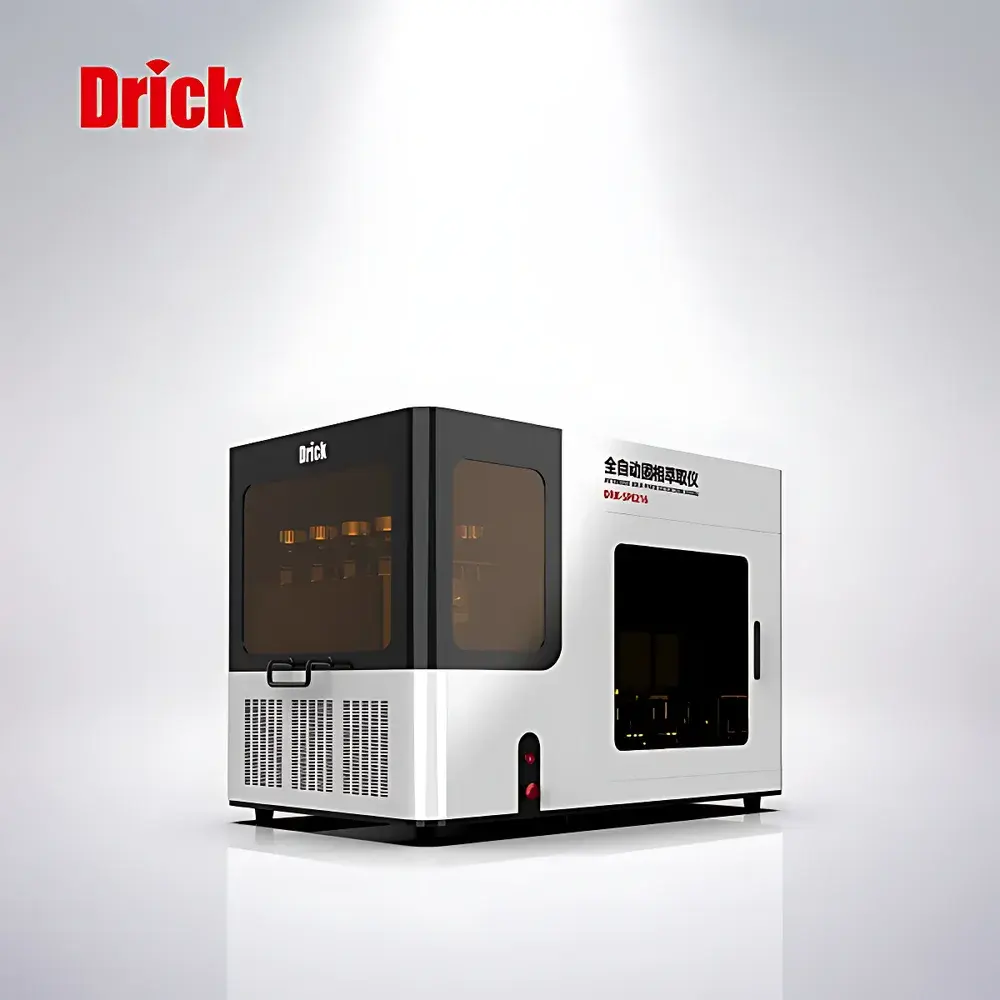
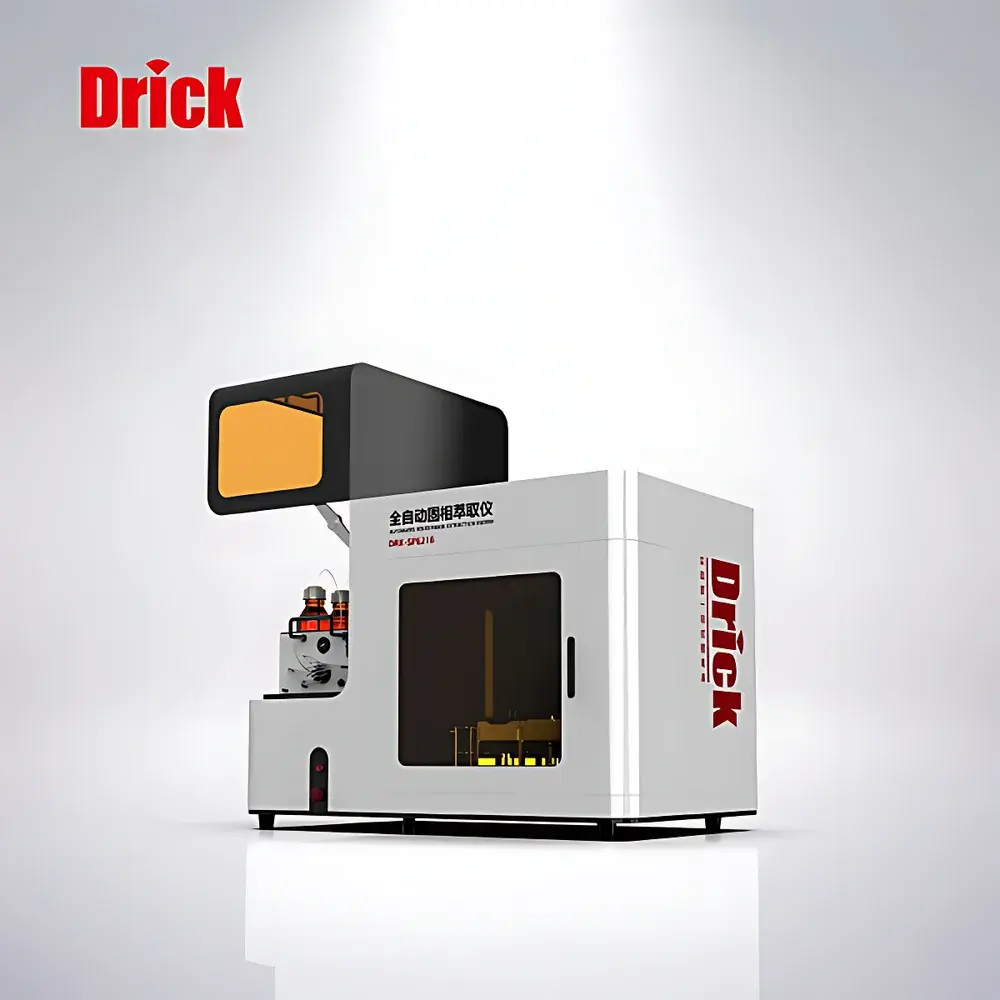
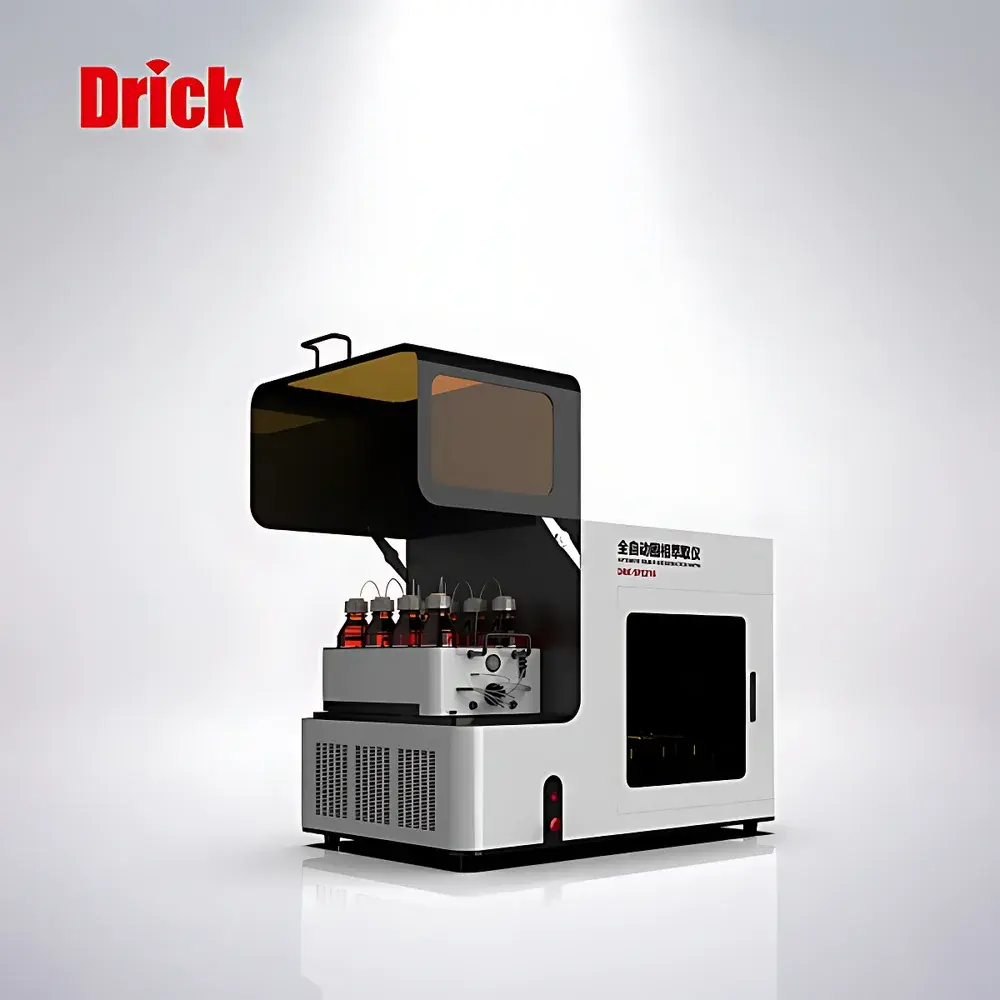
Drick DRK-SPE216 Fully Automated Solid Phase Extraction System
| Brand | Drick |
|---|---|
| Origin | Shandong, China |
| Manufacturer Type | Direct Manufacturer |
| Model | DRK-SPE216 |
| Automation Level | Fully Automated |
| Channel Configuration | Modular 1/2/4/6/8-Channel Support |
| Sample Capacity | Up to 52 positions (continuous processing) |
| SPE Format Compatibility | Column & Membrane Cartridges |
| Pump Flow Rate | 0.1–120 mL/min |
| Solvent Channels | 8 independent 500 mL solvent reservoirs |
| Sample Volume Range | 0.1–20 mL (expandable to ≥500 mL via large-volume loading module) |
| Collection Volumes | 10–15 mL standard |
| Column Compatibility | 1/3/6/12 mL standard cartridges |
| Pressure Range | 0–145 psi (0–1.0 MPa) with real-time pressure sensing and programmable overpressure cutoff (5–145 psi threshold) |
| Sealing Technology | Dual-seal H-axis compression with FFKM quad-ring (泛塞封) interface |
| Liquid-Level Tracking | Yes, adaptive needle immersion control |
| Needle Material | 316L stainless steel with side-bottom piercing aperture |
| Drying Modes | On-line N₂ purging + Na₂SO₄ desiccant cartridge integration |
| Concentration Mode | In-situ N₂ blow-down with user-defined time control |
| Waste Management | Triple-path segregated waste collection |
| Cleaning Protocols | N₂ purge, solvent rinse, agitation-assisted internal/external needle cleaning |
| Compliance Features | Audit trail logging, parameter lockout, electronic signature support per FDA 21 CFR Part 11 readiness |
| Remote Operation | Integrated Wi-Fi router |
Overview
The Drick DRK-SPE216 Fully Automated Solid Phase Extraction System is an engineered solution for high-throughput, reproducible sample preparation in regulated analytical laboratories. Based on positive-pressure solid-phase extraction (SPE) principles, the system applies precisely controlled pneumatic or pump-driven pressure to drive liquid samples and solvents through sorbent-packed cartridges or membrane devices. Unlike vacuum manifold systems, the DRK-SPE216 eliminates flow variability caused by column clogging or inconsistent vacuum levels—ensuring uniform residence time, consistent elution kinetics, and superior inter- and intra-run reproducibility. Its modular architecture supports scalable deployment across QC, environmental testing, clinical toxicology, and food safety labs where GLP/GMP traceability, operator safety, and method robustness are non-negotiable.
Key Features
- Modular multi-channel platform: Configurable for 1, 2, 4, 6, or 8 independent extraction channels—field-upgradable without hardware replacement.
- High-precision 4-axis robotic arm (X/Y/Z/H): Positioning accuracy ±0.01 mm; noise level <50 dB(A); X/Y coordinated motion optimizes cycle time; H-axis delivers uniform axial compression for leak-free cartridge sealing under pressures up to 145 psi.
- Integrated dual-mode drying: Programmable nitrogen gas purge combined with in-line anhydrous sodium sulfate cartridge for automated water removal prior to elution or concentration.
- True large-volume handling: Supports uninterrupted loading of ≥500 mL aqueous or particulate-laden samples using wear-resistant, corrosion-tolerant fluidic pathways—no consumable filters or routine maintenance required.
- Intelligent solvent management: Eight dedicated 500 mL solvent bottles with real-time volume monitoring, low-level alerts, and auto-pause functionality to prevent dry runs.
- Comprehensive contamination control: Multi-stage needle cleaning—including N₂ blow-back, solvent flush, and agitation-assisted internal wall scouring—minimizes carryover between samples.
- Safety-first design: Emergency stop button, sealed reagent handling, remote operation capability, and puncture-style sampling to eliminate volatile organic compound (VOC) exposure during vial access.
Sample Compatibility & Compliance
The DRK-SPE216 accommodates standard SPE formats (1, 3, 6, and 12 mL columns) as well as disk-based membranes, with mechanical adaptability for custom cartridge geometries. It supports both reversed-phase (C18, C8), ion-exchange (SCX, SAX), and mixed-mode chemistries. All wetted materials—including 316L stainless steel needles, PEEK tubing, FFKM seals, and chemically inert fluid path components—are compatible with aggressive solvents (e.g., dichloromethane, acetonitrile, methanol, ethyl acetate) and acidic/basic matrices. The system meets foundational requirements for regulatory compliance: full audit trail generation with timestamped user actions, editable method parameters with version history, electronic signature readiness aligned with FDA 21 CFR Part 11 Annex 11 expectations, and configurable lockout for critical settings during routine operation.
Software & Data Management
The embedded Linux-based control software provides intuitive method building with stepwise definition of conditioning, loading, washing, drying, and elution phases—including dwell time control for sorbent equilibration and solvent incubation. Each channel operates independently with customizable flow profiles and pressure thresholds. All methods and logs are exportable in CSV or PDF format. Cloud synchronization enables secure off-site backup of protocols and cross-instrument method portability. Remote access via encrypted HTTPS allows real-time status monitoring, live video feed of robotic motion, and emergency intervention—even during unattended overnight runs. Scheduled start functionality integrates seamlessly with downstream GC-MS or LC-MS instrument queue management systems.
Applications
The DRK-SPE216 is validated for diverse sample matrices requiring rigorous cleanup prior to instrumental analysis. Typical use cases include pesticide residue analysis in fruits and vegetables (per ISO 17025-accredited workflows), pharmaceutical impurity profiling (USP & ICH Q2-compliant), endocrine disruptor quantification in wastewater (EPA Method 1694), mycotoxin extraction from cereals (AOAC 2005.08), and forensic toxicology screening of blood and urine (SAMHSA-certified protocols). Its ability to execute A/B tandem column configurations enables orthogonal selectivity for complex interferences—such as phospholipid removal in plasma prior to LC-MS/MS bioanalysis.
FAQ
Does the DRK-SPE216 support method validation documentation?
Yes—software-generated audit trails, calibration logs, and performance verification reports (e.g., recovery studies, precision testing) comply with ISO/IEC 17025 and GLP documentation standards.
Can the system handle viscous or particulate-containing samples?
Yes—the large-volume loading module employs pulse-dampened positive displacement pumping and abrasion-resistant fluid paths, enabling direct processing of milk, juice, sediment extracts, and filtered wastewater without pre-filtration.
Is third-party LIMS integration possible?
Yes—via standardized RESTful API endpoints and HL7-compliant data export templates for seamless connection to laboratory information management systems.
What maintenance intervals are recommended?
No scheduled maintenance is required for the core fluidic or robotic systems; only periodic inspection of seals and replacement of consumable Na₂SO₄ cartridges per usage frequency.
How is cross-contamination prevented during high-throughput runs?
Through a combination of pressure-controlled flow uniformity, multi-step needle decontamination cycles, segregated waste routing, and real-time pressure anomaly detection that halts execution upon seal failure or blockage.



