
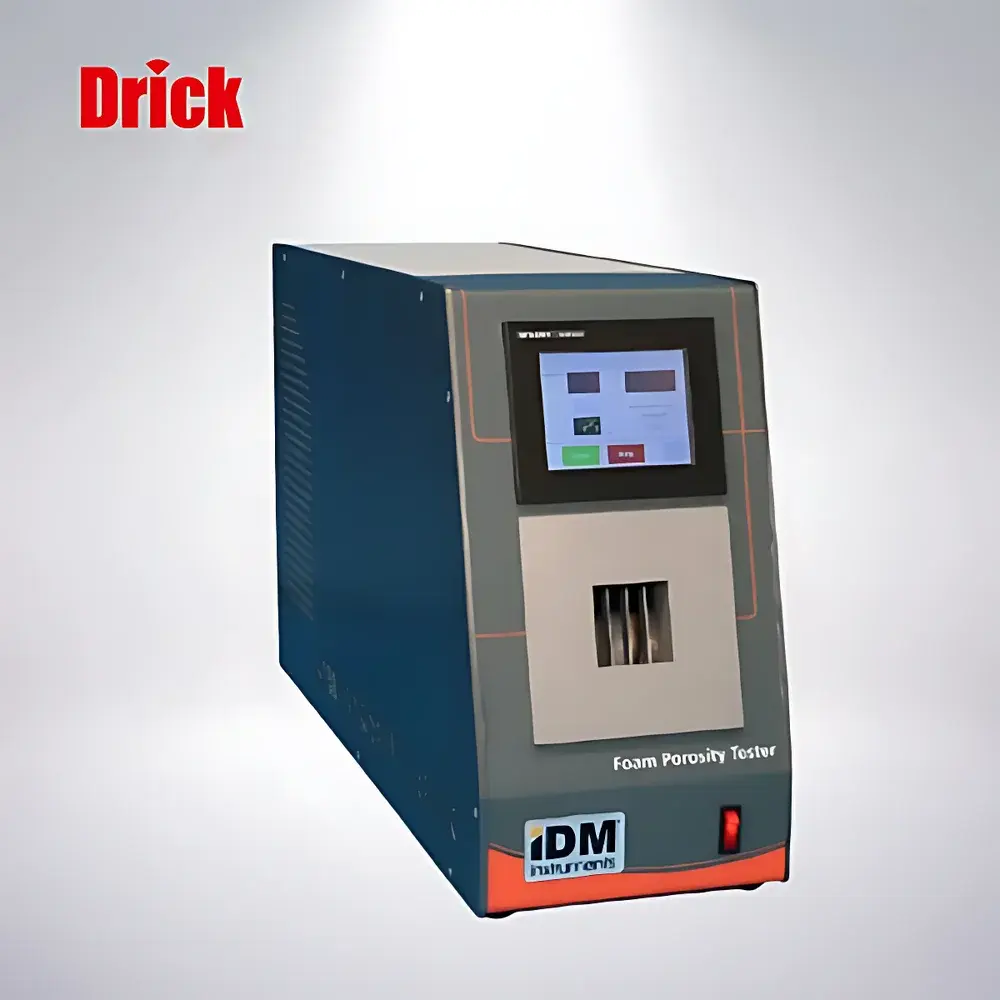
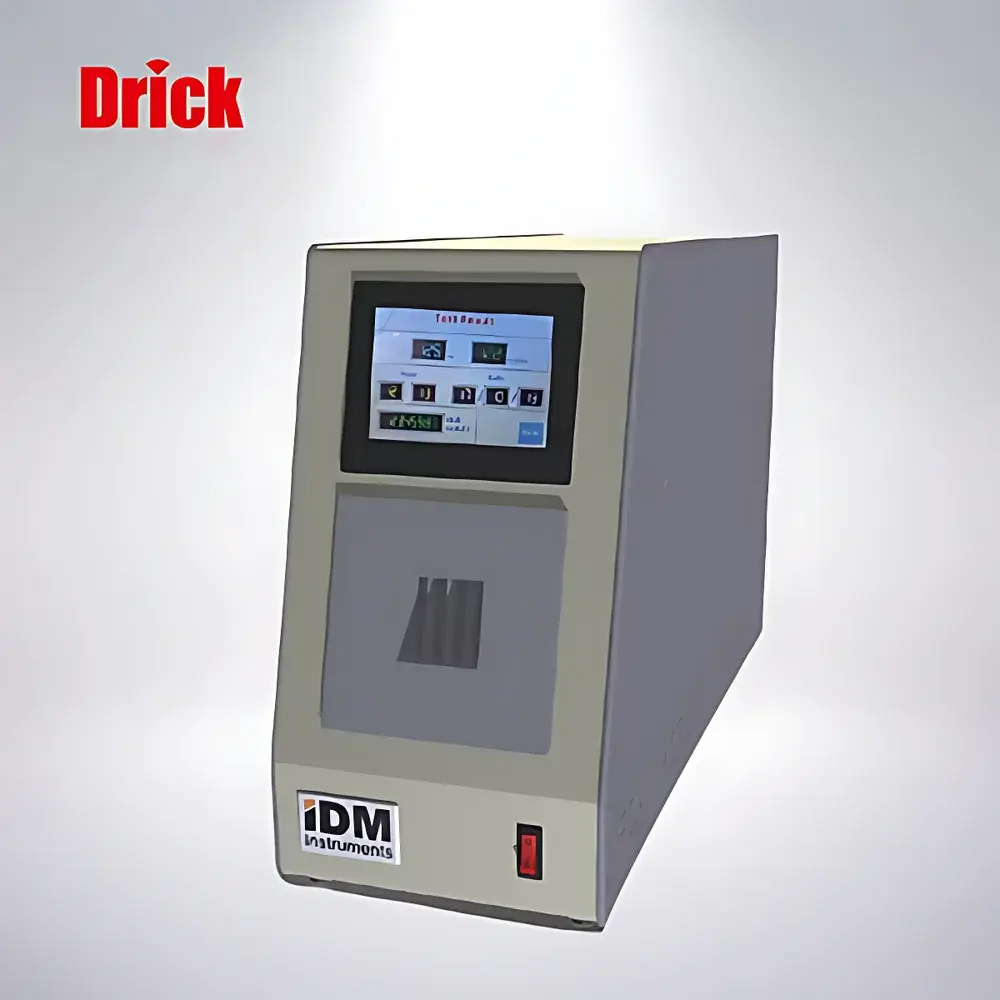
IDM F0031 Auto Foam Porosity & Air Permeability Tester for Flexible Cellular Polyurethane
| Brand | IDM |
|---|---|
| Origin | Shandong, China |
| Model | F0031 |
| Pressure Range | 0–500 Pa (±1% FS) |
| Test Area | 50 mm × 50 mm × 25 mm |
| Flow Ranges | 0.2–20 L/min (±2% FS) |
| Display | Digital touchscreen with integrated manometer |
| Control | Automatic constant differential pressure regulation |
| Data Output | RS232 serial interface |
| Units | Selectable (L/min or CFM) |
| Compliance Reference | ASTM D3574, ISO 4638, ISO 9237 (adapted for cellular foam) |
Overview
The IDM F0031 Auto Foam Porosity & Air Permeability Tester is an engineered instrument designed for quantitative assessment of airflow resistance through flexible cellular polymeric materials—primarily flexible polyurethane foams and viscoelastic foams used in bedding, seating, and automotive applications. It operates on the principle of controlled differential air pressure across a standardized test specimen under vacuum-assisted conditions. A precisely defined sample (50 mm × 50 mm × 25 mm) is clamped within a sealed test cavity; a digitally preset pressure differential (0–500 Pa) is applied, and the resulting volumetric airflow rate is measured at steady-state conditions. This measurement serves as an indirect yet highly reproducible indicator of open-cell content, interconnectivity, and average pore structure integrity. Unlike textile-specific air permeability testers governed by ISO 9237 or ASTM D737, the F0031 is calibrated and validated specifically for low-resistance, compressible cellular substrates where deformation under pressure must be minimized and compensated.
Key Features
- Touchscreen human-machine interface with intuitive navigation and real-time parameter visualization
- Integrated digital manometer offering ±1% full-scale accuracy over 0–500 Pa range
- Automated pressure ramping and stabilization algorithm ensuring repeatable differential pressure application
- Auto-hold function that locks airflow reading upon reaching target pressure, eliminating operator timing variability
- Selectable flow units (L/min or CFM) and configurable flow sensor modules to match application-specific dynamic ranges
- RS232 serial port enabling direct connection to laboratory PCs for automated data logging and traceability
- Modular test head design accommodating standard 50 mm × 50 mm specimen footprint with fixed 25 mm thickness compression control
- Compliance-ready architecture supporting audit trails when paired with validated third-party data acquisition software
Sample Compatibility & Compliance
The F0031 is optimized for rigidly defined specimens of flexible cellular polyurethane (e.g., slabstock or molded foams) and viscoelastic foams conforming to ASTM D3574 Method B (airflow resistance). While not intended for woven/knitted textiles per ISO 9237, its test geometry and pressure regime align with industry-accepted practices for foam porosity evaluation referenced in ISO 4638 and adapted sections of ISO 9237 Annex A. The instrument supports GLP-aligned workflows when integrated with timestamped data export and user-access-controlled operation modes. All pressure and flow calibrations are traceable to national metrological standards via optional annual verification services.
Software & Data Management
The embedded firmware enables standalone operation without external software dependency. For regulated environments, RS232 output permits integration with LIMS or custom Python/Excel-based acquisition tools. Raw data includes timestamp, setpoint pressure (Pa), stabilized flow value (L/min), unit selection, and sensor ID. Optional printer interface supports immediate hard-copy generation of test reports including operator ID, date/time, and pass/fail status against preconfigured limits. When deployed in GMP-compliant facilities, the system can be validated per IQ/OQ protocols; electronic records meet FDA 21 CFR Part 11 requirements when paired with appropriate access controls and electronic signature functionality in host software.
Applications
- Quality assurance of flexible polyurethane foam batches during manufacturing and incoming inspection
- Correlation studies between airflow resistance and comfort metrics (e.g., breathability, thermal regulation)
- R&D screening of new foam formulations for open-cell content optimization
- Validation of aging effects on cellular structure integrity after compression set or environmental exposure
- Supplier qualification testing against OEM-specified airflow tolerances (e.g., automotive seat cushion specifications)
- Supporting technical documentation for ISO/TS 16949 and IATF 16949 process audits
FAQ
Is the F0031 suitable for testing woven or knitted fabrics?
No. The F0031 is engineered exclusively for low-density, compressible cellular foams. Textile air permeability requires higher flow ranges, different clamping mechanics, and compliance with ISO 9237 or ASTM D737—use dedicated fabric permeability testers for those applications.
What calibration standards are recommended for routine verification?
Annual calibration using NIST-traceable pressure and flow standards is advised. IDM provides certified calibration certificates upon request, aligned with ISO/IEC 17025 accredited providers.
Can the instrument store historical test results internally?
No internal memory is provided; all data must be captured externally via RS232 or printed output. This design ensures data integrity and avoids uncontrolled local storage in regulated settings.
Does the F0031 support multiple user profiles with permission levels?
Not natively—the touchscreen interface operates in single-user mode. Role-based access control requires integration with external host software managing authentication and audit logs.
How is specimen thickness variation accommodated during testing?
The test head applies consistent 25 mm compression depth regardless of nominal foam thickness. Specimens exceeding 25 mm are trimmed; those below require supplementary support plates to maintain uniform sealing and avoid edge leakage.






