
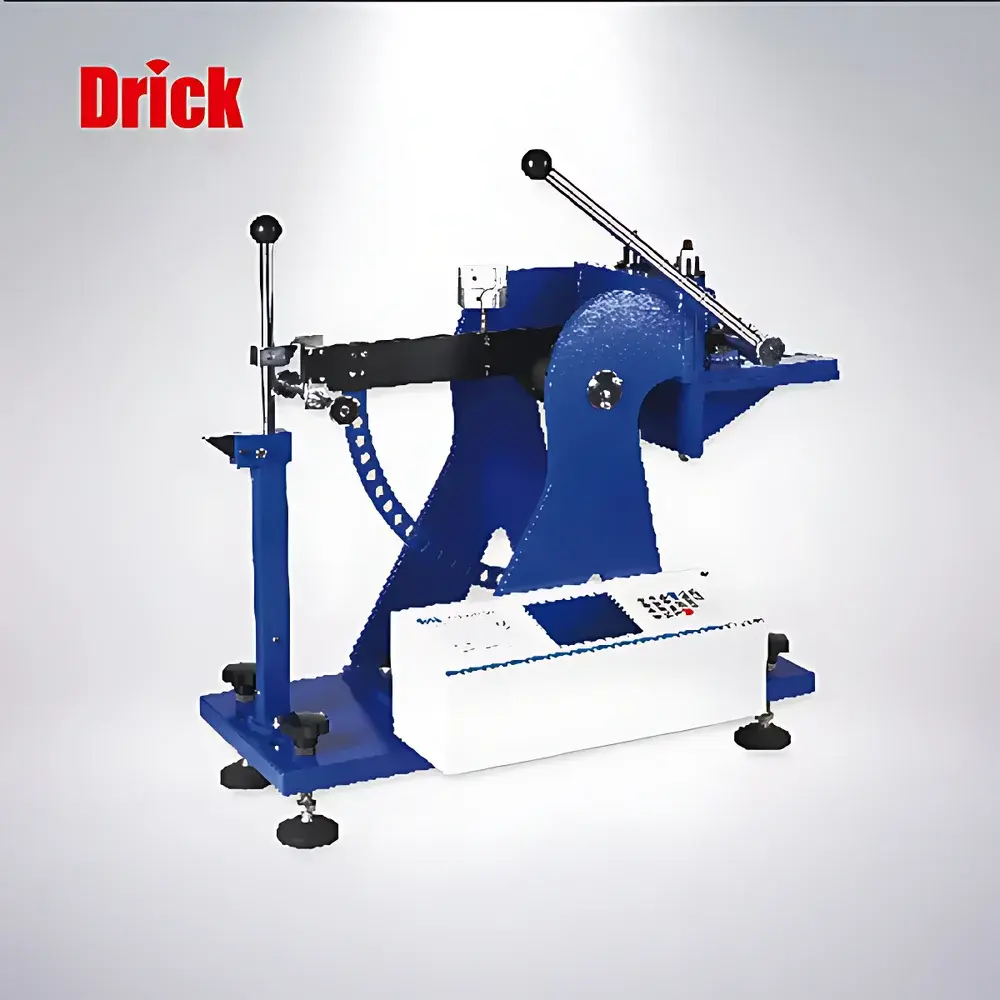
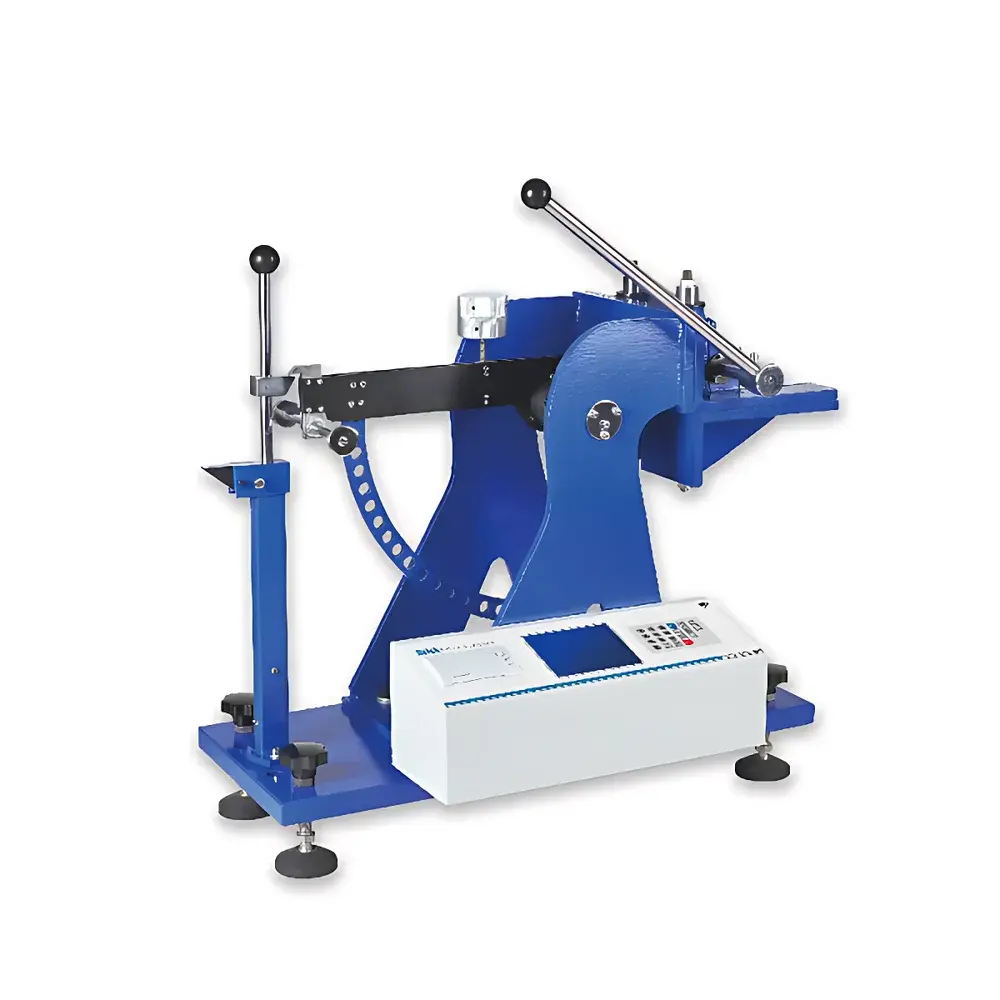
Drick DRK104 Electronic Button-Operated Puncture Strength Tester for Corrugated Board
| Brand | Drick |
|---|---|
| Origin | Shandong, China |
| Manufacturer Type | Manufacturer |
| Country of Origin | China |
| Model | DRK104 |
| Price | Upon Request |
| Measurement Range | 0–48 J (4 ranges: A: 0–6 J, B: 0–12 J, C: 0–24 J, D: 0–48 J) |
| Accuracy (20–80% of full scale per range) | ±0.05 J (A), ±0.10 J (B), ±0.20 J (C), ±0.50 J (D) |
| Friction Loss | ≤0.25 J |
| Punching Probe Geometry | Equilateral triangular pyramid |
| Dimensions (L×W×H) | 800 × 470 × 840 mm |
| Net Weight | 145 kg |
| Operating Environment | 5–35 °C, RH ≤85% |
| Pendulum Swing Frequency | >120 cycles/min |
Overview
The Drick DRK104 Electronic Button-Operated Puncture Strength Tester is a precision mechanical instrument engineered to quantify the energy required to puncture corrugated fiberboard and solid fiberboard specimens using a standardized triangular pyramid probe. It operates on the pendulum impact principle: a calibrated pendulum arm—fitted with an ISO 3036- and GB/T 2679.7-compliant angular cone—is released from a fixed height; upon impact, the probe penetrates the specimen, and the residual swing energy is measured via a calibrated pointer-and-dial system. The difference between initial and residual potential energy corresponds to the puncture energy absorbed by the board, expressed in joules (J). This method directly assesses the combined resistance of the material to localized penetration, tearing, and bending deformation—critical performance indicators for packaging integrity during handling, stacking, and transit. Unlike tensile or compression tests, puncture strength reflects real-world damage mechanisms such as corner impacts or protruding objects contacting cartons. The DRK104 delivers repeatable, traceable results essential for QC laboratories, packaging R&D centers, and third-party testing facilities complying with international regulatory frameworks.
Key Features
- Fully microprocessor-controlled operation with intuitive Chinese-language LCD interface, enabling rapid setup and real-time result display without external software dependency.
- Four-range selectable measurement system (0–6 J, 0–12 J, 0–24 J, 0–48 J), each optimized for accuracy within 20–80% of full-scale deflection per range—ensuring metrological validity across diverse board grades (e.g., single-wall vs. triple-wall corrugated).
- Integrated mechanical safety interlock and automatic handle reset mechanism, preventing unintended release and ensuring operator compliance with ISO 13857 and EN 614-1 machine safeguarding requirements.
- High-stiffness pendulum assembly with low-friction pivot bearings and <0.25 J frictional loss compensation—validated per ISO 3036 Annex B calibration procedures.
- Thermal-line printer with no ink, ribbon, or consumables; supports immediate hardcopy output of test ID, date/time stamp, energy value, and range selection—facilitating GLP-compliant record retention.
- Modular mechanical architecture: quick-release specimen clamping via dual spring-loaded pressure plates (upper/lower), enabling sub-15-second sample changeover and minimizing operator-induced variability.
Sample Compatibility & Compliance
The DRK104 accommodates standard test specimens measuring 175 mm × 175 mm (per GB/T 2679.7 and ISO 3036), suitable for all common corrugated board configurations—including single-, double-, and triple-wall structures—as well as solid bleached sulfate (SBS), chipboard, and laminated fiberboards. Specimen thickness up to 12 mm is supported without modification. The instrument conforms strictly to the geometric and dynamic specifications of ISO 3036:2017 “Paper and board — Determination of puncture resistance” and GB/T 2679.7–2005 “Test methods for paper and board — Puncture strength”. All critical components—including the triangular pyramid probe (equilateral base, 60 mm edges, 25 ± 0.7 mm height, R1.5 ± 0.1 mm edge radius)—are manufactured to dimensional tolerances verified via certified coordinate measuring machine (CMM) reports. Calibration certificates are supplied with each unit, traceable to national standards (CNAS-accredited reference labs).
Software & Data Management
While the DRK104 operates autonomously via embedded firmware, its data output architecture supports audit-ready documentation workflows. Each test generates a timestamped record containing specimen ID, selected range, puncture energy (J), and pass/fail status relative to user-defined thresholds. Printed reports include instrument serial number, calibration due date, and operator ID field—enabling alignment with FDA 21 CFR Part 11 electronic record requirements when paired with secure lab network protocols. Internal memory retains ≥500 test records; data export is supported via RS-232 interface for integration into LIMS or SAP QM modules. Firmware updates are delivered via USB port, with version history and change logs maintained in accordance with IEC 62304 medical device software lifecycle standards—applicable to regulated packaging validation environments.
Applications
This tester serves core quality assurance functions across the packaging supply chain: incoming raw material verification (linerboard, medium, recycled content batches); in-process monitoring of corrugated sheet production lines; final carton qualification for e-commerce fulfillment (ASTM D7379-compliant drop-test correlation studies); and technical service support for packaging engineers optimizing board composition or flute geometry. It is routinely deployed by ISO/IEC 17025-accredited testing labs for CNCA, SGS, and BV certification submissions. Research applications include accelerated aging studies correlating puncture loss with humidity cycling (ISO 187), comparative analysis of bio-based binders versus synthetic adhesives, and finite element model validation of localized failure mechanics.
FAQ
What standards does the DRK104 comply with?
It meets ISO 3036:2017 and GB/T 2679.7–2005 for puncture strength determination, with full traceability to dimensional and energy calibration protocols.
Is probe replacement required periodically?
Yes—the triangular pyramid probe must be inspected before each shift for edge wear or deformation; replacement is recommended after 5,000 tests or if measured radius exceeds R1.6 mm.
Can the DRK104 be integrated into automated production QA systems?
Via RS-232 or optional Ethernet module, it supports Modbus RTU protocol for PLC synchronization and real-time SPC charting in MES environments.
Does the instrument require annual recalibration?
Per ISO/IEC 17025 Clause 6.6, accredited labs must verify energy scale accuracy and friction loss annually using NIST-traceable reference pendulums.
What maintenance is required for long-term stability?
Monthly cleaning of pivot bearings with light mineral oil, biannual torque verification of clamping springs (±5% of nominal 25 N·m), and quarterly inspection of dial pointer zero drift (<0.02 J).







