
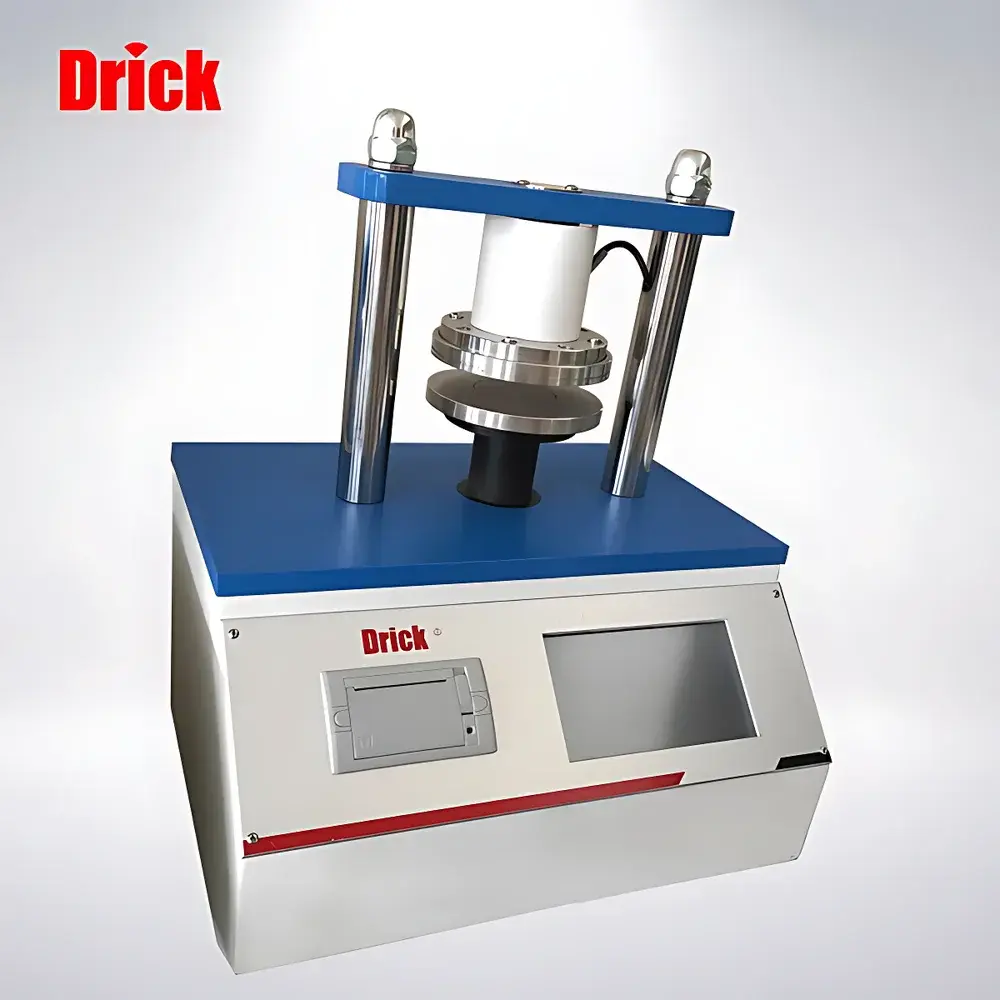
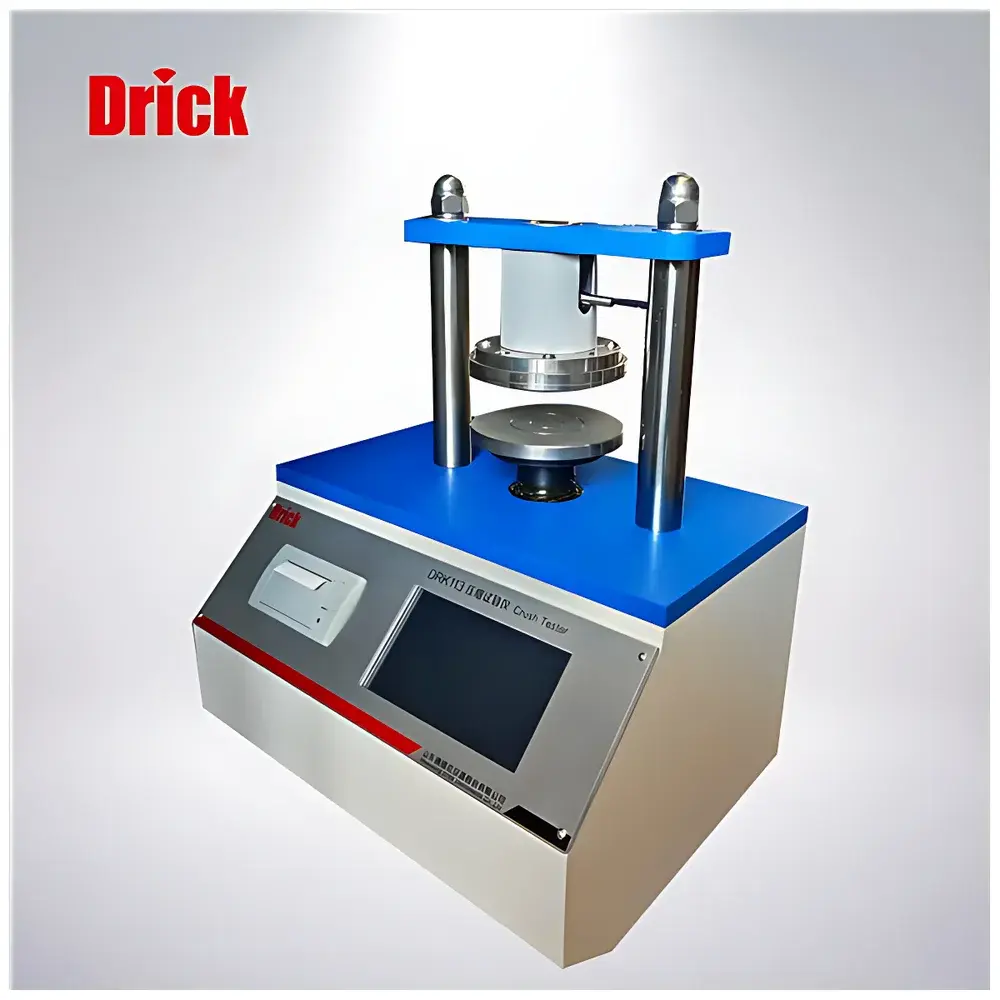
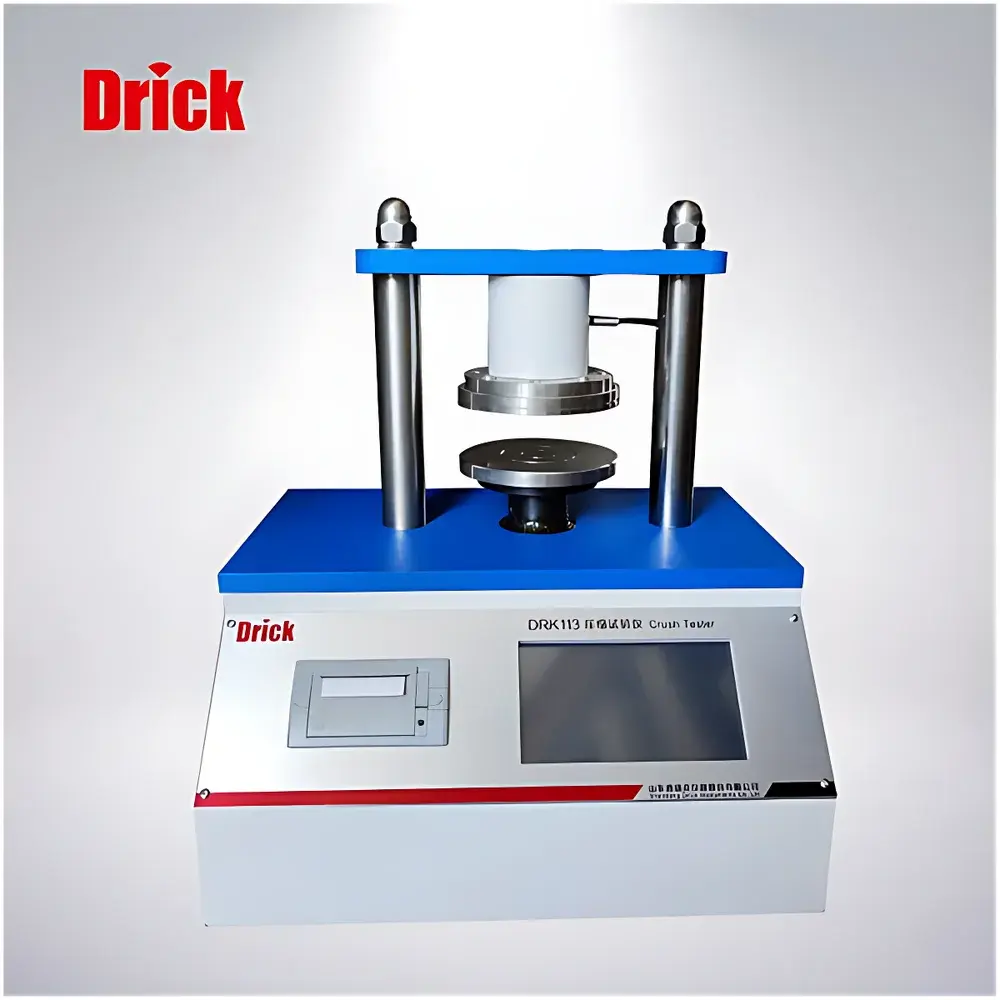
Drick DRK113D Touchscreen Compression Tester (Customizable Configuration)
| Brand | Drick |
|---|---|
| Origin | Shandong, China |
| Manufacturer Type | OEM/ODM Manufacturer |
| Country of Origin | China |
| Model | DRK113D |
| Power Supply | AC 220 V ±10%, 2 A, 50 Hz |
| Load Range | 5–5000 N |
| Load Accuracy | ±1% FS |
| Load Repeatability | <1% FS |
| Resolution | 0.1 N |
| Platen Parallelism | ≤0.05 mm |
| Test Speed | 12.5 ± 2.5 mm/min |
| Compression Platen Diameter | 135 mm |
| Stroke | 1–70 mm |
| Display | Touchscreen LCD with Chinese UI |
| Data Output | Integrated thermal printer (modular design) |
| PC Interface | RS232 or USB (software-supported) |
| Operating Environment | 10–30 °C, RH <85% |
| Dimensions (L×W×H) | 390 × 240 × 540 mm |
| Weight | ~40 kg |
Overview
The Drick DRK113D Touchscreen Compression Tester is an electromechanical precision instrument engineered for standardized and non-standard compressive strength evaluation of thin-fiber packaging materials. It operates on the principle of controlled uniaxial compression between parallel platens, measuring force (N) and displacement (mm) in real time to determine mechanical resistance under quasi-static loading conditions. Designed in strict compliance with international and national standards—including ISO 12192 (RCT), ISO 3037 (ECT), ISO 3035 (FCT), ISO 7263 (CMT), GB/T 2679.8, GB/T 6546, GB/T 6548, and QB/T 1048—the DRK113D delivers traceable, repeatable results essential for quality assurance in paper-based packaging R&D, production control, and third-party certification laboratories. Its embedded ARM-based microcontroller architecture ensures deterministic response timing, while the high-precision load cell (±1% full-scale accuracy, 0.1 N resolution) and rigid platen alignment (≤0.05 mm parallelism) minimize measurement uncertainty across the 5–5000 N dynamic range.
Key Features
- Integrated 7-inch capacitive touchscreen interface with intuitive Chinese-language menu navigation—no external PC required for basic operation
- Fixed upper platen configuration with calibrated S-type load cell for optimal force transmission and minimal lateral error
- Programmable test speed of 12.5 ± 2.5 mm/min, conforming to ISO and GB standard requirements for compression rate consistency
- Real-time dual-axis plotting: simultaneous display of compressive force (N) vs. deformation (mm), enabling immediate identification of peak load, yield point, and collapse behavior
- Modular thermal printer with quick-load paper mechanism—supports on-device result export including date/time stamp, sample ID, and statistical summary
- RS232/USB connectivity for bidirectional communication with Windows-based analysis software (included), supporting raw data export in CSV format and audit-trail-enabled session logging
- Automatic return-to-start positioning post-test; zero-point auto-calibration routine accessible via service menu
Sample Compatibility & Compliance
The DRK113D is validated for testing specimens within defined geometric and material constraints: paper sheets (0.15–1.00 mm thickness) for Ring Crush Test (RCT); corrugated board specimens for Edge Crush Test (ECT), Flat Crush Test (FCT), and Pin Adhesion Test (PAT); and cylindrical cores (diameter <60 mm) for Corrugated Medium Test (CMT). With optional accessories—including ring crush centering disk, RCT sampling cutter, ECT guide block, and PAT peel fixture—the system extends to specialized configurations per ISO 12192 Annex B, TAPPI T818, and ASTM D642/D7253 protocols. All mechanical and electronic subsystems are constructed to meet IEC 61000-4 electromagnetic compatibility requirements and comply with CE marking directives for laboratory equipment safety (EN 61010-1). The instrument supports GLP-compliant workflows through timestamped test records, operator ID tagging, and immutable data archiving in software mode.
Software & Data Management
The included PC software provides full lifecycle data management: test method configuration (predefined templates for RCT/ECT/FCT/CMT), real-time curve overlay, statistical analysis (mean, SD, CV%, min/max), and customizable report generation (PDF/Excel). Audit trails record all user actions—including parameter changes, calibration events, and result modifications—with digital signature support where required. Raw force-displacement datasets are stored with metadata (test ID, environmental conditions, operator, instrument serial number), ensuring full traceability for FDA 21 CFR Part 11–aligned environments when paired with appropriate IT infrastructure controls. Data encryption and role-based access control (administrator/operator) are configurable at deployment.
Applications
This tester serves as a core metrology platform in packaging QA/QC labs evaluating structural integrity of fiber-based containers. Primary use cases include: incoming inspection of linerboard and medium for corrugator operations; in-process validation of converted boxes prior to shipping; shelf-life stability assessment of cup/bowl sidewall rigidity; comparative analysis of adhesive bond strength in multi-ply laminates; and regulatory submission testing for ISTA 3A/6AM-compliant packaging systems. Its modular adaptability also supports research into honeycomb board crush resistance, molded pulp container energy absorption profiles, and biodegradable film-backed composite stiffness degradation under humidity cycling—when used with custom platens and environmental enclosures.
FAQ
Does the DRK113D support automated pass/fail judgment against user-defined limits?
Yes—threshold-based logic can be configured per test method to trigger visual alerts and flag outliers during acquisition.
Can the instrument be recalibrated in-house without sending it to the manufacturer?
Field calibration is supported using NIST-traceable deadweight standards; procedure documentation and verification templates are provided in the service manual.
Is firmware upgrade capability available over USB or network connection?
Firmware updates are delivered via USB flash drive; no remote network access is implemented to maintain air-gapped security in regulated labs.
What is the maximum allowable specimen height for FCT testing with standard platens?
The effective stroke of 70 mm permits specimen heights up to 65 mm (accounting for pre-load engagement and safety margin).
Are test reports generated by the software compliant with ISO/IEC 17025 documentation requirements?
Yes—reports include instrument identification, calibration status, environmental monitoring logs, uncertainty statements, and analyst signatures, satisfying Clause 7.8.2 of ISO/IEC 17025:2017.
Related Products







