
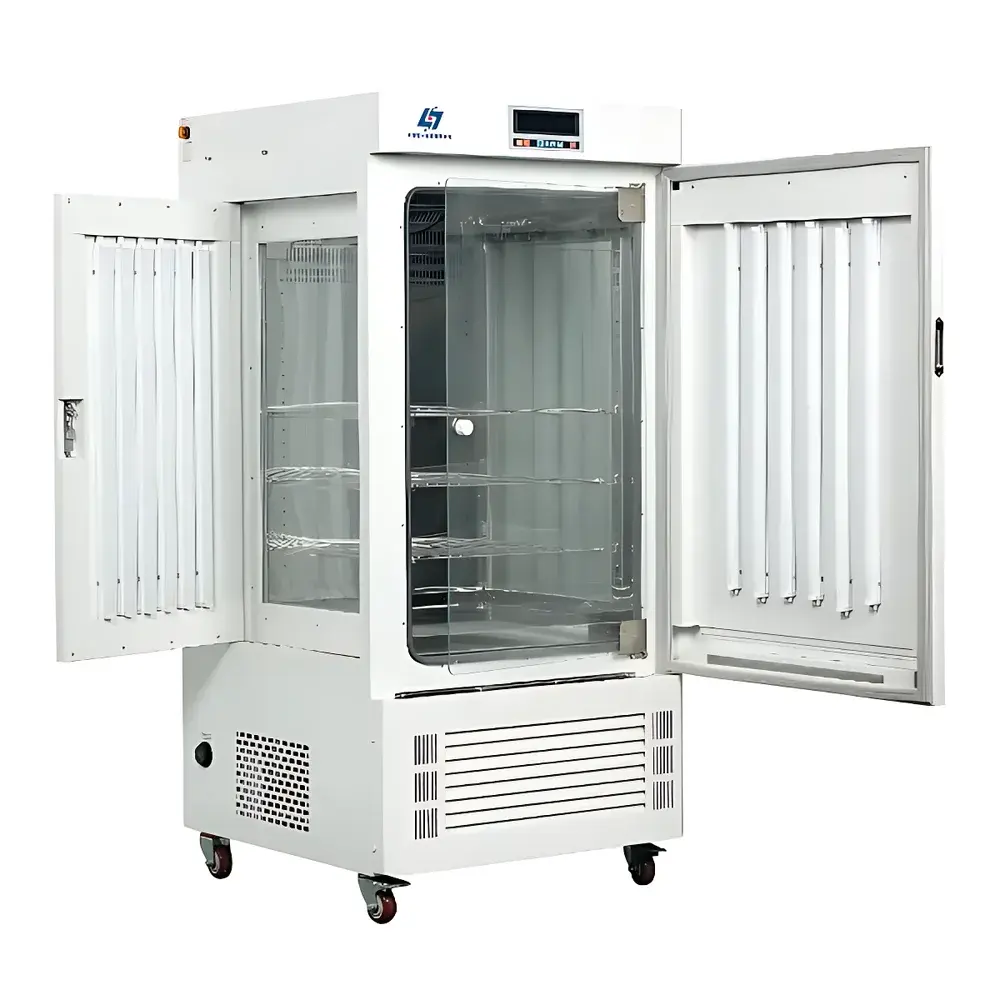
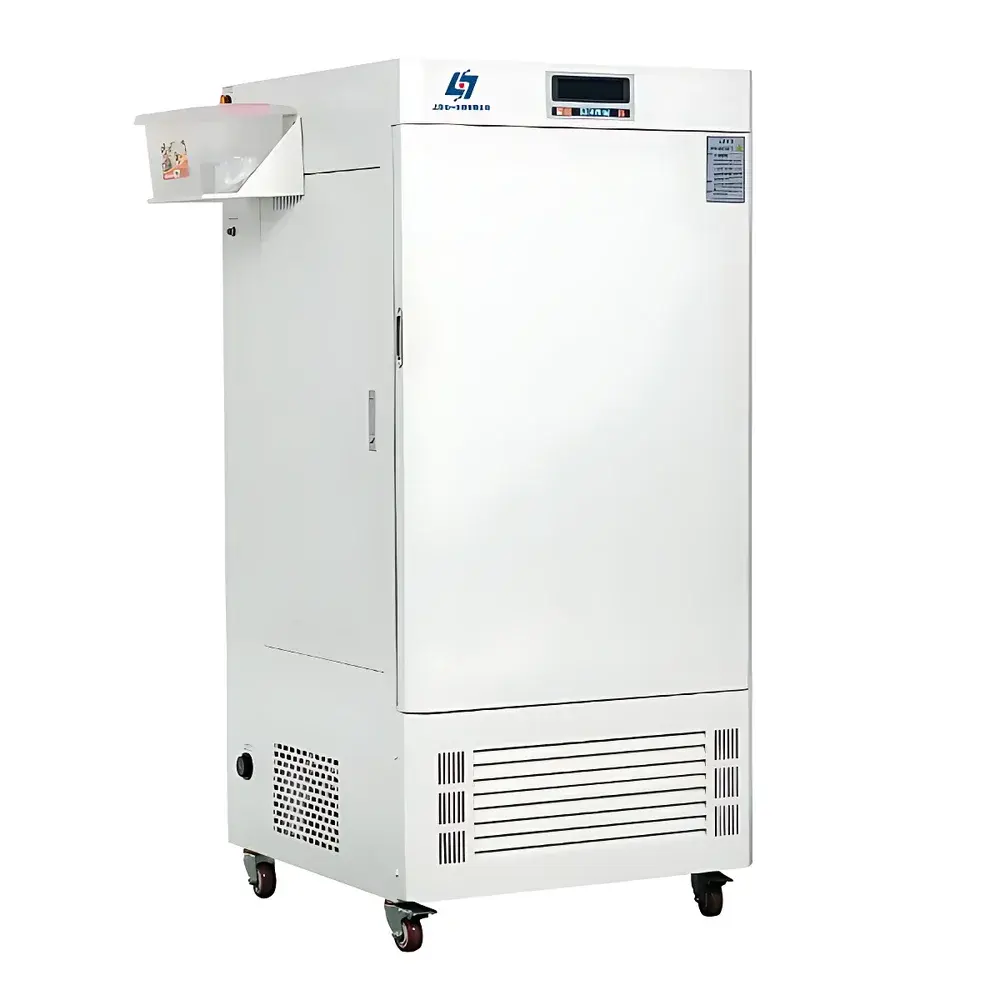
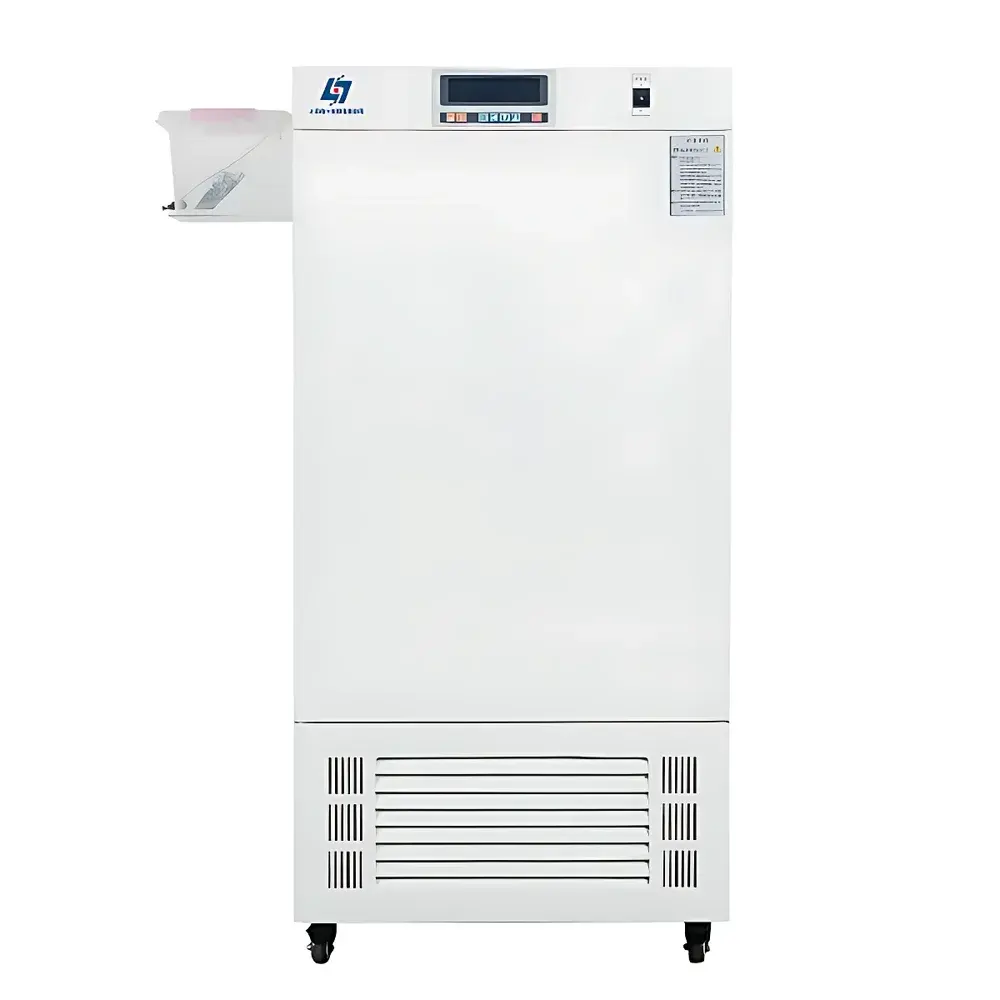
Yoyi MGC-400 Plant Growth Chamber
| Brand | Yoyi |
|---|---|
| Origin | Shanghai, China |
| Manufacturer Type | Direct Manufacturer |
| Model | MGC-400 |
| Illumination Method | Triple-Side LED Lighting |
| Light Source | High-Efficiency White LED Arrays |
| Spectral Range | Visible Spectrum (400–700 nm) |
| Temperature Control Range | 10–50°C (with illumination), 4–50°C (dark mode) |
| Temperature Uniformity | ±1°C |
| Light Intensity Adjustment | 6-Step Digital Dimming (0–25,000 lux) |
| Chamber Capacity | 400 L |
| External Dimensions (W×D×H) | 880 × 780 × 1810 mm |
| Refrigerant | R134a/R406a (CFC-Free) |
| Power Supply | AC 220 V, 50 Hz |
| Input Power | 2500 W |
| Working Environment | 5–30°C ambient, ≤80% RH |
Overview
The Yoyi MGC-400 Plant Growth Chamber is an engineered environmental simulation system designed for reproducible, long-term plant physiology studies, seed germination assays, photobiological research, and controlled-environment cultivation of model organisms. It operates on a dual-mode thermoregulation principle—integrating precision PID-controlled refrigeration and resistive heating with synchronized light–temperature coupling—to maintain stable setpoints across diurnal cycles. Unlike standard incubators, the MGC-400 implements active climate emulation: temperature profiles can be programmed independently for light and dark phases, enabling simulation of natural day/night transitions critical for circadian rhythm studies, stress acclimation experiments, and phenotyping workflows. Its triple-side LED illumination architecture ensures uniform photon flux distribution across the full working volume, minimizing spatial gradients in photosynthetically active radiation (PAR) and eliminating shadow zones commonly observed in single- or dual-source configurations.
Key Features
- Triple-side high-output white LED arrays delivering up to 25,000 lux at chamber floor level, calibrated within the visible spectrum (400–700 nm) to support broad-spectrum photomorphogenesis studies.
- Dual-mode temperature control: optimized cooling range (4–50°C in darkness) and extended operational band (10–50°C under illumination), enabled by R134a/R406a eco-friendly refrigerant and high-efficiency compressors with intelligent duty-cycle management.
- Microprocessor-based PID controller with 0.1°C temperature resolution, supporting up to 99 programmable cycles, each containing 30 segments with individual time (up to 99 h 59 min) and parameter settings.
- Robust air circulation system featuring JAKEL centrifugal fans and engineered airflow ducting, achieving ±1°C temperature uniformity (measured per ASTM E1545-20) across the entire 400 L working chamber.
- Double-glazed insulated door with low-emissivity coating and magnetic seal, preserving thermal integrity during observation without compromising internal stability.
- Electropolished mirror-finish stainless steel interior (AISI 304), radius-cornered design for seamless cleaning, and adjustable shelf spacing accommodating diverse sample containers—from Petri dishes to multi-tier growth trays.
Sample Compatibility & Compliance
The MGC-400 accommodates a wide range of biological specimens: Arabidopsis thaliana seedlings, rice callus cultures, fungal hyphal plates, Drosophila vials, small rodent behavioral enclosures (with optional ventilation kits), and tissue culture flasks. Its chamber geometry (680 × 550 × 1050 mm internal) supports ISO-standard stacking protocols and permits integration with external CO₂ supply lines (optional port). The unit complies with IEC 61000-6-3 (EMC emissions), IEC 61000-6-2 (immunity), and meets structural safety requirements per GB 4793.1–2007 (equivalent to IEC 61010-1). While not certified for GMP manufacturing environments, its data logging capability (via RS485/USB) supports GLP-aligned recordkeeping when paired with validated third-party software.
Software & Data Management
The embedded controller provides local real-time monitoring via a 5.7-inch backlit LCD interface with intuitive menu navigation. Optional connectivity modules enable traceable data acquisition: RS485 output supports Modbus RTU protocol for integration into LabArchives, DeltaV, or custom SCADA systems; USB port allows direct export of timestamped CSV logs (temperature, light intensity, cycle stage) to external storage. When configured with the optional embedded printer, hard-copy audit trails meet basic FDA 21 CFR Part 11 documentation expectations for non-clinical research. All firmware updates are performed offline via secure USB load, ensuring system integrity during validation periods.
Applications
- Photoperiodic response characterization in crop species under controlled PAR and temperature regimes.
- Long-duration stress assays (e.g., heat/drought priming) requiring uninterrupted operation beyond 360 hours.
- Standardized seed germination testing per ISTA and AOSA guidelines.
- Algal biomass production optimization using spectral tuning and diurnal cycling.
- Preclinical behavioral phenotyping of zebrafish or Drosophila under reproducible lighting conditions.
- Cell line expansion under defined light exposure (e.g., optogenetics prep cultures).
FAQ
What is the maximum PAR irradiance achievable inside the chamber?
The MGC-400 delivers up to 25,000 lux (approximately 400–500 µmol/m²/s PAR, depending on sensor calibration), measured at the center of the lowest shelf under full illumination.
Can temperature and light programs run asynchronously?
Yes—the controller allows independent scheduling of temperature setpoints and light intensity levels per time segment, enabling complex diel simulations such as ramped dawn/dusk transitions.
Is remote monitoring supported out-of-the-box?
No native Ethernet or Wi-Fi interface is included; however, the RS485 port enables integration with industrial gateways for networked supervision.
What safety mechanisms prevent thermal runaway during extended runs?
An independent mechanical overtemperature cutoff (optional accessory) interrupts power if chamber temperature exceeds user-defined limits, accompanied by audible/visual alarms compliant with IEC 60204-1.
Are calibration certificates provided with shipment?
Factory calibration reports (temperature uniformity, light intensity linearity) are available upon request; NIST-traceable field calibration services are offered separately.





