
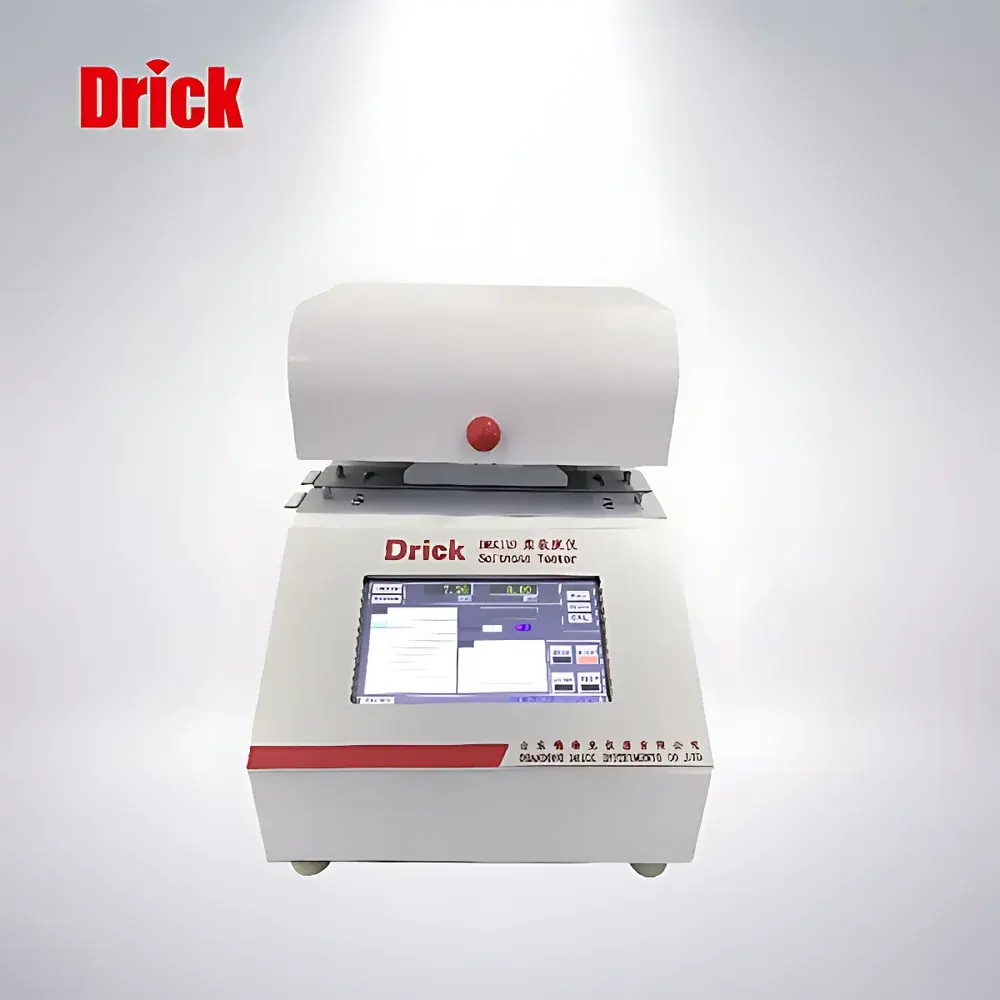
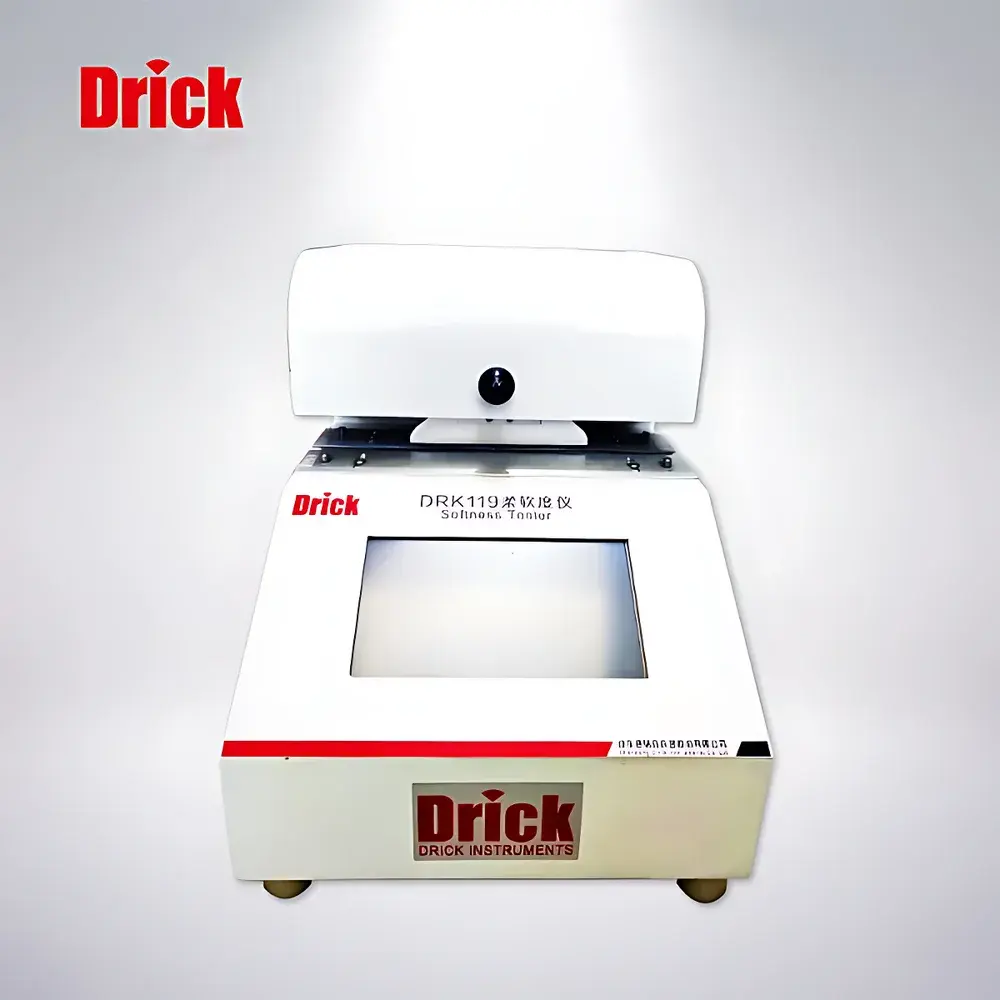
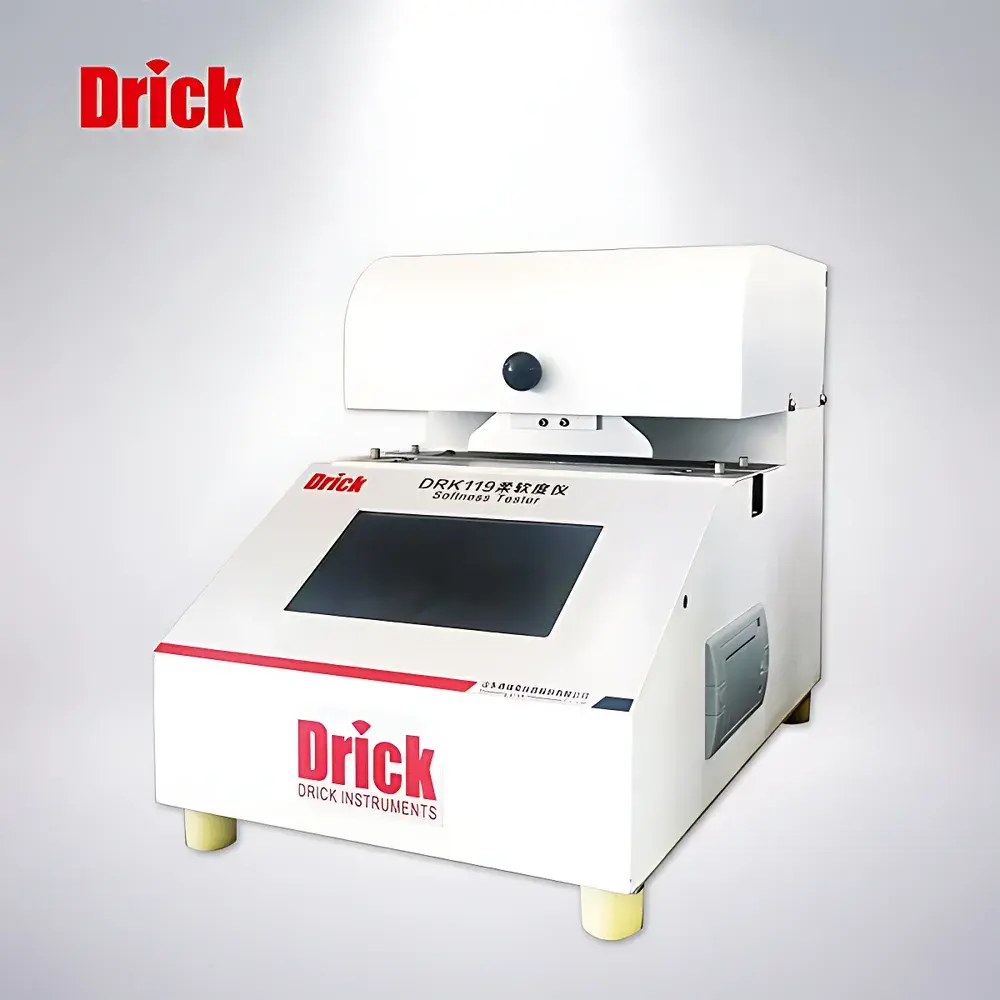
Drick DRK119 Touchscreen Color Display Softness Tester
| Brand | Drick |
|---|---|
| Origin | Shandong, China |
| Manufacturer Type | Manufacturer |
| Country of Origin | China |
| Model | DRK119 |
| Price | USD 7,000 (FOB Qingdao) |
| Force Resolution | 1/200,000 (7-digit display including decimal) |
| Force Accuracy | ±0.3% FS |
| Sampling Rate | 200 Hz |
| LCD Lifespan | ~100,000 hours |
| Touch Panel Durability | ~50,000 actuations |
| Data Storage Capacity | 511 batches × 10 tests/batch |
| Test Mode | Softness Determination per GB/T 8942–2016 |
| Compliance | GB/T 8942–2016 “Paper — Determination of Softness” |
Overview
The Drick DRK119 Touchscreen Color Display Softness Tester is a dedicated mechanical testing instrument engineered for objective, repeatable quantification of softness in flexible sheet materials—primarily paper, tissue, nonwovens, and thin packaging substrates. It operates on the principle of controlled bending resistance measurement: a standardized specimen is clamped horizontally, and a calibrated probe applies a precisely defined angular displacement at a fixed rate while measuring the resulting resisting torque or force. This mechanical response—expressed in millinewton-meters (mN·m) or gram-force centimeters (gf·cm)—correlates directly with perceived tactile softness, enabling quality control labs to replace subjective panel evaluation with traceable, instrument-based metrics. Built around an ARM-based embedded architecture, the DRK119 eliminates reliance on external PCs, ensuring deterministic real-time control, minimal latency, and immunity to OS-level instability. Its core signal chain integrates high-stability analog amplifiers and 24-bit A/D converters, delivering true 7-digit resolution (including decimal places) and certified force accuracy of ±0.3% full scale—critical for detecting subtle batch-to-batch variations in premium tissue or hygiene product manufacturing.
Key Features
- Industrial-grade 800 × 480 TFT color touchscreen with capacitive touch interface—optimized for gloved operation in production environments and validated for ≥50,000 actuations.
- Self-contained embedded control system eliminating PC dependency; supports standalone operation with no driver installation or software licensing.
- Dual-layer protection architecture: hardware interlocks prevent over-travel or overload damage, while firmware-level error trapping ensures graceful fault recovery without system crash.
- High-fidelity data acquisition at 200 Hz sampling rate—sufficient to capture transient force peaks during initial probe contact and dynamic bending phases.
- On-device data management: stores up to 511 test batches, each containing 10 individual measurements; all records include timestamp, operator ID (optional), and environmental metadata (if integrated with optional ambient sensor module).
- Compliance-ready configuration: preloaded test method template aligned with GB/T 8942–2016, supporting automatic calculation of mean softness value, standard deviation, and coefficient of variation (CV%) per batch.
Sample Compatibility & Compliance
The DRK119 is designed for specimens conforming to GB/T 8942–2016 geometry requirements: rectangular strips measuring 25 mm × 100 mm, conditioned at 23 °C ± 1 °C and 50% ± 2% RH per ISO 187. It accommodates grammage ranges from 10 g/m² (lightweight facial tissue) to 300 g/m² (heavy-duty industrial wiping cloth). While GB/T 8942–2016 is its primary reference standard, the instrument’s open calibration architecture allows adaptation to other national or internal specifications—including TAPPI T 556 (bending resistance), ISO 2431 (tissue softness), or custom OEM protocols—via parameter reconfiguration. All force transducers are factory-calibrated against NIST-traceable deadweight standards, and calibration certificates include uncertainty budgets compliant with ISO/IEC 17025 requirements. The device meets electromagnetic compatibility (EMC) Class B limits per GB/T 18268.1–2010 and electrical safety requirements per GB 4793.1–2007.
Software & Data Management
Data export is supported via USB 2.0 port in CSV format—structured for direct import into LIMS, SAP QM, or statistical process control (SPC) platforms such as Minitab or JMP. No proprietary software is required for data retrieval or report generation. Audit trail functionality logs all critical events—including calibration actions, method modifications, and user logins—with immutable timestamps. While not FDA 21 CFR Part 11–certified out-of-the-box, the firmware architecture supports electronic signature implementation and role-based access control (RBAC) when deployed within validated laboratory IT infrastructure. Firmware updates are delivered via signed binary packages verified using SHA-256 checksums, ensuring integrity and authenticity.
Applications
- Quality assurance of consumer tissue products (facial, bathroom, kitchen) across production shifts.
- Supplier qualification for nonwoven wipes used in medical device packaging or cleanroom applications.
- R&D screening of fiber blend formulations, creping patterns, or chemical softener efficacy.
- Process validation of converting lines where calendering, embossing, or laminating steps impact final hand-feel.
- Regulatory documentation support for ISO 9001, ISO 13485, or IATF 16949 audits requiring objective softness evidence.
FAQ
Does the DRK119 comply with international standards beyond GB/T 8942–2016?
Yes—the mechanical design and measurement algorithm are compatible with TAPPI T 556 and ISO 2431 methodologies; method parameters can be adjusted to match those standards’ probe geometry, speed, and deflection criteria.
Is remote diagnostics or firmware update possible over Ethernet or Wi-Fi?
No—this model relies exclusively on local USB-based firmware updates and does not include network connectivity hardware to maintain determinism and cybersecurity isolation.
What maintenance is required to sustain measurement accuracy?
Annual recalibration against traceable standards is recommended; routine verification using certified check weights should be performed daily or per shift in regulated environments.
Can test results be exported in PDF format with company branding?
Raw CSV export is native; branded PDF reporting requires integration with third-party tools (e.g., Python pandas + ReportLab or LabVIEW Report Generation Toolkit).
Is the instrument suitable for testing laminated or coated packaging films?
It is validated for homogeneous, flexible sheets up to 0.5 mm thickness; multilayer composites with significant interfacial slip may yield non-representative values and require method validation per ASTM D882 Annex A4.
Related Products






