
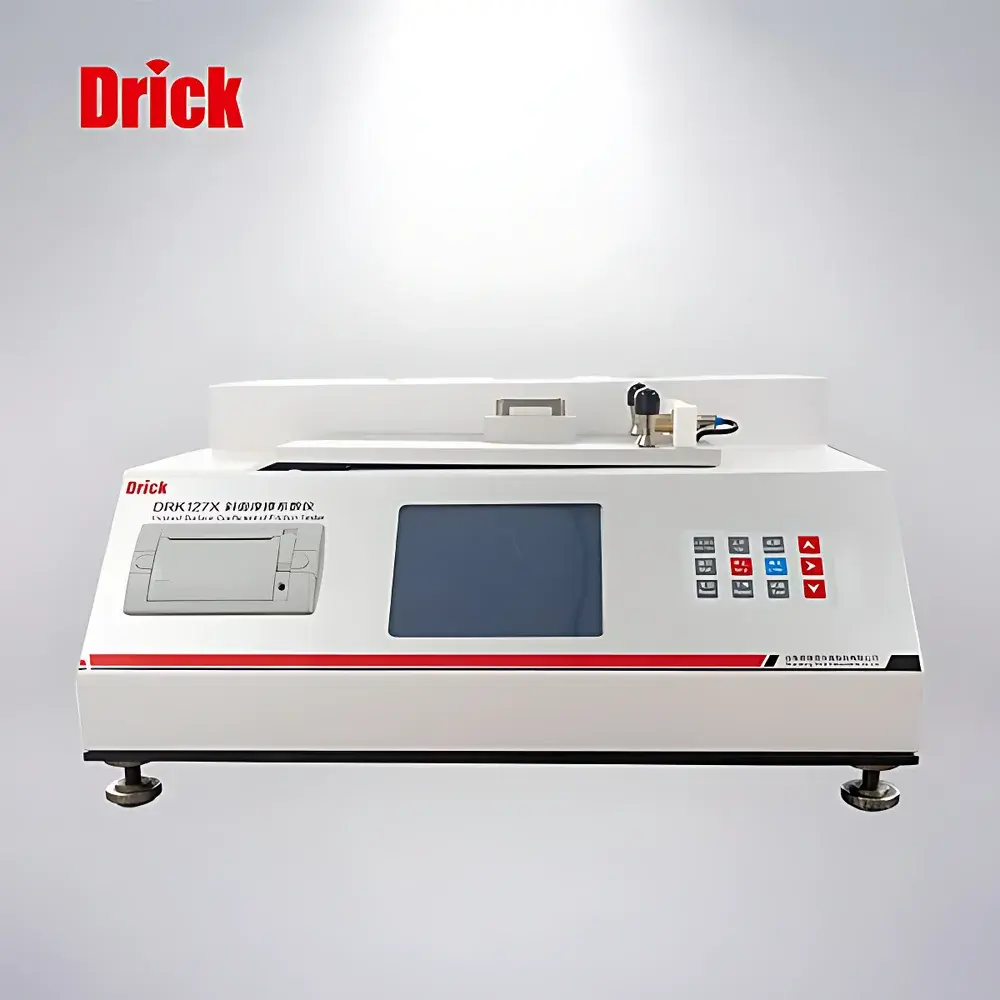
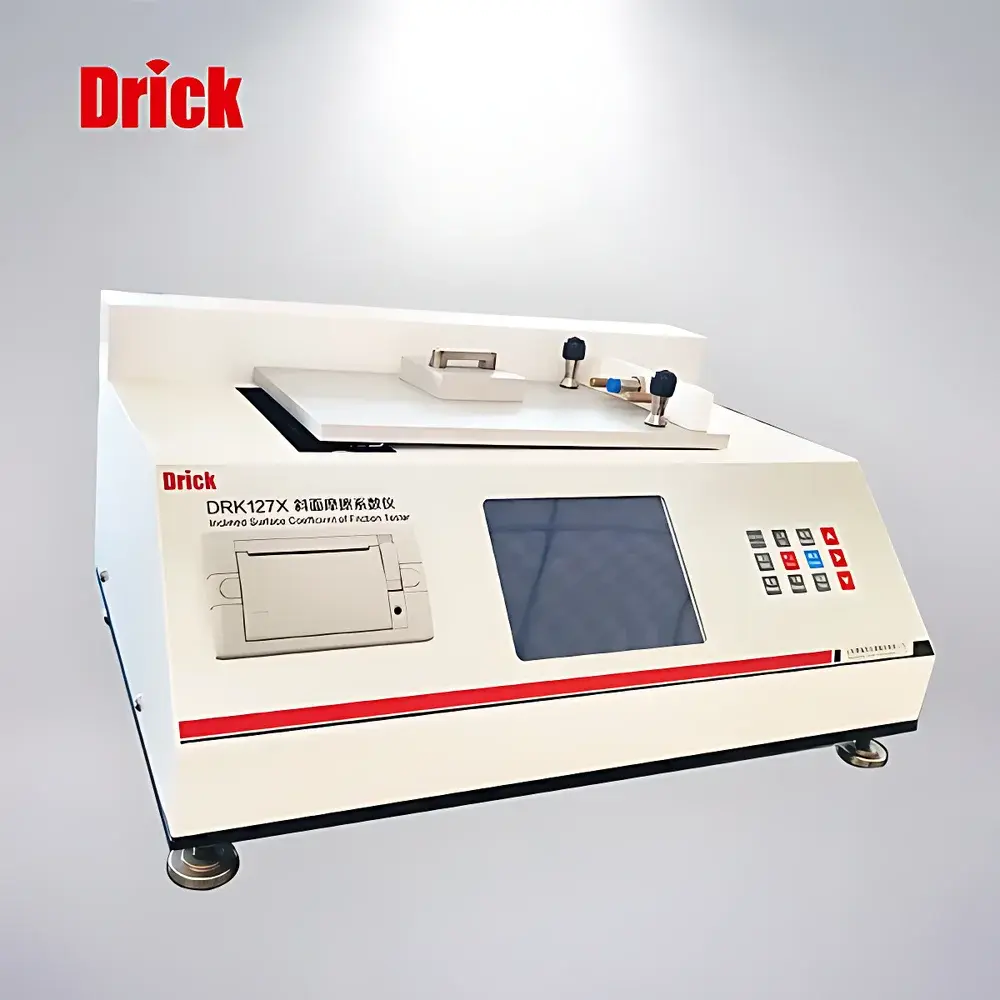
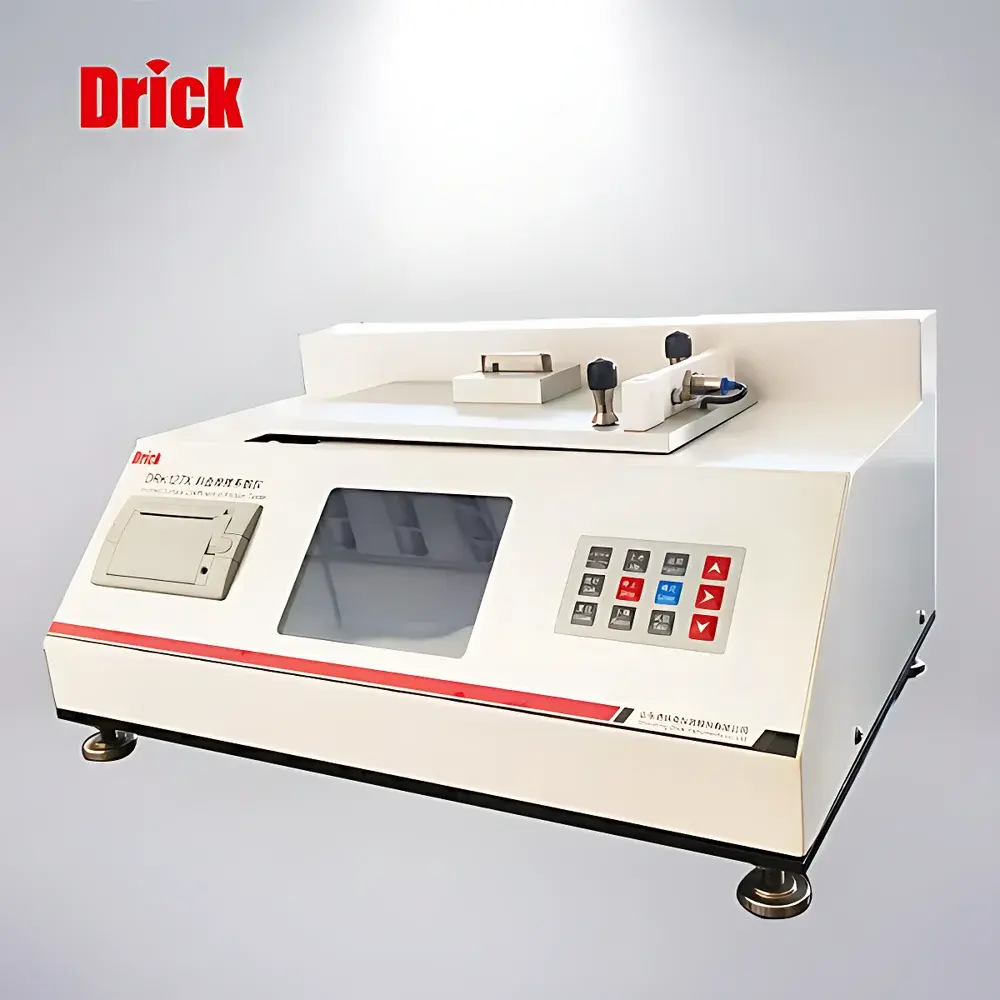
Drick DRK127x Inclined-Plane Coefficient of Friction Tester for Pharmaceutical and Food Packaging Laminates
| Brand | Drick |
|---|---|
| Origin | Shandong, China |
| Manufacturer Type | Direct Manufacturer |
| Country of Origin | China |
| Model | DRK 127x |
| Angle Range | 0°–85° |
| Angular Resolution | 0.01° |
| Angular Speed | 0.1°/s – 10.0°/s |
| Temperature Control Requirement | 23 ± 2 °C |
| Relative Humidity Range | 20–70 %RH |
| Dimensions (L×W×H) | 470 × 320 × 240 mm |
| Power Supply | AC 220 V, 50 Hz |
| Net Weight | 25 kg |
| Standard Slider Mass | 1300 g |
| Optional Sliders | 235 g, 200 g, custom sliders |
Overview
The Drick DRK127x Inclined-Plane Coefficient of Friction Tester is a precision-engineered instrument designed specifically for evaluating the static and kinetic coefficients of friction (COF) of flexible packaging materials used in pharmaceutical and food applications. It operates on the classical inclined-plane principle: a standardized slider is placed atop a conditioned test specimen mounted on a motorized, programmable tilt platform; the angle at which the slider begins to slide (static COF) or maintains uniform motion (kinetic COF) is measured with high angular resolution. This gravimetric method provides traceable, reproducible results aligned with internationally recognized physical testing conventions. Unlike horizontal pull-type testers, the inclined-plane configuration eliminates reliance on force transducers subject to mechanical hysteresis and cable alignment errors—making it especially suitable for quality control laboratories requiring robust, low-maintenance instrumentation compliant with routine GMP-aligned workflows.
Key Features
- Motor-driven, microprocessor-controlled tilt mechanism with programmable angular speed (0.1°/s to 10.0°/s) and fine angular resolution (0.01°), enabling precise determination of both static and kinetic friction thresholds.
- Dual-conditioned test surface: the inclined platform and stainless-steel slider base are surface-treated to minimize parasitic adhesion and ensure consistent contact geometry across repeated measurements.
- Integrated LCD interface with PVC membrane keypad allows standalone operation—no external PC required for basic test execution, data display, or real-time angle readout.
- Open-frame mechanical architecture facilitates rapid specimen loading, visual alignment verification, and cleaning between tests—critical for multi-material validation protocols involving PE, PP, PET, aluminum-laminated paperboard, and co-extruded films.
- Standard 1300 g slider complies with ASTM D202 and TAPPI T815 requirements for rigid substrate evaluation; optional 200 g and 235 g sliders support lighter-weight films and regulatory-compliant method adaptation per USP & ISO 8297-2.
- Onboard thermal and humidity monitoring inputs (optional integration) support environmental correlation logging, aligning test records with ISO 291 and ASTM E171 conditioning mandates.
Sample Compatibility & Compliance
The DRK127x accommodates flat, flexible specimens up to 150 mm × 150 mm—including monolayer and multilayer coextruded films (e.g., PET/PE, OPP/CPP), metallized laminates, wax-coated paperboards, and foil-backed blister packaging substrates. Its design conforms to the geometric and procedural constraints defined in ASTM D202 (Standard Test Methods for Coefficient of Friction of Paper and Paperboard), ASTM D4918 (Standard Practice for Measuring Coefficient of Friction of Plastic Film and Sheeting), and TAPPI T815 (Coefficient of Friction of Paper and Paperboard). When operated within specified ambient conditions (23 ± 2 °C, 20–70 %RH), test data meet documentation requirements for internal QC release, supplier qualification audits, and regulatory submissions under ICH Q5E and FDA 21 CFR Part 211 Subpart F (Laboratory Controls).
Software & Data Management
While fully functional as a stand-alone unit, the DRK127x supports optional RS232 or USB-to-serial connectivity for integration with laboratory information management systems (LIMS) or validated Excel-based data capture templates. All angle values, start/stop timestamps, and slider mass identifiers are logged with ISO/IEC 17025-compliant metadata tagging (operator ID, date/time, environmental readings if sensor-equipped). The built-in thermal printer outputs time-stamped, tamper-evident hardcopy reports—including calculated COF values (μs, μk), raw angle data, and pass/fail status against user-defined specification limits. Audit trail functionality satisfies GLP and GMP documentation expectations for traceability and reviewer accountability.
Applications
This instrument is routinely deployed in packaging development labs to optimize film formulation (e.g., slip additive concentration in LDPE), validate laminating process stability, and troubleshoot high-speed form-fill-seal (FFS) line jams caused by excessive interlayer drag. It supports comparative analysis of batch-to-batch consistency for sterilizable pouches (ISO 11607-1), child-resistant blister cards (ASTM D3475), and peelable medical device packaging (ISO 8536-4). In R&D contexts, it enables structure-property correlation studies linking surface energy (via contact angle), topography (AFM), and macroscopic friction behavior—providing foundational input for finite element modeling of web handling dynamics.
FAQ
What standards does the DRK127x comply with for pharmaceutical packaging validation?
It meets the test methodology requirements of ASTM D202, ASTM D4918, and TAPPI T815—widely accepted for COF assessment in regulated packaging environments. When paired with documented environmental controls and calibrated sliders, data are admissible in FDA pre-submission reviews.
Can the instrument differentiate between static and kinetic friction without operator intervention?
Yes. The microcontroller detects the onset of motion via real-time angular acceleration profiling and automatically records both the limiting static angle and the stabilized kinetic sliding angle during a single continuous ramp cycle.
Is calibration traceable to national metrology institutes?
Angular calibration uses NIST-traceable inclinometer standards; mass calibration of sliders follows ISO/IEC 17025-accredited procedures using Class M1 weights. Certificate of Conformance includes uncertainty budgets per ISO/IEC 17025 Clause 6.5.
How often should the slider and platform surfaces be cleaned or reconditioned?
A light ethanol wipe is recommended before each test series. Surface treatment integrity is verified quarterly using reference polyethylene film with certified COF values (±0.02 tolerance); replacement parts are available under Drick’s OEM service program.
Does the system support 21 CFR Part 11 compliance for electronic records?
The base model does not include electronic signature or audit trail software; however, its ASCII data export protocol enables integration with validated third-party LIMS platforms that provide full Part 11 functionality—including role-based access, electronic signatures, and immutable record archiving.





