
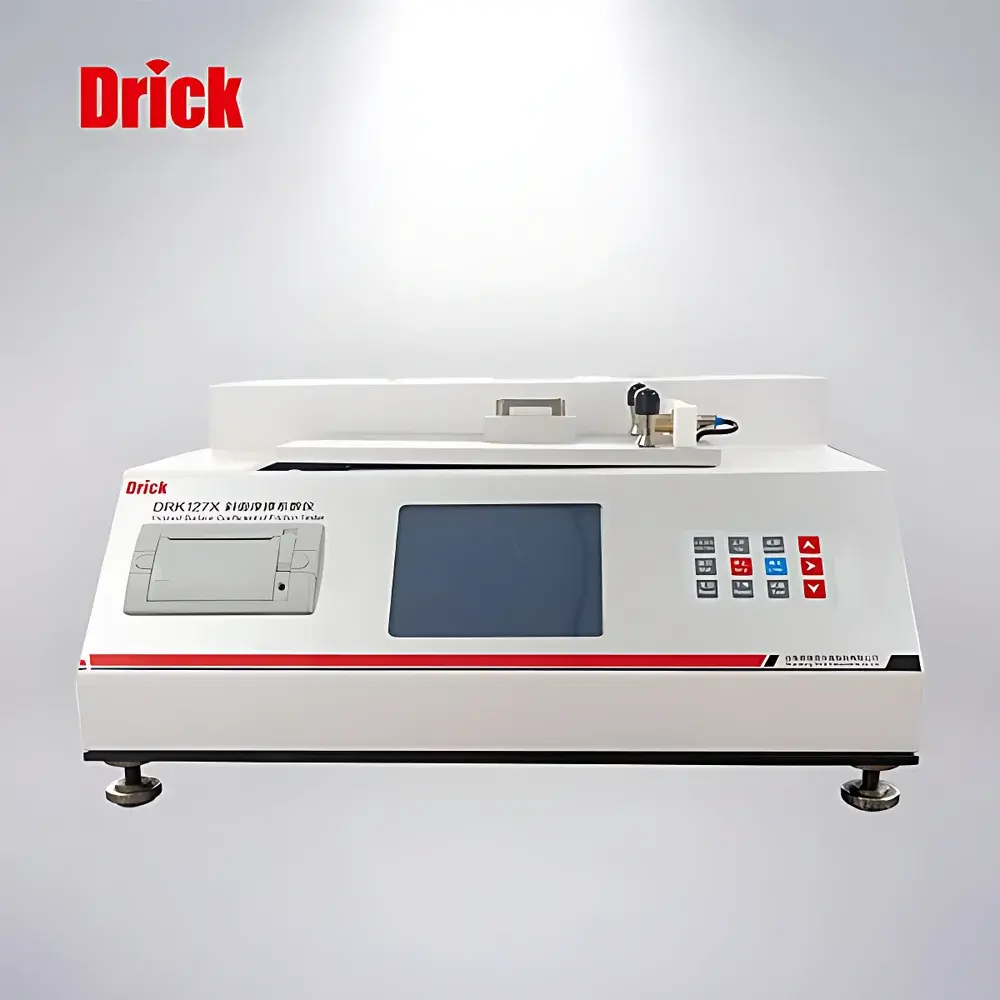
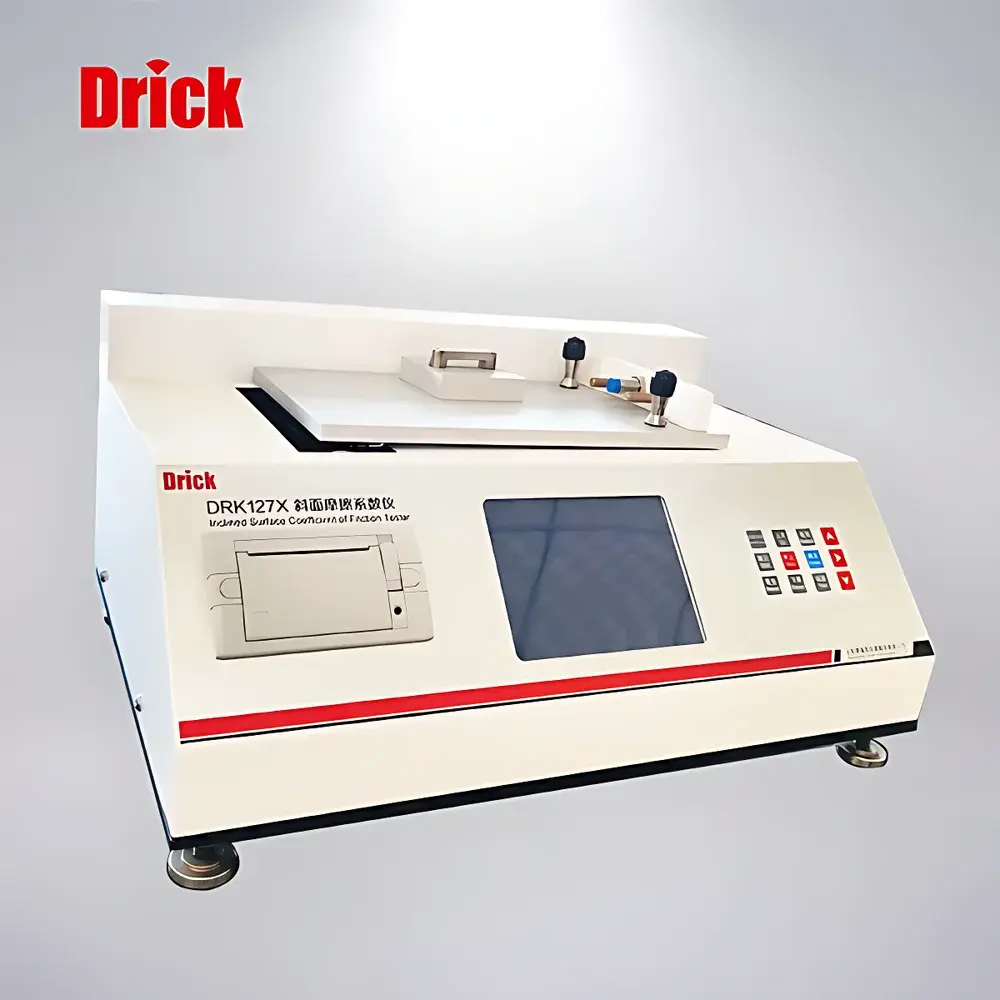
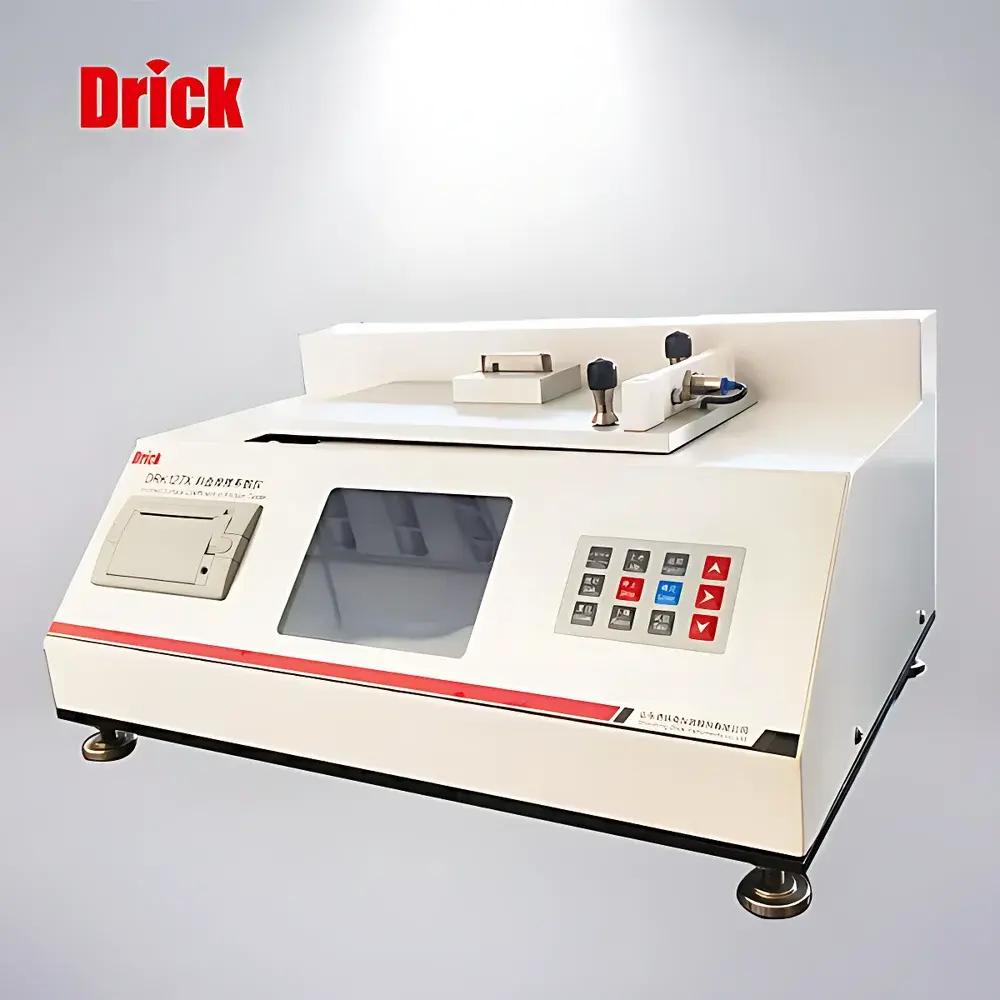
Drick DRK127X Inclined-Plane Static Coefficient of Friction Tester for Paper, Paperboard & Flexible Packaging Films
| Brand | Drick |
|---|---|
| Origin | Shandong, China |
| Manufacturer Type | Direct Manufacturer |
| Region of Origin | Domestic (China) |
| Model | DRK127X |
| Angle Range | 0°–85° |
| Angular Resolution | 0.01° |
| Angular Speed | 0.1°/s – 10.0°/s |
| Operating Environment | 23 ± 2 °C, 20–70 %RH |
| Dimensions (L×W×H) | 470 × 320 × 240 mm |
| Power Supply | AC 220 V, 50 Hz |
| Net Weight | 25 kg |
| Standard Accessories | Main Unit, Thermal Micro Printer, 1300 g Test Slider |
Overview
The Drick DRK127X Inclined-Plane Static Coefficient of Friction Tester is a precision-engineered laboratory instrument designed to quantify the static coefficient of friction (COF) of planar flexible materials under controlled gravitational loading conditions. It operates on the classical inclined-plane method defined in ASTM D1894, ASTM D202, ASTM D4918, and TAPPI T815—standards widely adopted in packaging R&D, quality control, and regulatory compliance workflows. Unlike horizontal pull-type COF testers, the DRK127X measures the critical angle at which a standardized slider begins to slip relative to the test specimen mounted on a motorized, programmable incline surface. This angle (θ) is directly converted to the static COF value using the relationship μs = tan(θ), ensuring traceable, geometry-based measurement without reliance on force transducer calibration drift. The system is specifically optimized for low-stiffness, high-surface-area substrates common in packaging—including uncoated and coated papers, corrugated board, plastic films (PE, PP, PET), laminates, and printed composites—where surface topography, coating uniformity, and additive migration significantly influence handling behavior on high-speed converting and filling lines.
Key Features
- Motor-driven precision incline mechanism with angular resolution of 0.01° and programmable ramp rates from 0.1°/s to 10.0°/s, enabling repeatable acceleration profiles for sensitivity analysis across material batches.
- Dual-surface metrology: Both the test platform and stainless-steel slider surfaces are ground and passivated to minimize micro-asperity-induced hysteresis and ensure long-term repeatability (RSD < 1.2% per ISO 5628 inter-laboratory validation protocols).
- Integrated microprocessor control with intuitive PVC membrane keypad and backlit LCD display—supports real-time angle readout, slip detection event logging, and on-device COF calculation without external software dependency.
- Open-frame mechanical architecture facilitates rapid specimen loading/unloading and accommodates non-standard sample widths up to 150 mm; modular slider design allows seamless interchange of 200 g, 235 g, and 1300 g masses to match application-specific normal-force requirements.
- Thermally stabilized base structure minimizes thermal expansion-induced angular drift; validated performance within 23 ± 2 °C and 20–70 %RH ambient conditions per ISO 291 conditioning guidelines.
Sample Compatibility & Compliance
The DRK127X is validated for use with flat, flexible specimens ≥ 0.05 mm thickness and ≤ 2 mm thickness, including but not limited to: virgin and recycled paper grades (kraft, offset, newsprint), solid bleached sulfate (SBS) and coated duplex board, biaxially oriented polypropylene (BOPP), low-density polyethylene (LDPE), polyester (PET) films, metallized laminates, and aluminum foil/paper composites. All test procedures align with GLP documentation requirements: timestamped angle data, slider mass ID, operator input, and environmental readings are automatically embedded in thermal printouts. The instrument supports audit-ready workflows compliant with FDA 21 CFR Part 11 when paired with optional PC-based data archiving modules (not included standard), and meets mechanical safety requirements per IEC 61010-1 for laboratory electrical equipment.
Software & Data Management
While the DRK127X operates autonomously via its onboard controller, optional USB-to-PC connectivity enables export of CSV-formatted datasets—including initiation time, final slip angle, calculated μs, ambient temperature/humidity stamps, and operator ID—for integration into LIMS or statistical process control (SPC) platforms. Raw angle vs. time traces can be retrieved for root-cause analysis of marginal slip events. All firmware updates are delivered via secure manufacturer-signed HEX packages; version history and calibration log entries are stored in non-volatile memory with write-protection enabled by default.
Applications
- Optimizing anti-block additive concentration in extrusion coatings to reduce film sticking during roll winding and storage.
- Validating surface treatment efficacy (e.g., corona, plasma, SiOx deposition) on barrier films prior to metallization or lamination.
- Assessing print ink slip resistance on folding cartons subjected to high-pressure die-cutting and creasing operations.
- Monitoring batch-to-batch consistency of release liners used in pressure-sensitive adhesive (PSA) manufacturing.
- Supporting ASTM F88 seal integrity testing by correlating peel initiation force with backing film COF.
FAQ
What standards does the DRK127X comply with?
ASTM D1894, ASTM D202, ASTM D4918, TAPPI T815, and ISO 8295 (for comparative reference). Full test reports include standard clause references and measurement uncertainty statements per GUM (JCGM 100:2008).
Can the DRK127X measure dynamic COF?
No—it is configured exclusively for static COF determination via the limiting angle of repose method. Dynamic COF requires continuous sliding velocity control and force feedback, which falls outside this model’s mechanical and sensor architecture.
Is environmental conditioning required before testing?
Yes. Per ISO 187 and TAPPI T402, specimens must be conditioned at 23 ± 1 °C and 50 ± 2 %RH for ≥ 24 hours prior to testing to stabilize moisture equilibration and eliminate hygroscopic swelling effects on surface energy.
How often should angular calibration be performed?
Factory calibration is valid for 12 months under normal usage. Users should perform daily zero-angle verification using the supplied precision spirit level and annual full-range verification with NIST-traceable optical inclinometer.
Does the thermal printer support barcode labeling?
No—the integrated micro printer outputs fixed-format text reports only. For barcode integration, users must route exported CSV data to external label-generation software.





