
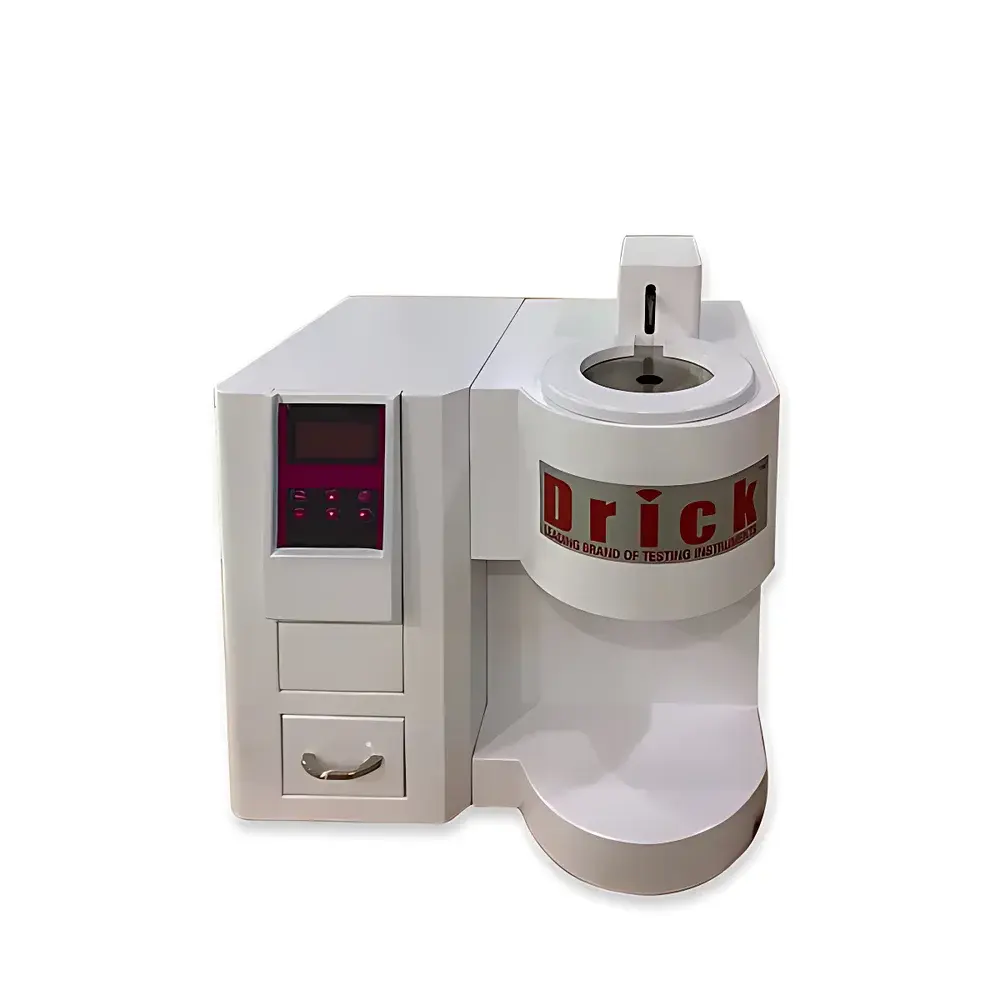
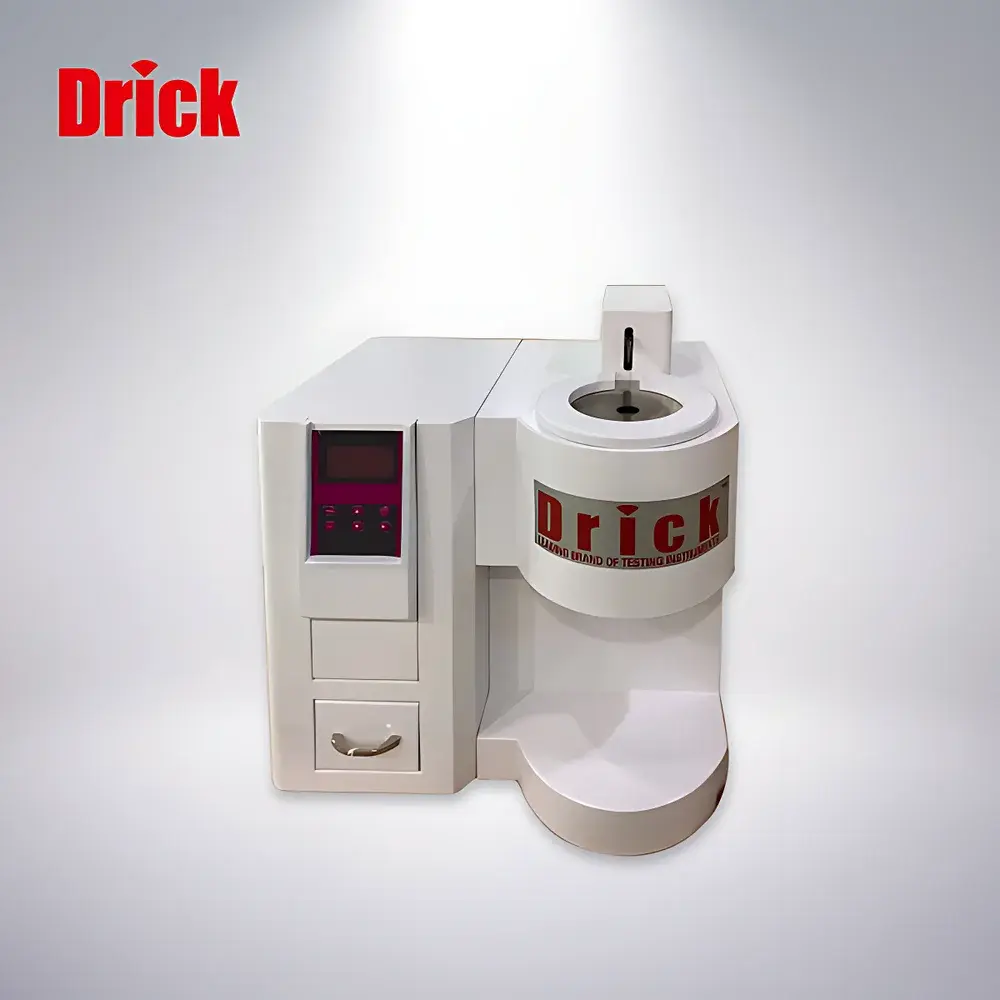
Drick DRK208 Melt Flow Indexer for Thermoplastic Resins
| Brand | Drick |
|---|---|
| Origin | Shandong, China |
| Manufacturer Type | Direct Manufacturer |
| Product Origin | Domestic (China) |
| Model | DRK 208 |
| Temperature Range | Ambient to 400 °C |
| Temperature Resolution | 0.1 °C |
| Temperature Accuracy | ±0.2 °C |
| Barrel Inner Diameter | 9.55 ±0.025 mm |
| Barrel Length | 160 mm |
| Piston Head Diameter | 9.475 ±0.01 mm |
| Die Inner Diameter | 2.095 mm |
| Die Length | 8 ±0.025 mm |
| Displacement Measurement Range | 0–30 mm |
| Displacement Accuracy | ±0.05 mm |
| MFR/MVR Measurement Accuracy | ±10% |
| Power Supply | 220 V ±10%, 50 Hz |
| Heating Power | 550 W |
Overview
The Drick DRK208 Melt Flow Indexer is a precision instrument engineered for the standardized determination of melt mass flow rate (MFR) and melt volume flow rate (MVR) of thermoplastic polymers under defined temperature and load conditions. Based on the principle of extrusion rheometry—where molten polymer is forced through a standardized capillary die under controlled thermal and mechanical conditions—the DRK208 provides quantitative data essential for quality control, material specification compliance, and process development in polymer manufacturing. Its design adheres strictly to the fundamental physical requirements outlined in ISO 1133-1:2011 and ASTM D1238-22, ensuring traceable, repeatable, and internationally comparable results. The instrument operates within a calibrated temperature range from ambient to 400 °C, accommodating high-melting engineering thermoplastics such as polyamide (PA), polycarbonate (PC), polyphenylsulfone (PPSU), and fluoropolymers, as well as commodity resins including polyethylene (PE), polypropylene (PP), ABS, and polyoxymethylene (POM).
Key Features
- Thermally stable barrel assembly with precise inner diameter (9.55 ±0.025 mm) and length (160 mm), compliant with ISO 1133 Annex A specifications
- Hardened steel piston with certified head diameter (9.475 ±0.01 mm) to ensure consistent cross-sectional area and minimal wall slip effects
- Standardized capillary die (2.095 mm nominal ID, 8 ±0.025 mm length) manufactured to ISO 1133 tolerances for reproducible shear rate profiles
- Digital temperature control system with ±0.2 °C accuracy and 0.1 °C resolution across the full 0–400 °C operating range
- High-resolution linear displacement sensor (±0.05 mm accuracy, 0–30 mm range) for direct MVR calculation via volumetric extrusion measurement
- Integrated load application mechanism supporting standard test weights (e.g., 2.16 kg, 5.00 kg, 10.00 kg) per ISO/ASTM classifications
- Robust industrial-grade heating system (550 W) enabling rapid thermal equilibration and stable soak performance at elevated temperatures
Sample Compatibility & Compliance
The DRK208 is validated for use with a broad spectrum of thermoplastic materials, including but not limited to polyolefins (HDPE, LDPE, PP), styrenics (PS, HIPS, ABS), engineering plastics (PC, PA6, PA66, POM), high-performance polymers (PEEK, PSU, PPSU), and fluorinated resins (PTFE, PVDF). It supports both single-point MFR/MVR determinations and multi-load testing for flow behavior analysis (e.g., flow activation energy, apparent viscosity vs. shear stress). The instrument meets the dimensional, thermal, and metrological requirements of GB/T 3682.1–2018, ISO 1133-1:2011, ASTM D1238-22, ASTM D3364-94(2020), DIN 53735:1984, UNI 5640:1971, and JJG 878–1994. While not inherently 21 CFR Part 11-compliant (as it lacks electronic audit trail functionality), its mechanical and thermal calibration framework aligns with GLP and GMP laboratory practices when operated with documented procedural controls and periodic verification using NIST-traceable reference materials.
Software & Data Management
The DRK208 operates as a standalone benchtop instrument with manual timing and mass measurement protocols, consistent with traditional ISO 1133-1 Method A (mass-based) and Method B (volume-based). No proprietary software is bundled; however, users may integrate external digital calipers, analytical balances (with RS232/USB output), and stopwatch applications to record time, extrudate mass, and piston displacement. For laboratories requiring electronic data capture, the instrument’s dimensional and thermal specifications are fully compatible with third-party LIMS or ELN platforms that support manual entry of MFR/MVR calculations per ISO 1133 equations. Calibration certificates for temperature sensors and displacement transducers can be issued upon request, supporting ISO/IEC 17025-compliant internal validation programs.
Applications
- Quality assurance of incoming polymer raw materials against supplier specifications (e.g., MFR tolerance bands for PP homopolymer)
- Batch-to-batch consistency monitoring in compounding and extrusion facilities
- Correlation of MFR with mechanical properties (e.g., tensile strength, impact resistance) during formulation development
- Thermal degradation assessment via MFR drift during extended dwell tests at fixed temperature and load
- Educational demonstration of polymer melt rheology principles in university polymer science laboratories
- Technical arbitration in contractual disputes involving polymer flow performance claims
FAQ
What standards does the DRK208 comply with?
The instrument satisfies the dimensional, thermal, and operational requirements of GB/T 3682.1–2018, ISO 1133-1:2011, ASTM D1238-22, ASTM D3364-94(2020), DIN 53735:1984, UNI 5640:1971, and JJG 878–1994.
Can the DRK208 measure both MFR and MVR simultaneously?
Yes—by recording both extrudate mass and piston displacement over a defined time interval, users can calculate MFR (g/10 min) and MVR (cm³/10 min) in accordance with ISO 1133-1 Clause 8.3.
Is the DRK208 suitable for fluoropolymers like PTFE?
Yes, provided appropriate temperature (up to 400 °C) and load conditions are applied; however, due to PTFE’s low melt strength and high thermal sensitivity, pre-drying and strict dwell-time control are recommended.
Does the instrument include automated weight loading?
No—the DRK208 uses manual placement of standardized test weights; automation is not included in the base configuration.
What maintenance is required for long-term accuracy?
Routine cleaning of the barrel and die with brass brushes and solvent, annual verification of temperature sensor calibration using a traceable reference thermometer, and periodic inspection of piston surface finish and die orifice geometry are recommended per ISO 1133 Annex C.





