
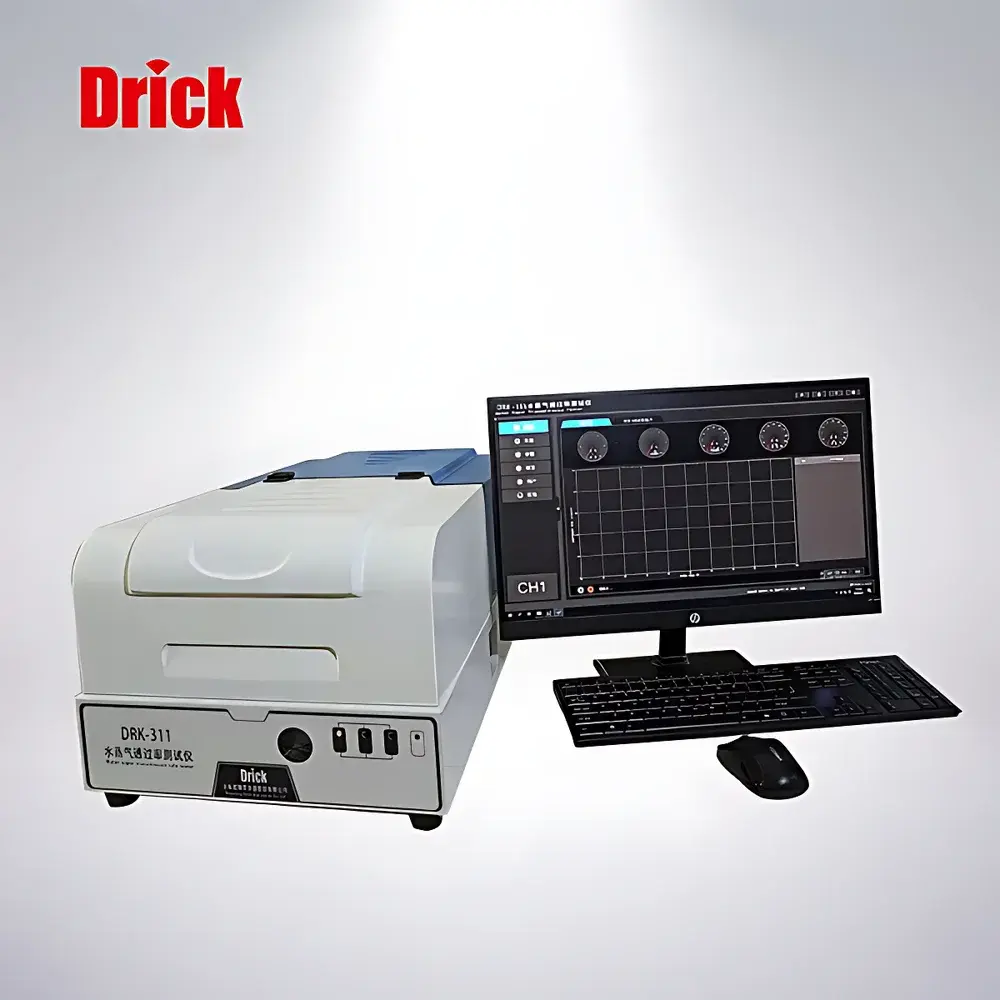
Drick DRK311 Triple-Chamber Infrared Water Vapor Transmission Rate (WVTR) Tester
| Brand | Drick |
|---|---|
| Origin | Shandong, China |
| Manufacturer Type | Direct Manufacturer |
| Region of Origin | Domestic (China) |
| Model | DRK 311 |
| Price | ¥250,000 CNY |
| Test Principle | Infrared Spectroscopic Detection of Water Vapor |
| Test Range | 0.01–40 g/(m²·24h) |
| Resolution | 0.01 g/(m²·24h) |
| Sample Capacity | 3 independent chambers |
| Sample Size | 100 mm × 110 mm |
| Effective Test Area | 50 cm² |
| Max Sample Thickness | ≤3 mm |
| Temperature Control Range | 15–55 °C |
| Temp Control Accuracy | ±0.1 °C |
| Humidity Control Range | 50–90 %RH |
| RH Control Accuracy | ±2 %RH |
| Carrier Gas Flow Rate | 100 mL/min |
| Carrier Gas | 99.999% high-purity nitrogen |
| Dimensions (W×D×H) | 680 × 380 × 300 mm |
| Power Supply | AC 220 V, 50 Hz |
| Net Weight | 72 kg |
Overview
The Drick DRK311 Triple-Chamber Infrared Water Vapor Transmission Rate (WVTR) Tester is a precision instrument engineered for quantitative determination of water vapor permeation through flexible packaging materials under controlled environmental conditions. It operates on the principle of infrared spectroscopic detection—where water vapor molecules transported across a test specimen are swept by dry carrier gas into a calibrated infrared sensor. The sensor measures absorbance at characteristic vibrational wavelengths (e.g., ~2.7 µm and ~6.3 µm), enabling real-time quantification of vapor concentration with high specificity and minimal interference from other gases. This method conforms to the fundamental physical basis outlined in ASTM F1249–22 (“Standard Test Method for Water Vapor Transmission Rate Through Plastic Film and Sheeting Using a Modulated Infrared Sensor”) and aligns with ISO 15106-3 (“Plastics — Film and sheeting — Determination of water vapour transmission rate — Part 3: Electrolytic detector method” — adapted via IR equivalence). The DRK311 is designed for laboratories requiring regulatory-compliant, repeatable WVTR data for barrier performance validation in food, pharmaceutical, medical device, and consumer goods packaging development and quality control.
Key Features
- Triple independent test chambers enable parallel evaluation of up to three specimens—identical or dissimilar—without cross-contamination or thermal/hygrometric coupling.
- High-stability climate control system maintains temperature within ±0.1 °C and relative humidity within ±2 %RH across the full operational range (15–55 °C / 50–90 %RH), ensuring adherence to standardized test conditions per ASTM D6751 and ISO 2528.
- Infrared detection module features drift-compensated optical path design and factory-calibrated response curve, delivering measurement resolution of 0.01 g/(m²·24h) over a dynamic range of 0.01–40 g/(m²·24h).
- Automated test execution with programmable ramp-and-hold profiles, real-time permeation curve visualization, and auto-endpoint detection based on steady-state flux criteria (±1.5% variation over 60 min).
- Integrated high-purity nitrogen delivery subsystem with mass flow controller ensures consistent 100 mL/min carrier gas flow; compatible with external N₂ supply or optional built-in generator.
- Rugged aluminum alloy frame and sealed chamber architecture minimize ambient thermal leakage and condensation risk during low-RH operation.
Sample Compatibility & Compliance
The DRK311 accommodates flat, non-porous, and semi-crystalline polymeric films and laminates—including PET, PE, PP, EVOH, PVDC-coated substrates, aluminum foil composites, and metallized films—within dimensional constraints of 100 mm × 110 mm and thickness ≤3 mm. Each chamber provides a defined diffusion area of 50 cm², eliminating edge-effect bias common in non-standardized fixtures. Instrument validation supports IQ/OQ protocols per FDA 21 CFR Part 11 requirements, with full traceability of calibration certificates (NIST-traceable hygrometer and thermistor standards), chamber leak integrity testing (<5×10⁻³ mbar·L/s), and sensor linearity verification across five reference points. All hardware and firmware comply with IEC 61000-6-3 (EMC) and IEC 61010-1 (safety) standards.
Software & Data Management
The embedded Windows-based control software implements role-based access control (RBAC) architecture compliant with GMP Annex 11 and EU GMP Annex 11 principles. User accounts are assigned granular permissions (e.g., operator, supervisor, administrator), with mandatory electronic signatures for critical actions such as method modification, calibration initiation, and report approval. All measurement events—including raw sensor output, environmental setpoints, chamber status, and user logins—are timestamped and stored with immutable audit trails. Data export supports CSV, PDF, and XML formats; USB 2.0 interface enables secure offline transfer without network exposure. Software includes built-in statistical process control (SPC) tools—X̄/R charts, capability indices (Cp/Cpk), and outlier detection per ISO 22514-2—for routine QC trending.
Applications
- Barrier specification verification for retort pouches, blister packs, and cold-chain shipping liners.
- Accelerated aging studies correlating WVTR shift with thermal oxidative degradation (e.g., EVOH hydrolysis at elevated RH).
- Comparative evaluation of nanocomposite additives (e.g., clay, graphene oxide) on polyethylene matrix permeability.
- Regulatory submission support for FDA IND/NDA dossiers requiring package integrity evidence per USP .
- Supplier qualification audits where ASTM F1249-compliant WVTR data is contractually mandated.
- Root cause analysis of field failures linked to moisture-induced delamination or active ingredient hydrolysis.
FAQ
What standards does the DRK311 comply with?
The instrument meets the functional and procedural requirements of ASTM F1249–22, ISO 15106-3, and GB/T 21528–2008 (Chinese national standard equivalent), with documented alignment to test condition tolerances and data reporting conventions.
Can the DRK311 test coated papers or breathable medical fabrics?
It is validated for low-permeability polymeric films and laminates. Highly porous or fibrous substrates (e.g., Tyvek®, filter paper) require gravimetric or coulometric methods per ASTM E96 and are not recommended for IR-based measurement due to signal saturation and boundary-layer interference.
Is third-party calibration certification available?
Yes—Drick provides optional annual calibration services traceable to NIST standards, including full uncertainty budget documentation per ISO/IEC 17025 requirements.
How is sensor drift managed during extended testing?
The system performs automatic zero-point compensation every 2 hours using dry nitrogen purge cycles, and includes a dual-wavelength referencing algorithm to correct for optical window fouling or source intensity decay.
Does the software support 21 CFR Part 11 compliance out-of-the-box?
Yes—the installed software includes electronic signature workflows, audit trail encryption, and configurable retention policies meeting baseline Part 11 technical controls; full validation packages (IQ/OQ/PQ) are available upon request.




