
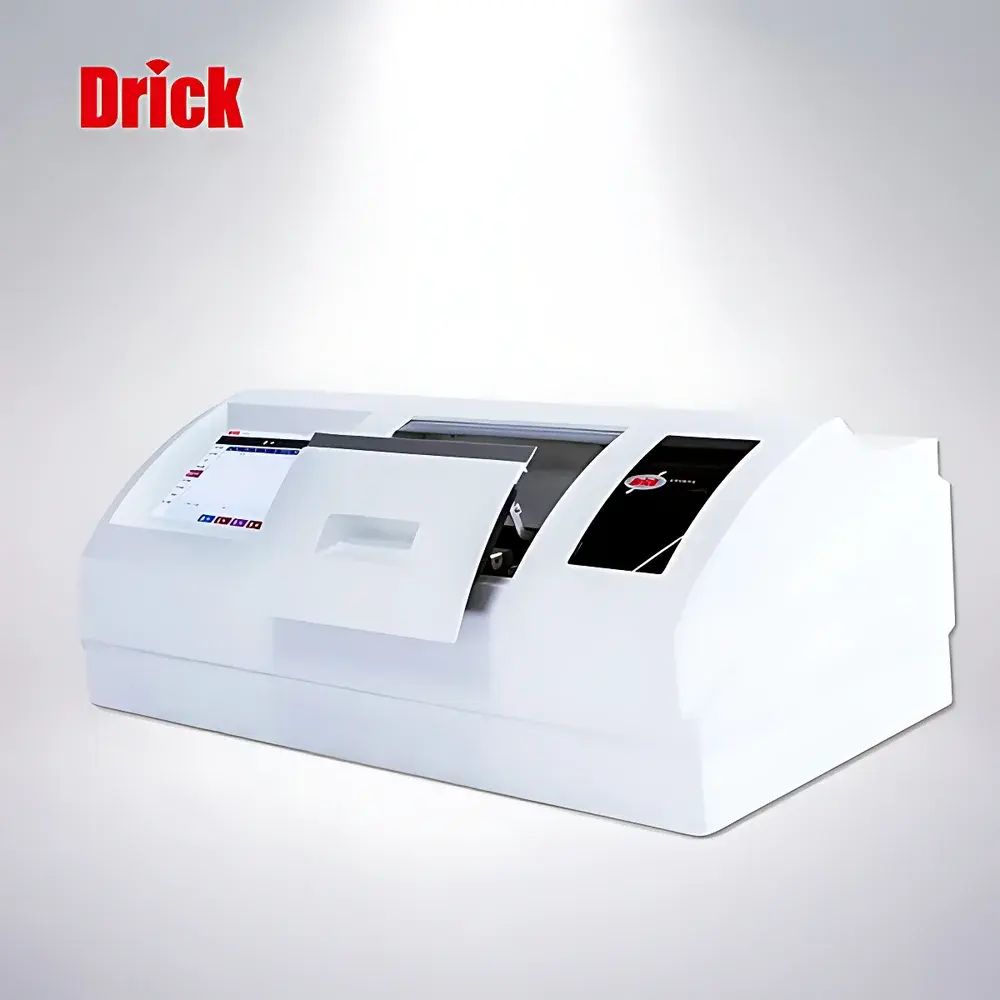
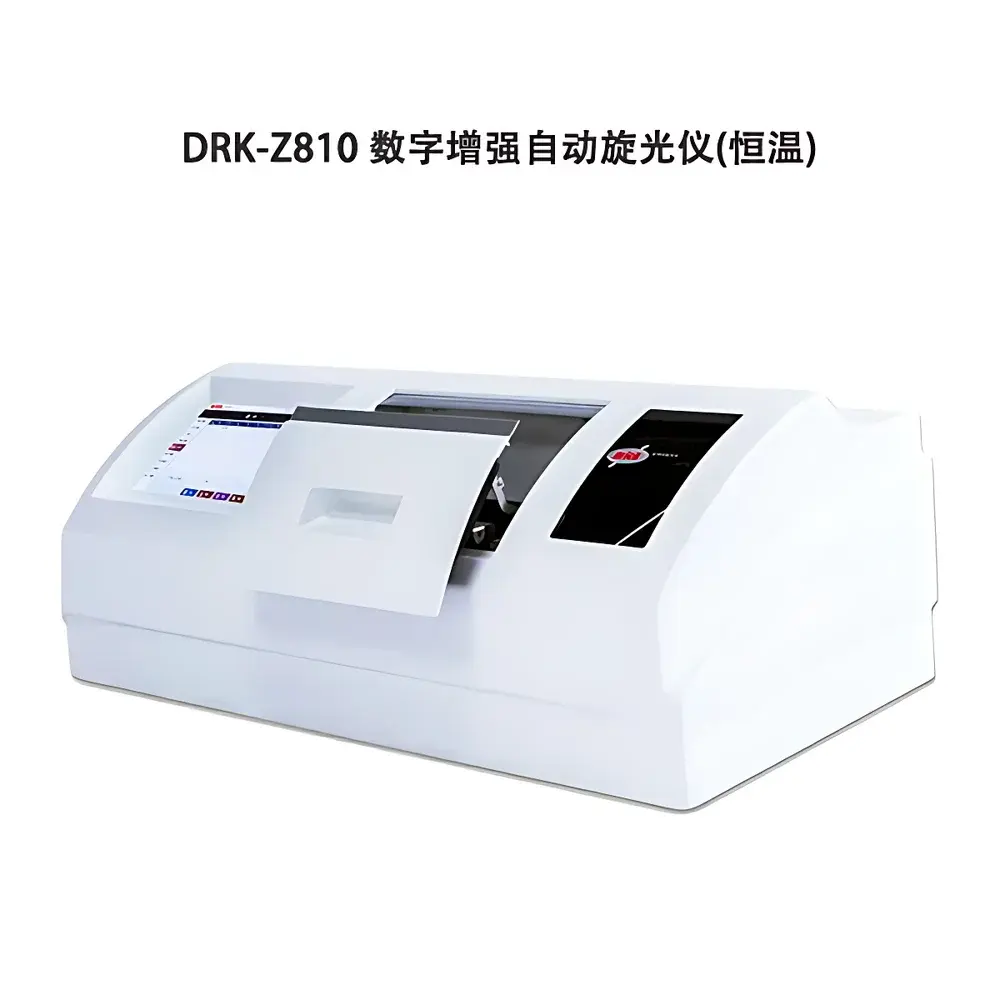
Drick DRK-Z810 Digital Enhanced Automatic Polarimeter with Integrated Peltier Temperature Control
| Brand | Drick |
|---|---|
| Origin | Shandong, China |
| Manufacturer Type | OEM Manufacturer |
| Country of Origin | China |
| Model | DRK-Z810 |
| Product Category | Automatic Polarimeter |
| Temperature Control | Integrated Peltier (±0.1 °C stability) |
| Digital Display | Yes |
| Light Source | High-Stability LED (589.3 nm equivalent) |
| Optical Rotation Range | ±90° |
| Sucrose Scale Range | ±259°Z |
| Accuracy | ±0.004° |
Overview
The Drick DRK-Z810 Digital Enhanced Automatic Polarimeter is a precision optical instrument engineered for high-reproducibility measurement of optical rotation in chiral substances. Based on the fundamental principle of plane-polarized light rotation through optically active media, the DRK-Z810 employs a stable monochromatic LED light source centered at 589.3 nm—functionally equivalent to the sodium D-line—ensuring compliance with classical polarimetric reference standards (e.g., ASTM E1252, USP , ISO 5725). Its integrated Peltier temperature control system maintains sample cell temperature within ±0.1 °C across a typical operational range of 10–40 °C, eliminating thermal drift and enabling temperature-dependent studies critical for pharmaceutical QC, sugar analysis, and polymer characterization. Unlike manual or semi-automatic instruments, the DRK-Z810 performs fully automated zero calibration, sample measurement, and endpoint detection—minimizing operator dependency and aligning with GLP/GMP documentation requirements.
Key Features
- Fully automatic measurement cycle with real-time angular feedback and auto-zero compensation
- Integrated Peltier thermoelectric module with digital PID temperature regulation and user-selectable setpoints (10–40 °C, resolution 0.1 °C)
- High-stability LED light source (589.3 nm equivalent) with >10,000-hour service life and negligible spectral drift
- Dual-scale display: optical rotation (α, in degrees) and sucrose concentration (°Z), both simultaneously shown on high-contrast LCD
- Robust optical path design featuring strain-free quartz half-shade field and precision-ground glass polarizers
- RS-232 and USB-B interfaces for external data logging and integration into LIMS environments
- Compliant with IEC 61000-4 electromagnetic immunity standards and CE-marked for laboratory use
Sample Compatibility & Compliance
The DRK-Z810 accommodates standard 100 mm and 200 mm pathlength cells (including jacketed thermostatted cells), supporting aqueous, alcoholic, and organic solvent-based samples with optical clarity above 85% transmittance at 589 nm. It meets essential metrological requirements outlined in ISO/IEC 17025 for accredited testing laboratories and supports audit-ready operation under FDA 21 CFR Part 11 when paired with validated third-party data acquisition software. Instrument validation documentation—including IQ/OQ templates, traceable calibration certificates (NIST-traceable quartz control plates), and uncertainty budgets—is provided upon request. The system is routinely deployed in environments requiring adherence to pharmacopeial methods (USP , Ph. Eur. 2.2.7, JP 2.07) and food-grade sugar analysis per AOAC Official Method 957.02.
Software & Data Management
While the DRK-Z810 operates as a standalone instrument with embedded firmware, its serial and USB interfaces enable bidirectional communication with PC-based applications. Optional Drick PolarSoft v3.2 (Windows 10/11 compatible) provides full data capture, statistical reporting (mean, SD, RSD, trend charts), method storage (up to 99 protocols), and export to CSV, PDF, or XML formats. Audit trail functionality records user ID, timestamp, parameter changes, and measurement events—supporting ALCOA+ data integrity principles. Raw angular data can be exported for secondary processing in MATLAB, Python (NumPy/Pandas), or JMP for advanced multivariate correlation studies (e.g., specific rotation vs. concentration, temperature, or pH).
Applications
- Pharmaceutical QC: Enantiomeric purity verification of APIs (e.g., ibuprofen, levodopa), excipient identity testing, and stability-indicating assays
- Food & Beverage: Sucrose content quantification in syrups, juices, and honey per °Z scale; lactose and fructose differentiation via temperature-corrected specific rotation
- Chemical Synthesis: Real-time monitoring of asymmetric reactions and chiral catalyst performance
- Academic Research: Teaching core concepts of molecular chirality, optical activity, and stereochemistry in undergraduate physical chemistry labs
- Polymer Science: Characterization of chiral polymeric systems (e.g., poly(lactic acid)) and degradation kinetics via specific rotation trends
- Essential Oil & Flavor Chemistry: Authenticity assessment of natural terpenoid-rich extracts (e.g., limonene, camphor) using literature-specific rotation references
FAQ
What is the wavelength accuracy of the LED source, and how is it verified?
The LED output is spectrally stabilized to emit peak intensity at 589.3 nm ±0.5 nm, confirmed during factory calibration using a NIST-traceable optical spectrum analyzer. No user recalibration is required.
Does the DRK-Z810 support GLP-compliant electronic signatures?
The base instrument does not include built-in electronic signature capability; however, when interfaced with validated third-party LIMS or ELN platforms supporting 21 CFR Part 11, full audit trail and role-based access control are achievable.
Can the Peltier system cool below ambient temperature?
No—the integrated Peltier module is configured for heating and passive cooling only, maintaining setpoints ≥10 °C. For sub-ambient operation, external recirculating chillers may be coupled via optional jacketed cell adapters.
Is calibration traceable to national standards?
Yes—each unit ships with a calibration certificate referencing NIST SRM 1991a (quartz rotatory standard) and includes two certified quartz control plates (±5° and ±30°) for daily verification.
What maintenance is required for long-term accuracy?
Annual verification of optical alignment and temperature sensor calibration is recommended; LED lifetime exceeds 10,000 hours with no luminance degradation under continuous operation.





