
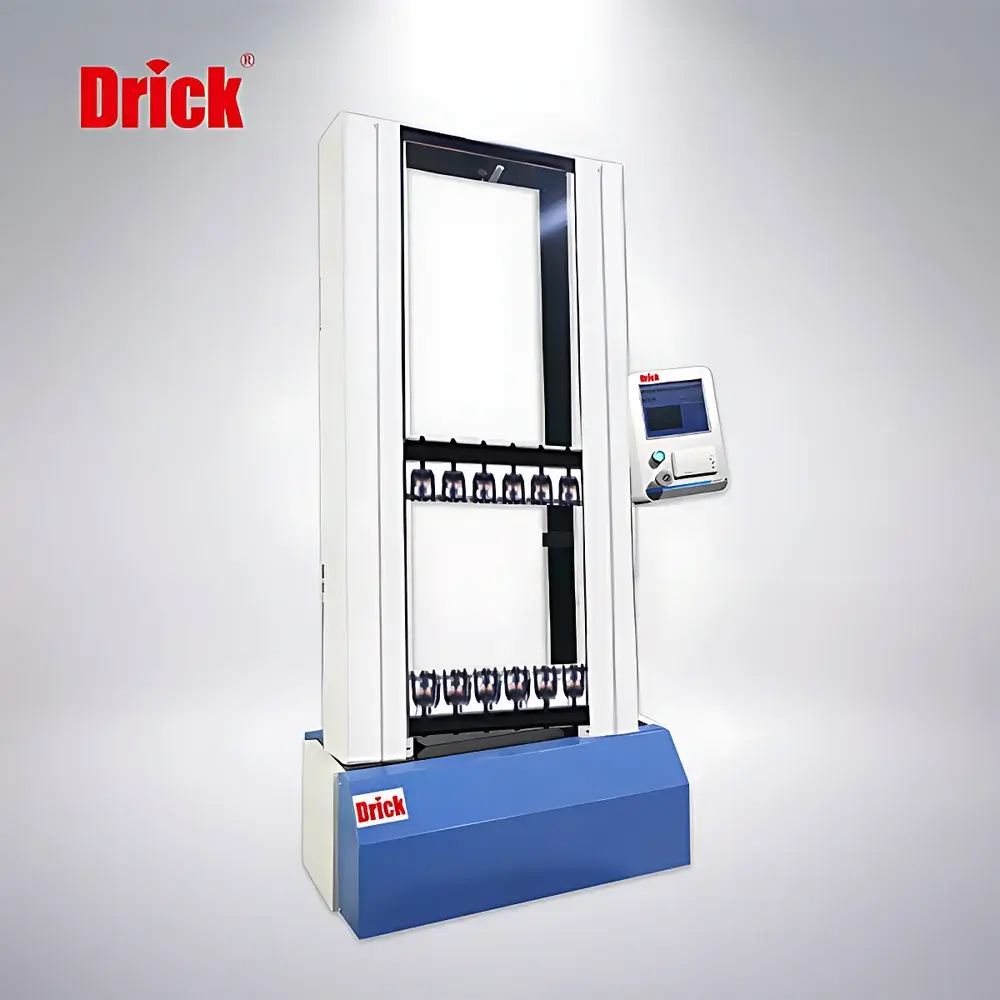
Drick DRKWD6-1 Six-Station Universal Tensile Testing Machine
| Brand | Drick |
|---|---|
| Origin | Shandong, China |
| Manufacturer Type | Direct Manufacturer |
| Product Category | Domestic |
| Model | DRKWD6-1 |
| Instrument Type | Electromechanical Tensile Tester |
| Maximum Test Load | 500 N |
| Load Range | 500 N (Full Scale) |
| Force Accuracy Class | Class 1 (per ISO 7500-1 / ASTM E4) |
| Test Stroke | 1200 mm |
| Displacement Resolution | 0.01 mm |
| Crosshead Speed Range | 1–500 mm/min (infinitely variable) |
| Number of Stations | 6 |
| Specimen Width Capacity | 25 mm |
| Clamping Method | Pneumatic (air supply required: 0.6–0.7 MPa, Ø6 mm polyurethane tubing) |
| Power Supply | AC 220 V ±5%, 50 Hz |
Overview
The Drick DRKWD6-1 Six-Station Universal Tensile Testing Machine is an electromechanical static testing system engineered for high-reproducibility mechanical characterization of flexible and thin-film materials under uniaxial loading conditions. Based on the principle of controlled displacement-driven force measurement via precision load cell feedback and servo-controlled crosshead motion, it complies with fundamental mechanical testing standards including ISO 527-3 (plastics), ISO 1184 (paper and board), ASTM D882 (thin plastic sheeting), ASTM D3330 (pressure-sensitive tapes), and ISO 1974 (tear resistance). Its dual-column, dual-ball-screw architecture ensures axial alignment stability and minimal lateral deflection—critical for maintaining measurement fidelity across extended stroke lengths up to 1200 mm. Designed specifically for quality control laboratories in packaging, medical device, adhesive, and paper industries, the DRKWD6-1 supports standardized test protocols for tensile strength, elongation at break, peel adhesion, tear propagation, heat seal strength, and puncture resistance.
Key Features
- Dual-column, dual-ball-screw transmission system with preloaded linear guides—minimizes mechanical play and delivers consistent load-path alignment over full 1200 mm stroke.
- Six independent, pneumatically actuated test stations—enables parallel sample evaluation under identical environmental and operational conditions, reducing inter-test variability and increasing throughput by up to 6× versus single-station systems.
- Integrated multi-function test capability—including tensile, peel (90°/180°), tear (Elmendorf, trouser, dart), heat seal strength, and puncture—configured via software-defined test methods without hardware reconfiguration.
- Class 1 force accuracy (per ISO 7500-1:2018) validated across the full 500 N range, supported by factory calibration traceable to national metrology institutes.
- Infinitely variable crosshead speed (1–500 mm/min) with closed-loop position control—enables compliance with rate-dependent test standards such as ISO 11337 (peel rate sensitivity) and ASTM F88 (seal strength at defined separation rates).
- Embedded industrial computer with real-time OS—eliminates external PC dependency, reduces electromagnetic interference risks, and ensures deterministic data acquisition timing at ≥1 kHz sampling rate.
- Automated pneumatic clamping (0.6–0.7 MPa air supply required)—standardized grip pressure ensures uniform initial stress distribution and mitigates slippage during high-strain-rate tests.
Sample Compatibility & Compliance
The DRKWD6-1 accommodates specimens up to 25 mm wide and is routinely deployed for mechanical evaluation of polymer films (e.g., BOPP, PET, PE), laminated flexible packaging, pressure-sensitive adhesives (PSAs), medical transdermal patches, silicone-coated release liners, kraft and coated papers, elastomeric rubbers, and nonwovens. All test routines adhere to documented standard operating procedures aligned with GLP and GMP frameworks. Data integrity is maintained through audit-trail-enabled software compliant with FDA 21 CFR Part 11 requirements—including electronic signatures, user access levels, and immutable raw-data archiving. Calibration certificates include uncertainty budgets per ISO/IEC 17025 guidelines.
Software & Data Management
The proprietary DrickTest™ software provides ISO/IEC 17025-compliant test method templates, customizable pass/fail criteria, and automated report generation in PDF/XLSX formats. It supports synchronized multi-curve overlay analysis for comparative material evaluation, statistical summarization (mean, SD, min/max, CV%), and derivative calculation of engineering properties—including Young’s modulus (from linear elastic region), yield stress, breaking energy (area under stress–strain curve), and peel adhesion energy (J/m²). All test parameters, metadata, and raw force/displacement time-series data are stored in encrypted SQLite databases with version-controlled backups and optional networked NAS integration.
Applications
- Quality assurance of heat-sealed pouches and blister packs in pharmaceutical and food packaging lines.
- Peel strength validation of medical device backing layers and wound dressing adhesives per ISO 29462.
- Tensile property benchmarking of biodegradable films against ASTM D882 specifications.
- Seal integrity assessment of sterile barrier systems per ISO 11607-2 Annex C.
- Adhesive performance qualification for label stock under varying humidity and temperature preconditioning.
- Rubber elasticity profiling for gasket and diaphragm component development.
FAQ
What standards does the DRKWD6-1 support out-of-the-box?
Pre-configured test methods cover ASTM D882, D3330, D1876, D1938, ISO 527-3, 1184, 1974, 29462, and GB/T 1040.2—custom protocols can be added via editable method templates.
Is pneumatic supply included with the system?
No—users must provide a clean, dry compressed air source (0.6–0.7 MPa) with Ø6 mm polyurethane tubing; an inline filter-regulator-lubricator (FRL) unit is recommended for long-term valve longevity.
Can test data be exported for LIMS integration?
Yes—CSV and XML exports include full metadata (operator ID, timestamp, environmental conditions, calibration IDs); REST API access is available for enterprise-level LIMS or MES synchronization.
What maintenance intervals are recommended?
Ball screw lubrication every 6 months; load cell verification annually or after 10,000 cycles; pneumatic valve inspection quarterly; full system calibration recommended biannually per ISO/IEC 17025.
Does the system support third-party transducers or extensometers?
The embedded controller features analog input channels compatible with industry-standard LVDTs and video extensometers (e.g., Keyence CV-X series) via optional signal conditioning modules.



