
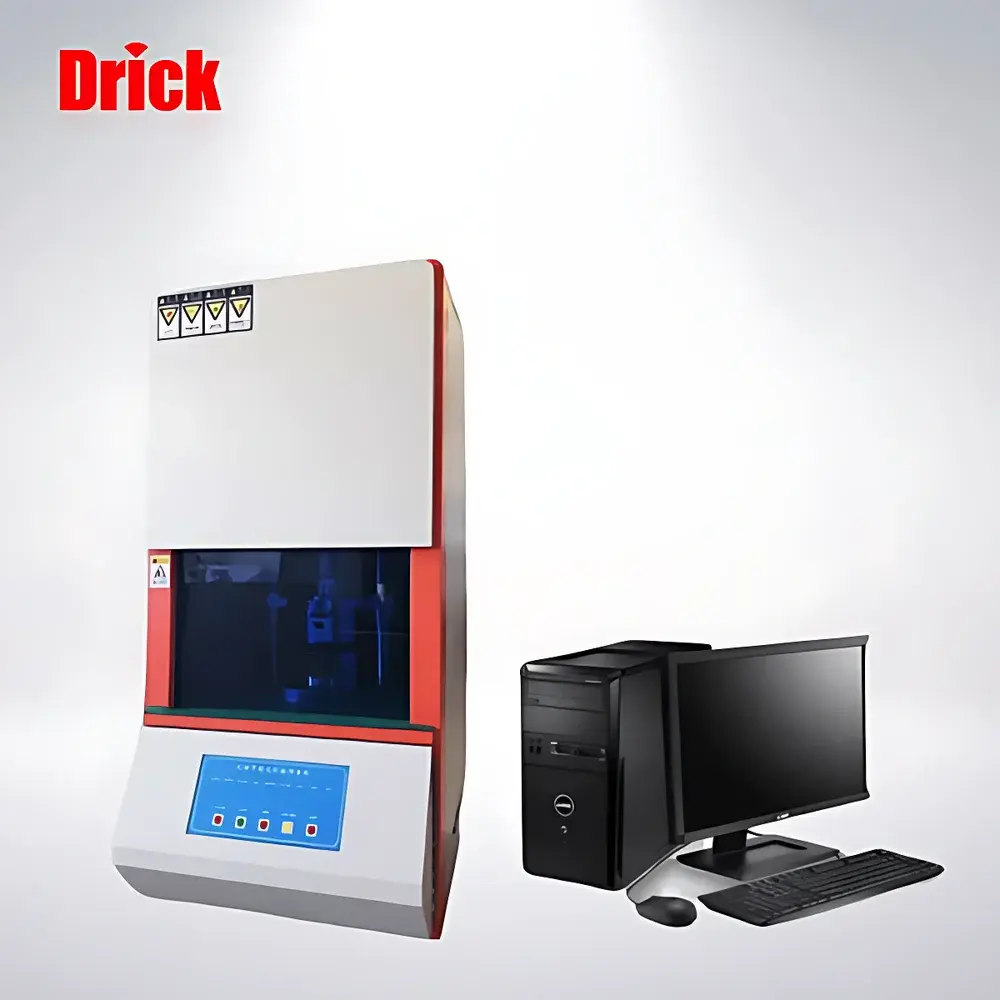
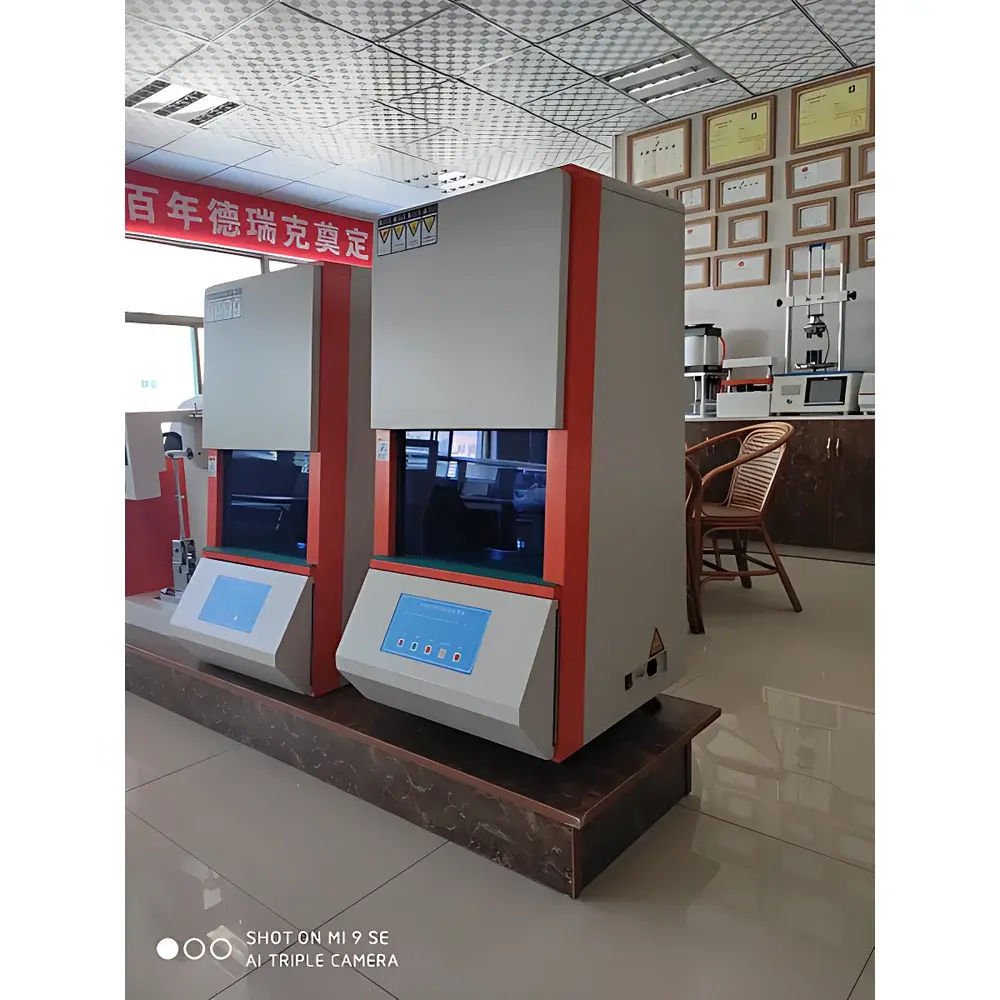
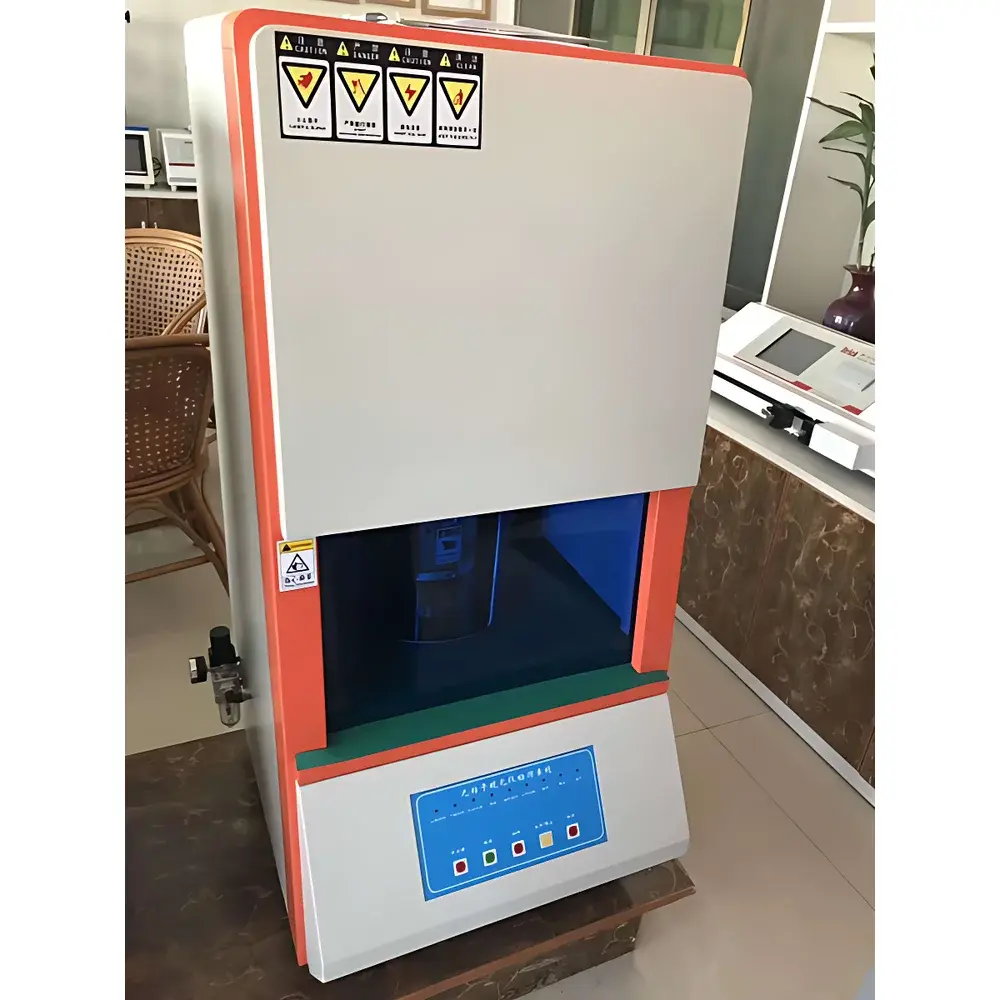
Drick LH-B GB/T 16584 Rotorless Vulcanizometer for Rubber Processing
| Brand | Drick |
|---|---|
| Origin | Shandong, China |
| Manufacturer Type | Direct Manufacturer |
| Country of Origin | China |
| Model | LH-B |
| Power Supply | 220 V AC, 50 Hz |
| Compressed Air Requirement | ≥ 0.40 MPa |
| Oscillation Frequency | 100 cpm (1.7 Hz) |
| Oscillation Angle | ±0.5° or ±1.0° |
| Temperature Range | Ambient to 200 °C |
| Temperature Stability | ≤ ±0.3 °C |
| Temperature Resolution | 0.01 °C |
| Torque Range | 0–20 N·m |
| Torque Resolution | 0.001 N·m |
| Compliance Standards | GB/T 3709–2003, GB/T 16584, ISO 6502 |
Overview
The Drick LH-B Rotorless Vulcanizometer is a precision-engineered instrument designed for real-time characterization of rubber compound vulcanization kinetics under standardized thermal and mechanical conditions. Operating on the principle of oscillating-die rheometry, it measures torque response of uncured rubber specimens confined in a fully sealed, temperature-controlled cavity during isothermal or programmed heating cycles. Unlike rotor-based systems, the LH-B employs a non-rotating, oscillating die configuration—aligned with ASTM D5289 and ISO 6502 methodologies—to eliminate shear-induced degradation and ensure high reproducibility across repeated measurements. Its primary function is to quantify critical cure parameters including scorch time (ts₁, ts₂), optimum cure time (t₁₀, t₉₀), minimum and maximum torque (ML, MH), and cure rate indices (Vc₁, Vc₂), enabling formulation optimization, quality control, and process validation in tire, conveyor belt, sealing, and automotive rubber component manufacturing.
Key Features
- Fully sealed, air-tight cavity design—mechanically and thermally identical to Alpha Technologies (formerly Monsanto) MV series instruments, ensuring cross-platform data comparability.
- Integrated PID temperature control system with platinum resistance thermometer (Pt100) feedback and adaptive parameter tuning, delivering ≤ ±0.3 °C stability over ambient to 200 °C operating range.
- High-resolution torque transduction (0.001 N·m) with dual-range capability (0–20 N·m full scale) and real-time digital acquisition at configurable sampling intervals.
- Dual-mode operation: standalone microcontroller interface with LCD display and audible alerts, plus PC-based control via proprietary DRICK software with full GLP-compliant audit trail functionality.
- Oscillation frequency fixed at 100 cycles per minute (1.7 Hz) with selectable amplitude (±0.5° or ±1.0°), meeting ISO 6502 requirements for standard test protocols.
- Compressed-air-assisted cavity closure mechanism (≥0.40 MPa) ensures consistent sample compression and eliminates operator-induced variability.
Sample Compatibility & Compliance
The LH-B accommodates standard 4.5 g rubber test specimens molded into cylindrical geometry (Φ16 mm × 4 mm thick) per GB/T 16584 and ISO 6502. It supports natural rubber (NR), styrene-butadiene rubber (SBR), ethylene propylene diene monomer (EPDM), nitrile rubber (NBR), and silicone compounds—including filled, oil-extended, and highly loaded formulations. All hardware and firmware comply with Chinese national standards GB/T 3709–2003 (vulcanization testing terminology) and GB/T 16584 (rotorless vulcanizometer method), and are functionally aligned with ISO 6502 for international test equivalence. The system supports 21 CFR Part 11–ready data integrity features when operated in PC mode, including electronic signatures, time-stamped raw data logs, and immutable record archiving.
Software & Data Management
The DRICK Vulcanization Analysis Suite provides comprehensive test setup, execution, and post-processing capabilities. Users define temperature profiles, oscillation parameters, and pass/fail criteria prior to run initiation. Real-time dual-curve visualization (torque vs. time and temperature vs. time) enables immediate process monitoring. Post-test, the software automatically calculates and exports all standard cure metrics—including ML, MH, ts₁, ts₂, t₁₀, t₉₀, Vc₁, Vc₂—and generates PDF reports compliant with internal QA documentation requirements. Database functionality allows longitudinal trending, batch-to-batch comparison using color-coded overlays, statistical analysis (mean, SD, Cp/Cpk), and export to CSV or Excel for integration with LIMS or MES platforms.
Applications
- Formulation development and screening of accelerators, curatives, fillers, and plasticizers.
- In-process QC for incoming raw material verification and batch release testing.
- Process window definition for injection molding, extrusion, and calendering operations.
- Accelerated aging studies correlating cure state with compression set and hardness evolution.
- Supporting ISO/IEC 17025-accredited rubber testing laboratories requiring traceable, repeatable, and auditable cure data.
FAQ
Does the LH-B meet international calibration traceability requirements?
Yes—temperature sensors are Pt100 class A certified and torque transducers are calibrated against NIST-traceable reference standards; calibration certificates are provided with each unit.
Can the system be integrated into an existing laboratory network?
Yes—the PC software supports TCP/IP communication and offers API hooks for custom automation scripts and ERP/LIMS interfacing.
Is compressed air supply mandatory for operation?
Yes—pneumatic actuation is required for precise, repeatable cavity closure pressure (0.40–0.60 MPa); failure to maintain minimum pressure triggers automatic safety lockout.
What is the typical service interval for preventive maintenance?
Drick recommends annual verification of thermal uniformity, torque linearity, and oscillation amplitude accuracy by authorized service personnel.
Does the instrument support multi-step temperature ramping?
No—the LH-B operates in isothermal mode only, per GB/T 16584 and ISO 6502; dynamic ramping requires optional upgrade to the LH-C series.






