
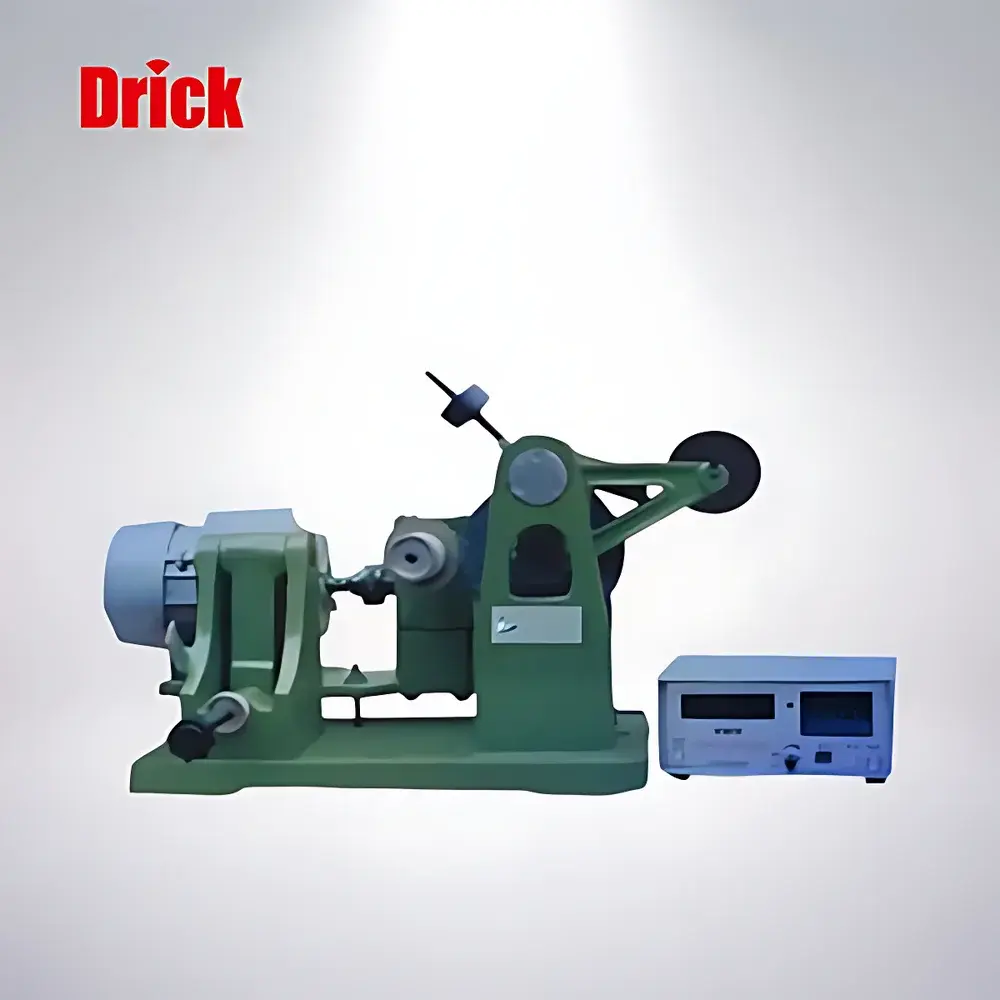
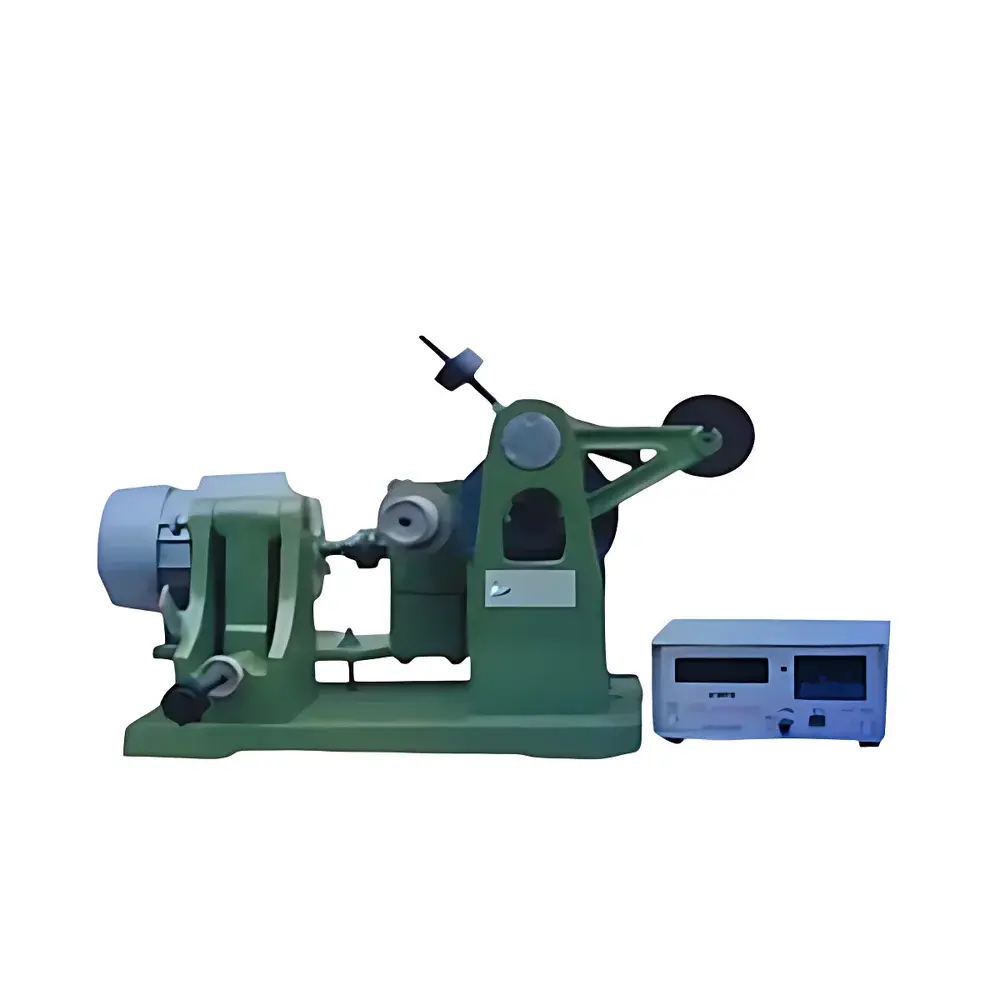
Drick WML-76 Akron Abrasion Tester for Vulcanized Rubber (Compliant with GB/T 1689)
| Key | Brand: Drick |
|---|---|
| Model | WML-76 |
| Applied Standard | GB/T 1689 |
| Load on Rubber Wheel | 26.7 N (2.7 kgf) |
| Rubber Wheel Speed | 76 ± 2 rpm |
| Abrasive Wheel Speed | 33–35 rpm |
| Adjustable Inclination Angle | 0°–45° |
| Power Supply | AC 220 V ± 10% |
| Dimensions (L×W×H) | 600 × 480 × 400 mm |
| Net Weight | 60 kg |
| Control | Digital Counter with Auto-Stop Function |
| Origin | Shandong, China |
| Manufacturer Type | OEM/ODM Producer |
Overview
The Drick WML-76 Akron Abrasion Tester is a precision-engineered instrument designed to quantify the abrasion resistance of vulcanized rubber compounds in accordance with the Chinese national standard GB/T 1689—Determination of Abrasion Resistance of Vulcanized Rubber (Akron Abrasion Method). This tester operates on the principle of controlled rotary abrasion: a standardized rubber test specimen rotates against a calibrated abrasive wheel under defined normal load, rotational speed, and angular inclination. The volumetric loss of the specimen after a prescribed number of revolutions is measured—typically via displacement or gravimetric methods—to yield abrasion resistance in mm³ per kilometer (or equivalent SI units). The WML-76 implements a dual-axis rotational architecture: the rubber wheel rotates at 76 ± 2 rpm while the abrasive wheel rotates counter-directionally at 33–35 rpm, ensuring reproducible shear stress distribution across the contact interface. Its mechanical design adheres to fundamental tribological constraints outlined in ISO 48-4 and ASTM D1630, facilitating cross-laboratory comparability when used with certified reference materials.
Key Features
- Integrated digital control panel with programmable revolution count, real-time display, and automatic shutdown upon completion—eliminating operator-dependent timing errors.
- Adjustable inclination angle (0°–45°) between rubber wheel axis and abrasive wheel plane, enabling systematic evaluation of directional wear anisotropy in anisotropic elastomers.
- Precisely regulated loading mechanism applying a constant 26.7 N (2.7 kgf) vertical force to the rubber wheel—calibrated and traceable to national metrological standards.
- Robust cast-iron frame and sealed bearing assemblies ensure long-term dimensional stability and minimal runout (<0.05 mm TIR), critical for repeatable contact geometry.
- Modular abrasive wheel mounting system compatible with standardized Akron-type grinding wheels (e.g., 60-grit aluminum oxide, 152 mm diameter), conforming to GB/T 1689 specifications.
- Compact footprint (600 × 480 × 400 mm) and 60 kg net weight facilitate installation in QC labs without structural reinforcement.
Sample Compatibility & Compliance
The WML-76 accommodates standard dumbbell-shaped or cylindrical rubber specimens (per GB/T 1689, ISO 48-4, and ASTM D1630) with nominal dimensions of 25.4 mm × 25.4 mm × 6.4 mm. Specimen preparation follows strict conditioning protocols: 23 °C ± 2 °C and 50 % RH ± 5 % for ≥16 h prior to testing. The instrument satisfies mandatory requirements for rubber quality assurance in tire treads, conveyor belts, footwear soles, and industrial seals. It supports full audit trails for GLP-compliant environments when paired with external calibrated balances and volumetric measurement tools. While not inherently 21 CFR Part 11 compliant (as it lacks embedded electronic records), its deterministic mechanical operation and digital counter output are fully documentable within LIMS-integrated workflows.
Software & Data Management
The WML-76 operates as a standalone electromechanical system with no embedded firmware or network interface. All operational parameters—including set revolution count, actual revolutions completed, and stop trigger status—are displayed on a high-contrast LED counter. Test data (e.g., pre- and post-test mass, density, calculated volume loss) must be recorded manually or imported into laboratory information management systems (LIMS) or Excel-based QA templates. For automated reporting, users may integrate the digital counter’s TTL-compatible pulse output with third-party data acquisition modules (e.g., National Instruments DAQ devices) to log timestamps and cycle completion events. Calibration certificates for load cells and rotational encoders are provided with each unit, supporting ISO/IEC 17025 accreditation documentation.
Applications
- Quality control of compounded natural and synthetic rubbers (SBR, BR, EPDM, CR) in tire manufacturing.
- Formulation screening during R&D of high-wear elastomer blends for mining conveyor belts and hydraulic seals.
- Comparative assessment of carbon black vs. silica filler systems on abrasion resistance.
- Validation of surface-modified rubber grades intended for low-noise pavement applications.
- Third-party certification testing per GB/T 1689, GB/T 9867 (ISO 48-4), and ASTM D1630 for export compliance.
- Accelerated aging studies when combined with thermal cycling per GB/T 3512 (ISO 188).
FAQ
What standards does the WML-76 explicitly comply with?
The instrument is engineered and verified to meet the mechanical and procedural requirements of GB/T 1689, with functional alignment to ISO 48-4 and ASTM D1630 for comparative testing.
Is calibration traceable to national standards?
Yes—load application and rotational speed are factory-calibrated using NIM-traceable force sensors and optical tachometers; calibration reports are included.
Can the WML-76 be used for non-rubber polymers?
It is validated only for vulcanized elastomers; thermoplastics or uncured compounds exhibit inconsistent adhesion and deformation behavior under the specified load/speed regime.
What maintenance is required for long-term accuracy?
Monthly inspection of abrasive wheel wear, quarterly torque verification of loading springs, and annual recalibration of the digital counter and load train are recommended.
Does Drick supply certified reference materials (CRMs)?
Drick provides standard Akron abrasive wheels with batch-specific grit uniformity certificates but does not supply CRM rubber specimens; users should procure NIST-traceable reference rubbers separately.




