
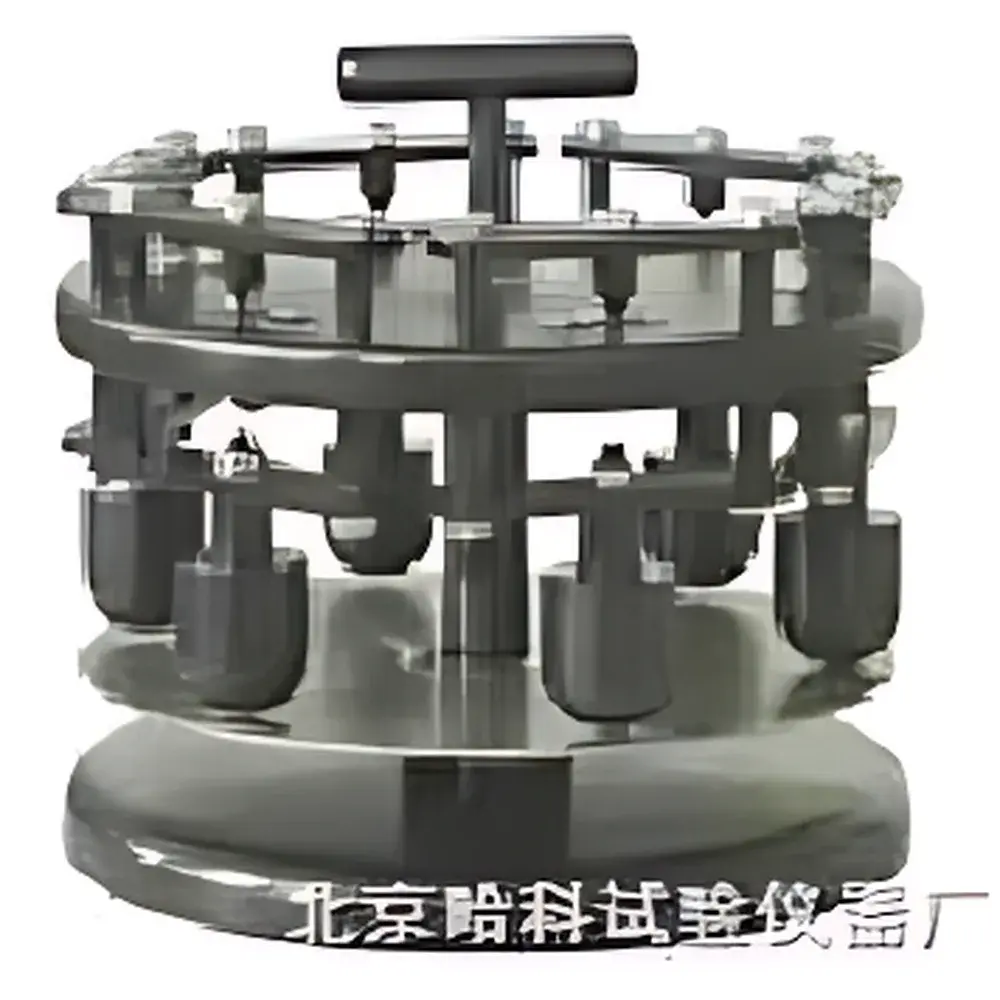
DRY-3.5 Heat Deformation Tester for Cable Compounds
| Key | Origin: Beijing, China |
|---|---|
| Manufacturer Type | Distributor |
| Model | DRY-3.5 |
| Quotation | Upon Request |
| Total Force | 3.50 ± 0.02 N |
| Plunger Tip Diameter | 3.15 ± 0.03 mm |
| Test Station Capacity | 6-position fixture |
| Specimen Geometry | Ø12 mm circular disc or 12 mm × 12 mm square |
Overview
The DRY-3.5 Heat Deformation Tester is a precision-engineered instrument designed specifically for evaluating the thermal deformation behavior of polymer-based cable insulation and jacketing compounds under controlled mechanical load and elevated temperature conditions. It operates on the principle of standardized heat deflection under specified force—aligned with methodologies referenced in ASTM D648 (Deflection Temperature Under Load), ISO 75 (Plastics – Determination of Temperature of Deflection Under Load), and GB/T 1634 (Chinese national standard equivalent). Unlike general-purpose thermal analyzers, the DRY-3.5 implements a fixed-load, multi-station configuration optimized for routine quality control in wire & cable manufacturing and compound formulation labs. Its architecture ensures consistent axial loading via calibrated spring-loaded plungers, minimizing operator-induced variability and supporting reproducible inter-laboratory comparisons.
Key Features
- Stable 3.50 ± 0.02 N total applied force—achieved through traceable mechanical spring calibration, eliminating dependency on electronic load cells subject to thermal drift.
- Plunger tip geometry precisely maintained at 3.15 ± 0.03 mm diameter, ensuring uniform stress distribution across the specimen contact area per ISO 75–1 requirements.
- Six-position test frame enables parallel evaluation of multiple specimens—critical for statistical process control (SPC) and batch release testing without sequential delays.
- Thermally insulated bath chamber compatible with standard silicone oil or transformer oil media, supporting temperature ramp rates up to 120 °C at ±0.5 °C stability (when used with external circulator).
- Robust aluminum alloy frame with corrosion-resistant surface treatment, engineered for long-term dimensional stability in industrial laboratory environments.
- No embedded microprocessor or touchscreen interface—designed for integration into GLP-compliant workflows where manual observation and analog recording meet audit requirements.
Sample Compatibility & Compliance
The DRY-3.5 accepts only flat, rigid specimens conforming to standardized geometries: either circular discs of exactly 12.0 ± 0.1 mm diameter or square specimens measuring 12.0 ± 0.1 mm per side, with thickness between 3.0 and 10.0 mm. Specimens must be free of voids, delamination, or surface irregularities that could compromise load transmission. The tester complies with the specimen preparation protocols outlined in ASTM D648 Method A (1.82 MPa stress level) and ISO 75–2 Type B (1.8 MPa), enabling direct correlation with industry-accepted heat deflection temperature (HDT) benchmarks. While not itself certified to ISO/IEC 17025, the instrument supports laboratories pursuing accreditation by providing metrologically stable mechanical loading and unambiguous geometric constraints.
Software & Data Management
The DRY-3.5 is a manually operated, non-digital instrument—intentionally omitting proprietary software, Bluetooth connectivity, or automated data logging. This design choice aligns with regulatory expectations in regulated manufacturing settings (e.g., ISO 9001-certified cable plants, IATF 16949 audited suppliers), where paper-based or LIMS-integrated manual entry reduces validation burden. Users record deformation onset visually via calibrated scale or micrometer at defined temperature intervals, documenting results in accordance with 21 CFR Part 11–compatible electronic notebooks or bound logbooks with witness signatures. Calibration certificates for plunger force and tip geometry are supplied with each unit and recommended for annual re-verification against NIST-traceable reference standards.
Applications
- Quality assurance of PVC, XLPE, LSZH, and EPR cable compounds during incoming raw material inspection.
- Comparative HDT screening during polymer formulation development—particularly for flame-retardant additive systems where thermal softening onset directly impacts fire performance ratings.
- Batch-to-batch consistency verification prior to extrusion line qualification.
- Supporting technical documentation for UL, CSA, and CE marking submissions requiring empirical heat resistance evidence.
- Educational use in polymer engineering laboratories to demonstrate structure–property relationships between crosslink density, crystallinity, and thermomechanical response.
FAQ
What temperature range is supported by the DRY-3.5?
The instrument itself imposes no intrinsic upper limit; operational range depends entirely on the heat transfer medium and external temperature controller—commonly 30 °C to 150 °C using silicone oil with a calibrated circulator.
Can the DRY-3.5 be used for ASTM D1525 (Vicat Softening Temperature)?
No—Vicat testing requires a needle-shaped penetrator and different force profiles (e.g., 10 N or 50 N); the DRY-3.5’s 3.15 mm flat plunger and fixed 3.5 N load are specific to deflection-based HDT methods.
Is third-party calibration available for this model?
Yes—authorized metrology laboratories in China and EU member states offer force and dimensional calibration services traceable to national standards; calibration interval is recommended annually or per internal QA protocol.
Does the unit include heating bath or temperature controller?
No—the DRY-3.5 comprises only the mechanical test frame, plungers, and specimen holders; users must supply an external thermostatic bath with immersion capability and temperature readout.
How is specimen alignment verified before testing?
Each station includes a machined locating pin and depth stop to ensure consistent specimen seating; alignment is confirmed visually using a 0.02 mm feeler gauge between plunger face and reference surface.




