
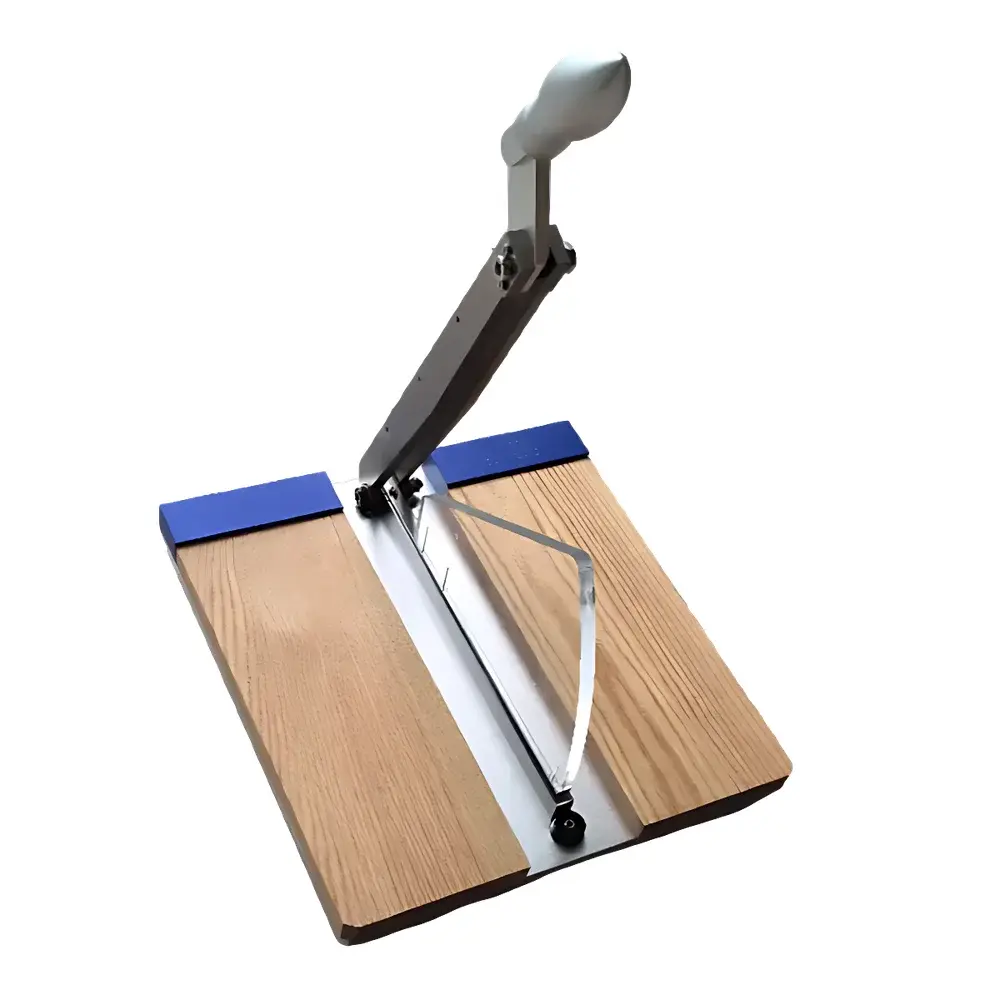
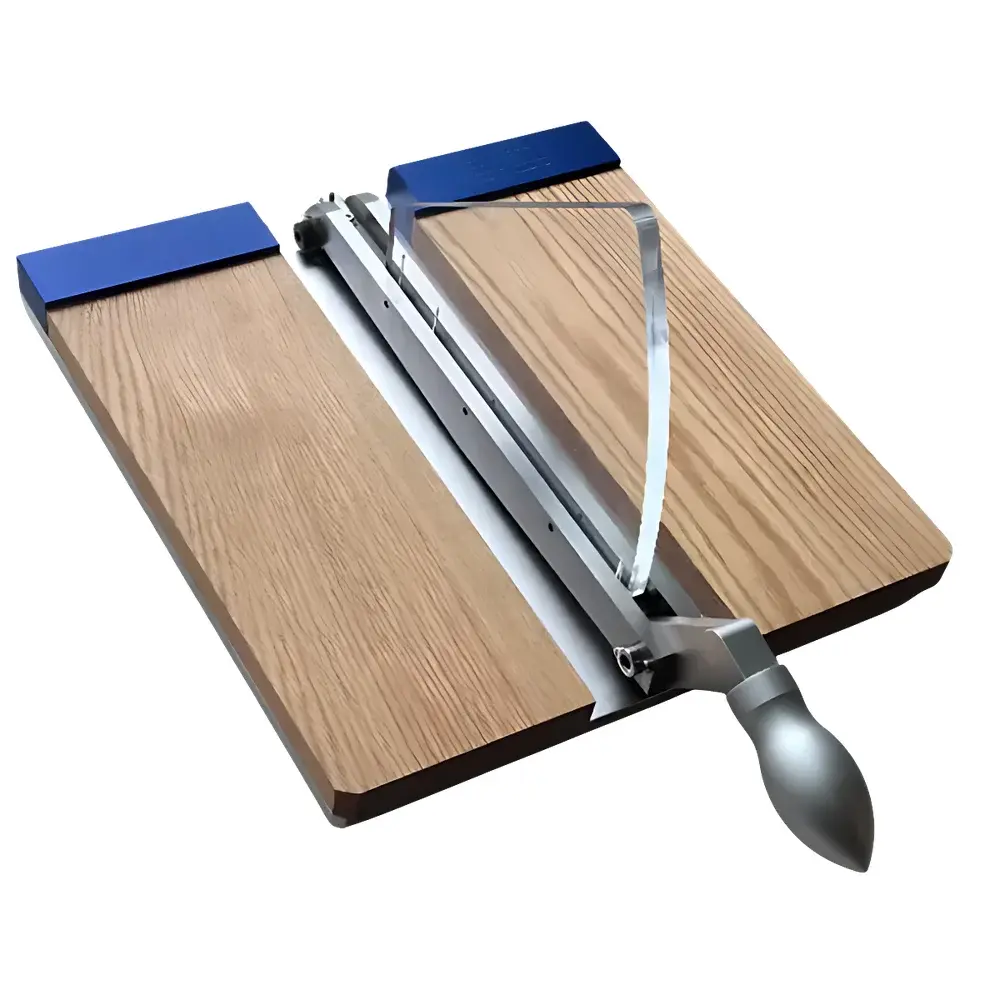
Dual-Edge Cutting Knife (Standard Paper Cutting Die)
| Brand | SHANG ZHUN |
|---|---|
| Origin | Guangdong, China |
| Manufacturer Type | Authorized Distributor |
| Origin Classification | Domestic |
| Model | KF22-36 / KF22-37 |
| Quotation | Available Upon Request |
| Cutting Width | 15 mm |
| Sample Length | 300 mm |
| Dimensional Accuracy | ±0.05 mm (KF22-36) or ±0.1 mm (KF22-37) |
| Material Thickness Range | 0.005–1.0 mm (paper), 0.005–0.6 mm (plastic film), 0.005–0.3 mm (aluminum foil) |
| Work Surface | Solid Natural Wood Base |
| Included Components | 1 × Dual-Edge Cutting Head, 1 × Ergonomic Handle, 1 × Solid Wood Cutting Platform |
Overview
The SHANG ZHUN Dual-Edge Cutting Knife (Model KF22-36/KF22-37) is a precision manual die-cutting tool engineered for standardized specimen preparation in quality control laboratories, packaging R&D facilities, and paper & film manufacturing environments. Designed in accordance with core principles of mechanical shear geometry and controlled blade engagement, it delivers repeatable, orthogonal cuts across flexible sheet materials without thermal distortion or edge deformation. Unlike rotary or guillotine-style cutters, this dual-edge system employs two parallel, hardened steel blades mounted in precise alignment to simultaneously engage both sides of the sample—minimizing lateral deflection and ensuring consistent cross-sectional integrity. Its application scope aligns with internationally recognized test method prerequisites for tensile, burst, tear, and grammage analysis where dimensional fidelity of specimens directly impacts measurement validity (e.g., ISO 1924-2, TAPPI T494, ASTM D828).
Key Features
- High-precision dual-blade architecture ensures symmetrical force distribution during cutting, reducing curling and micro-tearing in low-modulus substrates such as tissue paper and nonwovens.
- Interchangeable blade configuration supports both KF22-36 (±0.05 mm tolerance) and KF22-37 (±0.1 mm tolerance) specifications—enabling selection based on required metrological rigor per application tier.
- Fixed 15 mm cutting width and 300 mm maximum cut length provide compliance with standard specimen dimensions specified in ISO 536 (paper grammage), ISO 1924 (tensile testing), and ISO 5636 (air permeance).
- Natural solid wood base offers dimensional stability, vibration damping, and resistance to surface abrasion—critical for maintaining long-term planarity and repeatability under repeated operator loading.
- Ergonomic handle design minimizes hand fatigue during high-volume sampling; knurled grip surface ensures secure control even with gloved operation in cleanroom or industrial settings.
Sample Compatibility & Compliance
The KF22 series accommodates a broad spectrum of thin-sheet materials commonly encountered in physical testing protocols: uncoated and coated papers, corrugated board liners, metallized polyester films, aluminum foils, spunbond polypropylene nonwovens, and embossed sanitary tissue. Its validated thickness range—0.005–1.0 mm for paper, 0.005–0.6 mm for plastic films, and 0.005–0.3 mm for aluminum foil—is aligned with the upper limits of specimen thickness accepted by standard tensile testers (e.g., Instron 3340 series) and air permeability instruments (e.g., Gurley-type testers). All components comply with RoHS Directive 2011/65/EU for hazardous substance restrictions. While not certified to ISO/IEC 17025, the tool is routinely employed in GLP-compliant labs for sample prep preceding accredited testing.
Software & Data Management
As a purely mechanical, non-electronic specimen preparation device, the KF22-36/37 requires no firmware, drivers, or software integration. Its operational consistency relies solely on mechanical calibration and periodic blade inspection—not algorithmic control or digital feedback loops. Laboratories implementing electronic lab notebooks (ELNs) or LIMS platforms (e.g., LabWare, Thermo Fisher SampleManager) may log cutter usage, blade replacement cycles, and calibration verification dates manually or via barcode-scanned maintenance records. No data output interface is provided; however, its deterministic performance supports traceable documentation under FDA 21 CFR Part 11 when paired with controlled SOPs governing specimen preparation workflows.
Applications
- Preparation of standardized strips for tensile strength and elongation testing per ISO 1924-2 and TAPPI T494.
- Cutting uniform specimens for burst strength evaluation (ISO 2758) and Mullen test calibration.
- Generating defined-area samples for grammage determination (ISO 536) and caliper measurement validation.
- Producing test coupons from composite laminates prior to peel or shear adhesion assessment.
- Specimen conditioning for accelerated aging studies where edge integrity must remain unaffected by thermal or solvent-based cutting methods.
FAQ
Is blade replacement supported? What is the recommended maintenance interval?
Yes—blades are field-replaceable using standard hex-key tools. For routine QC use (≤50 cuts/day), inspect blade edge integrity every 200 operations; replace when burring or inconsistent cut quality is observed.
Can this cutter be used with automated feed systems?
No—the KF22-36/37 is designed exclusively for manual, operator-actuated cutting. It lacks mounting interfaces or pneumatic/electric actuation provisions.
Does the wooden base require special environmental conditioning?
The solid natural wood platform should be stored at 23 ± 2 °C and 50 ± 5 % RH to prevent warping. Avoid direct sunlight or proximity to HVAC vents.
Are calibration certificates available?
SHANG ZHUN provides a factory-verified dimensional conformance report with each unit, referencing traceable gauges calibrated to NIM (China National Institute of Metrology) standards. Third-party calibration is optional but not included by default.
What safety certifications apply to this device?
It conforms to general mechanical safety principles outlined in ISO 12100 and carries CE marking for mechanical equipment under Directive 2006/42/EC. No electrical safety certification applies, as no powered components are present.





