
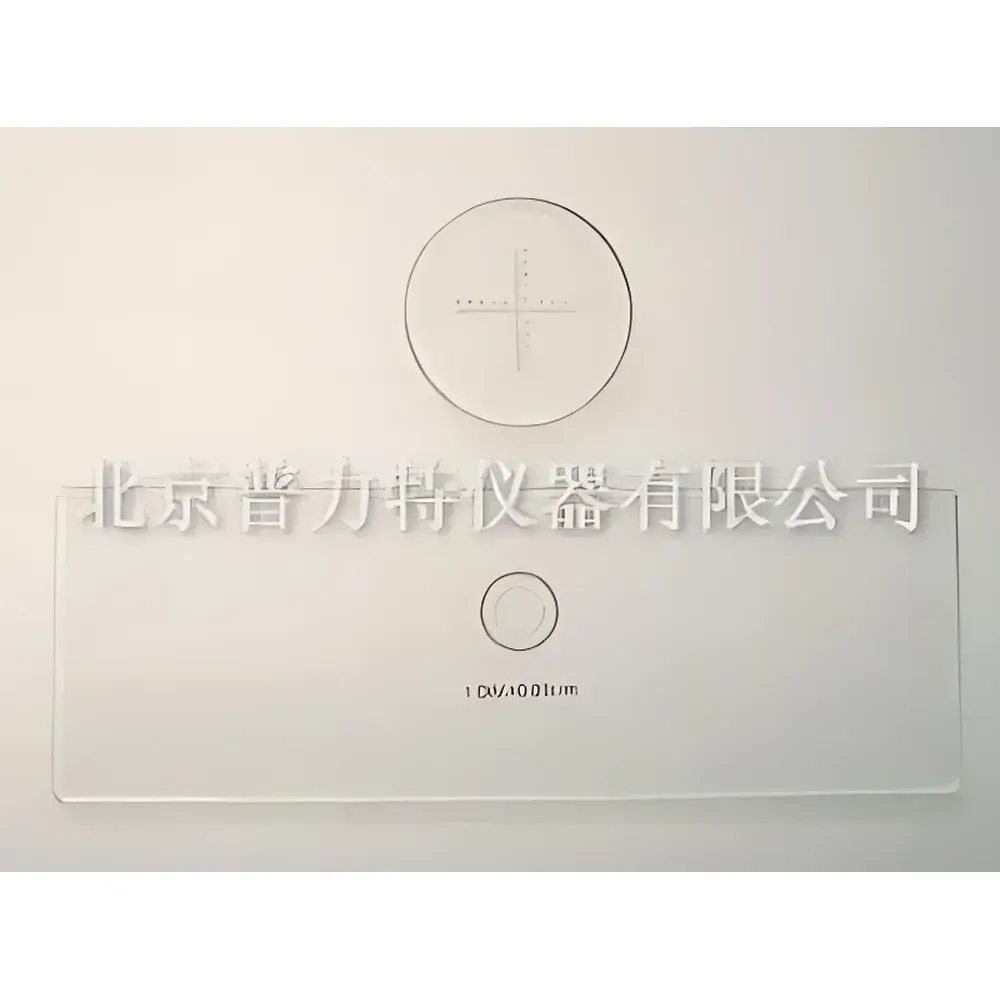
S/O-M Dual-Micrometer Calibration Set for Microscopic Plankton and Algal Sizing
| Origin | Beijing, China |
|---|---|
| Manufacturer Type | Authorized Distributor |
| Regional Origin | Domestic (PRC) |
| Model | S/O-M |
| Pricing | Available Upon Request |
Overview
The S/O-M Dual-Micrometer Calibration Set is a precision optical metrology tool engineered for quantitative morphometric analysis of planktonic and algal specimens under light microscopy. It comprises two interdependent components: a stage-mounted stage micrometer (mirror-stage micrometer) and an ocular micrometer (eyepiece graticule), both fabricated from optically stable borosilicate glass with laser-etched calibration marks. The system operates on the principle of comparative calibration—where the fixed-scale stage micrometer (10 µm per division) serves as the traceable reference standard to determine the true physical dimension represented by each division of the ocular micrometer under specific microscope optical configurations. This calibration process is essential for converting observed pixel- or graticule-based measurements into SI-traceable metric values (µm), enabling compliance with standardized protocols in environmental microbiology, limnology, and regulatory water quality assessment.
Key Features
- Stage micrometer with 1 mm total length and 0.01 mm (10 µm) graduation interval, certified for dimensional stability across temperature ranges typical of laboratory environments (15–30 °C).
- Ocular micrometer featuring 100-division circular scale, compatible with standard 23.2 mm field-of-view eyepieces (10×, 15×, and 20× magnification variants).
- Calibration equation embedded in operational protocol: Ocular division value (µm) = (Number of stage micrometer divisions between two coincident lines × 10) ÷ (Number of ocular micrometer divisions between same two lines).
- No electronic components or power requirements—designed for use with transmitted-light compound microscopes, inverted microscopes, and stereomicroscopes equipped with interchangeable eyepieces.
- Compliant with ISO 8596:2017 (Ophthalmic optics — Visual acuity testing — Standard charts) for graticule linearity verification methodology, adapted for biological metrology applications.
Sample Compatibility & Compliance
The S/O-M set supports direct measurement of phytoplankton (e.g., diatoms, dinoflagellates, cyanobacteria), zooplankton (e.g., rotifers, cladocerans, copepod nauplii), and colonial or filamentous algae in preserved or live-water samples prepared on standard glass slides or Sedgwick-Rafter chambers. It meets methodological requirements outlined in ASTM D5907-22 (Standard Test Methods for Determination of Total Suspended Solids and Total Dissolved Solids in Water), EPA Method 10200B (Microscopic Examination of Phytoplankton), and ISO 14442:2022 (Water quality — Enumeration of algae by microscopic counting). Calibration records generated using this set satisfy GLP documentation requirements for auditability, including operator signature, microscope configuration (objective × eyepiece), ambient conditions, and date-stamped verification.
Software & Data Management
While the S/O-M is a hardware-only calibration solution, it integrates seamlessly into digital microscopy workflows. When used in conjunction with image-capture systems (e.g., USB CMOS cameras, microscope-adapted DSLRs), calibrated ocular scale values enable pixel-to-micron conversion in open-source platforms such as ImageJ/Fiji or commercial software including NIS-Elements (Nikon), ZEN (Zeiss), and LAS X (Leica). All calibration calculations are manually documented per ISO/IEC 17025:2017 Clause 7.7 (Ensuring validity of results), supporting traceability to national standards via the stage micrometer’s defined 10 µm pitch. No proprietary drivers or firmware are required; no data storage or network connectivity is implemented—ensuring full compatibility with air-gapped analytical environments governed by ITAR or FDA 21 CFR Part 11 Annex 11 data integrity expectations.
Applications
- Quantitative biovolume estimation for trophic state index (TSI) modeling in freshwater reservoirs and estuarine systems.
- Size-class partitioning of phytoplankton communities to assess bloom dynamics and nutrient limitation responses.
- Regulatory reporting under China’s HJ 1081–2019 (Technical Specification for Monitoring of Phytoplankton in Surface Water) and EU WFD (Water Framework Directive) Article 5 monitoring programs.
- Method validation for ISO 16192:2022 (Water quality — Determination of algal biomass by chlorophyll-a measurement) where cell-size correction factors are applied.
- Training and proficiency testing in accredited environmental laboratories conducting ISO/IEC 17025 internal audits.
FAQ
How often must the ocular micrometer be recalibrated?
Recalibration is required whenever objective lens or eyepiece is changed, or if microscope alignment is adjusted. Best practice mandates recalibration at the start of each analytical session and after any mechanical disturbance to the optical train.
Can the S/O-M set be used with digital microscopes lacking traditional eyepieces?
Yes—when paired with a trinocular port and camera adapter, the stage micrometer remains visible in the live feed, allowing spatial calibration of the imaging sensor’s pixel dimensions using identical coincidence-line methodology.
Is certification of the stage micrometer traceable to national metrology institutes?
The stage micrometer is manufactured to dimensional tolerances consistent with JJG 553–2011 (Chinese National Verification Regulation for Micrometers), with optional third-party calibration certificates available upon request (CNAS-accredited labs).
Does this kit include instructions for uncertainty budgeting per GUM (Guide to the Expression of Uncertainty in Measurement)?
A technical appendix outlining dominant uncertainty contributors—including stage micrometer pitch tolerance (±0.2 µm), human parallax error (±0.5 division), and thermal expansion coefficient of glass—is provided in the user manual, aligned with ISO/IEC Guide 98-3:2008.
Related Products







