
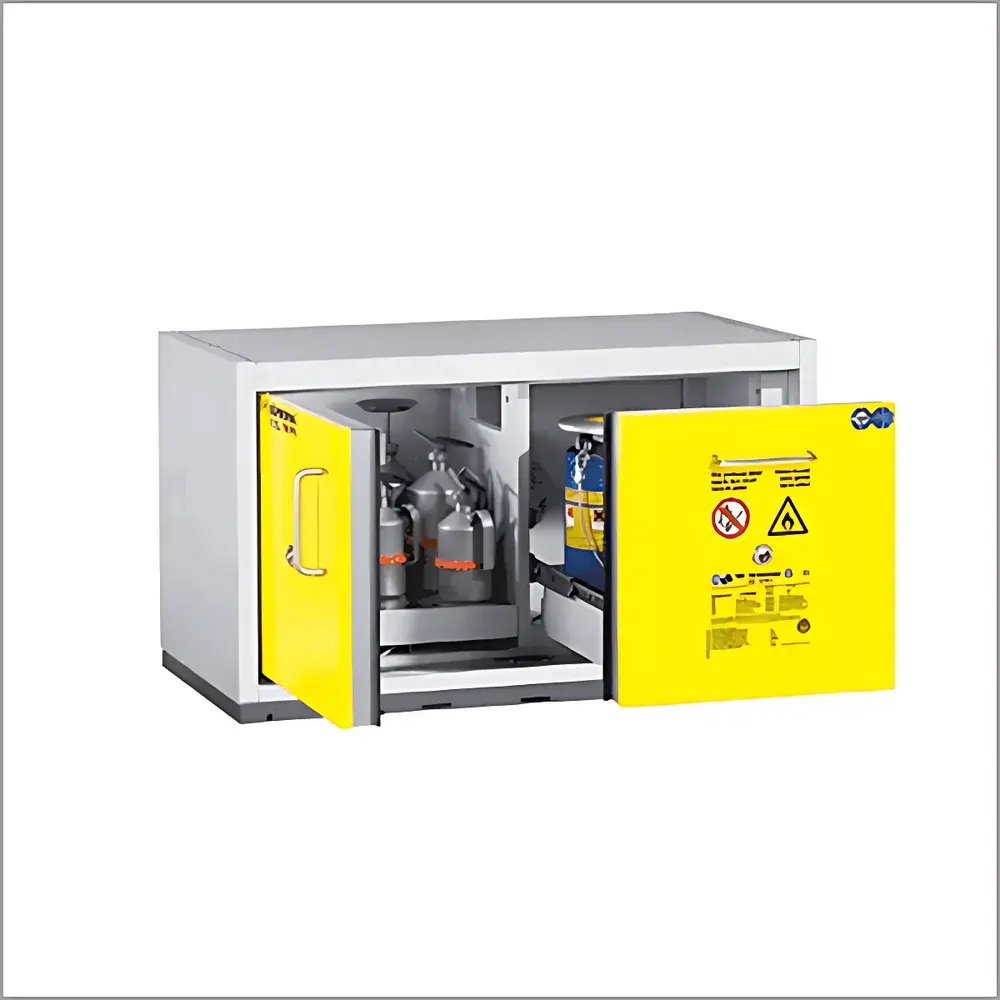
Dueperthal DUEPERTHAL Undercounter Safety Cabinet with Wing Doors and Drawer Configuration
| Brand | Dueperthal |
|---|---|
| Origin | Germany |
| Type | Undercounter Safety Cabinet |
| Door/Access Mechanism | Wing Doors + Drawer System |
| Construction Material | Steel (EN 14470-1 compliant) |
| Fire Resistance Rating | 90 min (DIN 14470-1 Class 90) |
| Compliance | CE, GS, ISO 9001, EN 14470-1, EN 1363-1 |
| Application | Storage of Flammables, Corrosives, Toxics, Pressurized Gas Cylinders, and Sensitive Documentation |
Overview
The Dueperthal Undercounter Safety Cabinet with Wing Doors and Drawer Configuration is a certified, space-optimized storage solution engineered for laboratories, pharmaceutical production facilities, and industrial R&D environments where floor space is constrained but regulatory compliance and operational safety are non-negotiable. Designed and manufactured in Germany to EN 14470-1 Class 90 fire resistance standards, this undercounter cabinet integrates passive fire protection with ergonomic accessibility—enabling secure containment of hazardous substances directly beneath standard laboratory workbenches or fume hoods. Its measurement principle is based on thermally insulated double-walled steel construction with intumescent seals and self-closing wing doors, which activate automatically during thermal exposure to maintain internal temperature below 180 °C for ≥90 minutes—ensuring integrity of stored materials and structural stability during fire events. Unlike generic storage cabinets, the Dueperthal design incorporates pressure-relief vents, anti-static grounding terminals, and spill containment sumps conforming to DIN 12925-1, making it suitable for multi-category hazard storage without cross-contamination risk.
Key Features
- Undercounter footprint (typically 600 × 600 × 850 mm H) optimized for integration beneath benchtops or adjacent to analytical instrumentation
- Wing door system with gas-spring-assisted opening and automatic thermal-release closing mechanism (activation at 50–55 °C)
- Dual-access configuration: upper compartment with hinged wing doors for rapid access to liquids or documentation; lower drawer module with full-extension ball-bearing slides for controlled retrieval of cylinders, bottles, or sample containers
- Double-walled 1.5 mm cold-rolled steel housing with 40 mm mineral wool insulation and intumescent door gaskets meeting EN 1363-1 fire endurance criteria
- Integrated 50 mm deep spill containment sump with removable galvanized steel tray (capacity: ≥110% of largest container volume)
- Grounding terminal (M6 brass stud) pre-installed for static dissipation in flammable liquid storage applications
- Adjustable, corrosion-resistant shelf supports and drawer dividers compatible with polypropylene or stainless-steel inserts
Sample Compatibility & Compliance
This cabinet is validated for concurrent storage of diverse hazard classes under a single enclosure—provided segregation protocols are followed per CLP/GHS labeling and local occupational safety regulations. Compatible substances include: Class I–III flammable liquids (flash point ≤ 60 °C), oxidizing agents (UN Class 5.1), organic acids (e.g., nitric, sulfuric), alkalis (e.g., sodium hydroxide solutions), toxic compounds (e.g., cyanides, heavy metal salts), pressurized gas cylinders (up to 2× 5 L capacity), and moisture-sensitive documentation or calibration certificates. All units undergo factory-certified fire testing per EN 14470-1 and bear GS/CE marks issued by TÜV Rheinland. Quality management adheres to ISO 9001:2015, with full traceability of raw material certifications (e.g., EN 10130, EN 10142). Not intended for volatile peroxide-forming solvents without additional vapor monitoring integration.
Software & Data Management
As a passive mechanical safety device, this cabinet does not incorporate embedded electronics or software. However, its design supports digital workflow integration via standardized mounting interfaces for third-party environmental monitoring systems (e.g., temperature/humidity loggers, hydrogen sulfide or VOC sensors) compliant with IEC 61508 SIL-2. Optional accessories include RFID-tagged drawer labels and QR-coded asset tags aligned with ISO/IEC 18000-6C for CMMS (Computerized Maintenance Management Systems) linkage. Audit trails for cabinet commissioning, leak testing, and annual fire-resistance verification are documented per GLP Annex 11 requirements and archived in accordance with FDA 21 CFR Part 11 principles when paired with validated electronic record systems.
Applications
- Pharmaceutical QC labs: Secure storage of reference standards, cytotoxic intermediates, and solvent batches beneath HPLC or dissolution test stations
- University chemistry departments: Localized containment for teaching lab reagents—separating flammables (acetone, ethanol) from corrosives (HCl, NaOH) within shared bench zones
- Biotech cleanrooms: Installation in Grade C/D environments using optional stainless-steel cladding and HEPA-filtered ventilation kits (EN ISO 14644-1 compliant)
- Hospital pharmacy satellite dispensaries: HIPAA-compliant document and controlled substance storage with tamper-evident drawer locks
- Contract manufacturing organizations (CMOs): Integration into GMP Annex 1-aligned facility layouts where spatial efficiency and audit-ready fire documentation are critical
FAQ
Does this cabinet require external ventilation or ducting?
No—this is a self-contained, unventilated fire-rated cabinet. Forced ventilation is prohibited per EN 14470-1 §7.3. Optional active air-sampling ports may be added only for sensor integration, not exhaust.
Can it be installed in a seismic zone?
Yes—when anchored using M10 expansion bolts (supplied) to reinforced concrete substrates per ASCE 7-22 Category IV requirements. Seismic restraint kits are available as accessory SKUs.
Is the drawer module rated for cylinder storage?
The lower drawer is structurally reinforced to support two upright 5 L compressed gas cylinders (≤15 kg total), provided they are secured with integrated strap anchors and valve protection caps are used.
What maintenance intervals are specified?
Quarterly visual inspection of door seals, grounding continuity, and sump integrity; annual third-party fire-resistance revalidation recommended per DIN SPEC 18009.
Are custom dimensions or material upgrades available?
Yes—stainless-steel (1.4301) construction, extended fire rating (120 min), and electromagnetic lock integration are offered under Dueperthal’s OEM engineering program (lead time: 12–16 weeks).



