
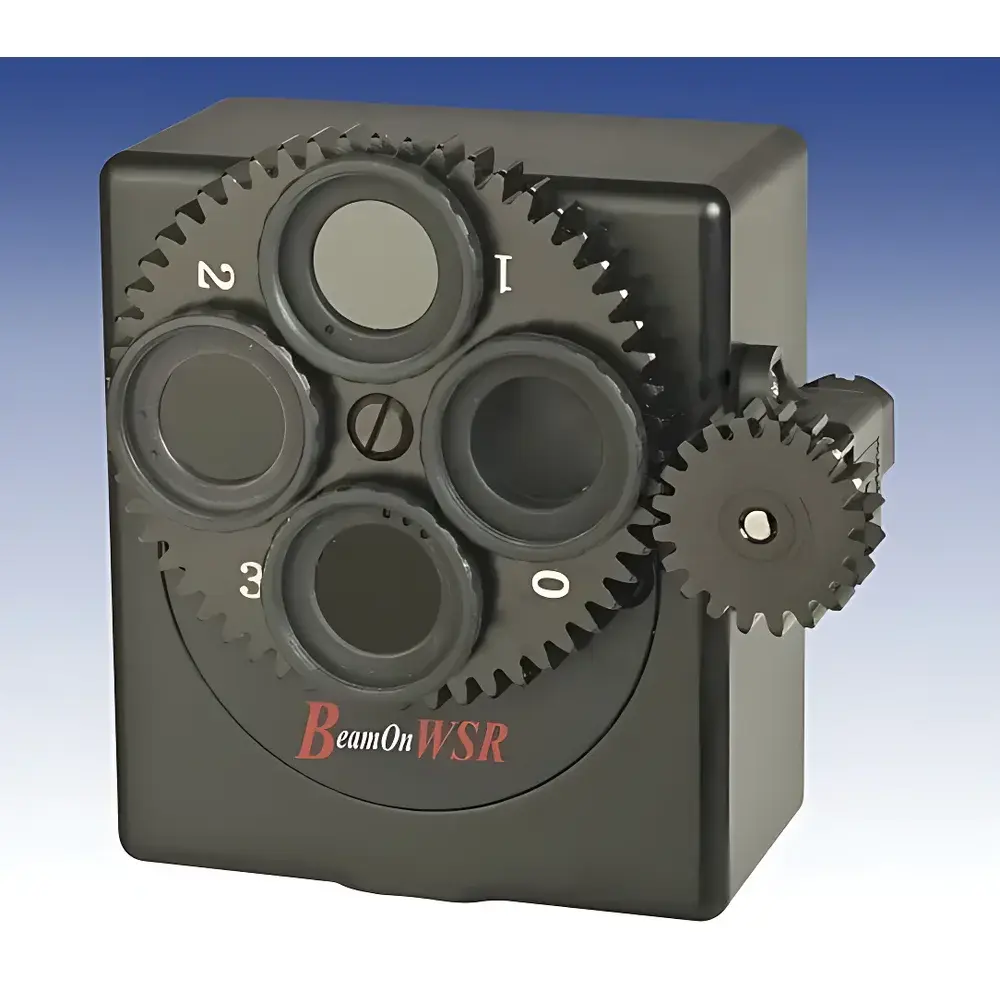
Duma Optronics Beam On WSR Camera-Based Laser Beam Profiler
| Brand | Duma Optronics |
|---|---|
| Origin | Israel |
| Model | Beam On WSR |
| Spectral Range | 190–1600 nm |
| Detector Type | WSR (Wide Spectral Response) CMOS Sensor |
| Active Area | 6.47 mm × 4.83 mm |
| Pixel Size | 8.6 µm (H) × 8.3 µm (V) |
| Resolution | 752 × 582 pixels |
| Interface | USB 2.0 |
| Max Frame Rate | 25 Hz (standard mode) |
| Shutter Speed | 1/50×256 s to 1/100,000 s |
| Gain | 6–41 dB |
| Sensitivity | ~160 µW/cm² @ 1550 nm (with ×256 shutter) |
| Saturation Power Density | ~1 mW/cm² @ 633 nm (no attenuation) |
| Damage Threshold | 50 W/cm² / 1 J/cm² (with full filter set) |
| Operating Temperature | −10 °C to +50 °C (non-condensing) |
| Dimensions | 80 mm × 78.5 mm × 49 mm |
| Weight | ~400 g (including cable) |
| Power Supply | 5 V, 0.6 A (USB 2.0 powered) |
Overview
The Duma Optronics Beam On WSR is a high-precision, camera-based laser beam profiler engineered for quantitative characterization of continuous-wave (CW) and pulsed laser beams across an exceptionally broad spectral range—from deep ultraviolet (190 nm) to near-infrared (1600 nm). Unlike scanning-slit or knife-edge profilers, the Beam On WSR employs a wide-spectral-response (WSR) CMOS imaging sensor with calibrated pixel geometry and linear photoresponse, enabling direct, non-scanning acquisition of 2D intensity distributions. This architecture supports real-time spatial analysis—including beam width (D4σ, ISO 11146-1 compliant), centroid position, ellipticity, kurtosis, and M² estimation when integrated with appropriate collimation and focusing optics. Designed for demanding industrial and research environments, the system maintains measurement stability under thermal drift, mechanical vibration, and variable ambient lighting—critical for in-line laser process monitoring, ultrafast amplifier alignment, and high-power fiber laser qualification.
Key Features
- Ultra-broad spectral response: 190–1600 nm, covering excimer, Ti:sapphire, Nd:YAG, fiber, and quantum cascade laser sources
- High dynamic range imaging: Adjustable gain (6–41 dB) and programmable shutter (1/50×256 s to 1/100,000 s) enable reliable profiling from µW/cm² to kW-class focused intensities (with optional attenuators)
- Real-time 2D/3D visualization: Live contour plots, cross-sectional line profiles, and volumetric intensity maps updated at up to 25 Hz
- Integrated optical filtering: Three calibrated neutral-density filters mounted on a motorized wheel for rapid, repeatable attenuation without manual handling
- USB 2.0 plug-and-play operation: No external power supply required; fully powered via host interface with deterministic latency and low jitter
- Rugged mechanical design: Aluminum housing, IP52-rated enclosure, and shock-absorbing internal mounting ensure operational integrity in production-floor environments
Sample Compatibility & Compliance
The Beam On WSR accommodates free-space beams ranging from sub-micron focal spots (e.g., 1.2 µm diffraction-limited f/2 focus) to unfocused beams up to 8 mm in diameter. Its 6.47 mm × 4.83 mm active area supports both single-mode and multimode beam geometries, including top-hat, donut, and Bessel profiles. The system complies with ISO 11146-1:2005 for beam width definitions and centroid calculation methodology. When used with traceable NIST-calibrated reference sources and validated alignment procedures, measurement data satisfies GLP and GMP documentation requirements. All firmware and software revisions maintain audit trails per FDA 21 CFR Part 11 guidelines for electronic records and signatures in regulated environments.
Software & Data Management
The included BeamGage Professional software provides full control over acquisition parameters, real-time statistical analysis (mean, RMS, peak-to-valley), and automated report generation in PDF or CSV formats. Batch processing supports time-series trending of beam position stability (µm-level resolution over 1-hour runs), power-normalized profile comparison across wavelengths, and pass/fail thresholding against user-defined specifications. Raw image data is stored in lossless TIFF format with embedded metadata (timestamp, exposure, gain, wavelength, filter ID). API support (DLL and Python bindings) enables integration into LabVIEW, MATLAB, and custom MES/SCADA systems for closed-loop beam stabilization feedback.
Applications
- Quantitative validation of beam shaping optics (e.g., diffractive optical elements, micro-lens arrays) in UV lithography and laser material processing
- In-process monitoring of fiber-coupled diode laser arrays during automotive battery welding and EV power electronics manufacturing
- M² factor determination for ultrafast oscillators and amplifier chains using multi-plane propagation analysis
- Alignment and stability assessment of high-power CO₂ and disk lasers in sheet metal cutting systems
- Characterization of structured light patterns in optical trapping and optogenetics platforms
- Calibration of photodetector arrays and CCD-based wavefront sensors
FAQ
What is the maximum average power the Beam On WSR can measure without damage?
With all three ND filters installed, the detector withstands incident fluences up to 1 J/cm² (pulsed) and average irradiances up to 50 W/cm²—sufficient for direct measurement of focused kW-class CW beams when properly attenuated.
Does the system support M² measurement out of the box?
Yes—when used with the optional Beam Propagation Kit (including motorized translation stage and collimated reference source), BeamGage Professional performs ISO-compliant M² calculations via iterative beam waist and divergence fitting.
Can the Beam On WSR operate in vacuum or controlled atmospheres?
The standard unit is rated for ambient air operation only; however, a custom hermetic version with fused silica viewport and vacuum-compatible housing is available upon request.
Is calibration traceable to national standards?
Each unit ships with a factory calibration certificate referencing NIST-traceable irradiance and spatial scale standards; annual recalibration services are offered through Duma’s ISO/IEC 17025-accredited lab.
How does the WSR sensor differ from standard silicon CMOS detectors?
The WSR sensor incorporates proprietary anti-reflective coatings and back-thinned architecture to extend quantum efficiency below 250 nm and above 1100 nm—enabling accurate profiling of excimer, supercontinuum, and mid-IR OPO sources without spectral gaps.



