
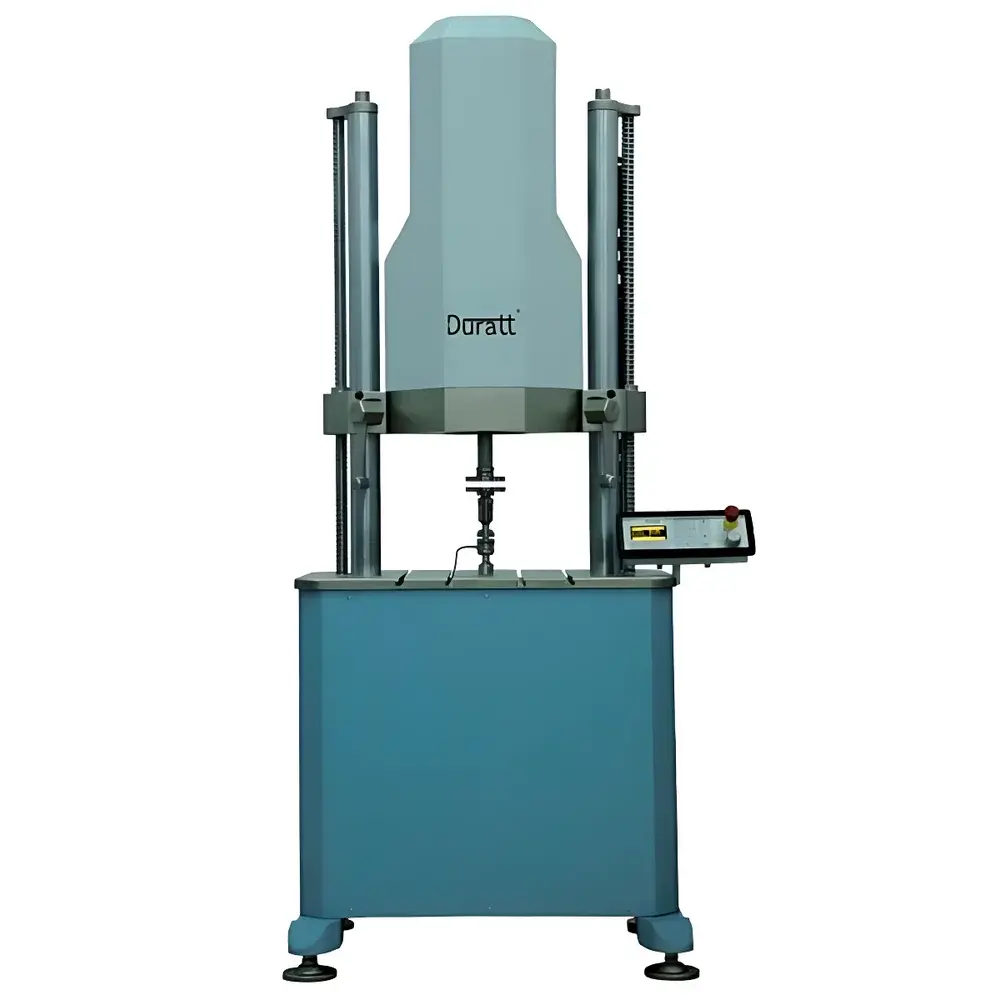
Duratt D8000/D10000/D12000 High-Load Electromagnetic Fatigue Testing System
| Brand | Duratt |
|---|---|
| Origin | Shanghai, China |
| Model | D8000 / D10000 / D12000 |
| Max Dynamic Force | 12000 N |
| Frequency Range | 0.01–100 Hz |
| Dynamic Displacement | ±30 mm |
| Host Weight | 200 kg |
| Compliance | CE-certified electrical design |
| Actuation | Custom high-performance linear motor with integrated ball-screw vertical positioning |
Overview
The Duratt D8000/D10000/D12000 is a high-force electromagnetic fatigue testing system engineered for precision dynamic mechanical analysis (DMA) and static-dynamic biaxial testing of advanced materials and miniaturized components. Utilizing a custom-designed high-bandwidth linear motor actuator, the platform delivers controlled sinusoidal, stepped, or arbitrary waveform excitation across a frequency spectrum from quasi-static (0.01 Hz) up to 100 Hz—enabling both low-cycle fatigue (LCF) and high-cycle fatigue (HCF) characterization. With a maximum dynamic force capacity of 12,000 N and peak-to-peak displacement of ±30 mm, the system supports rigorous mechanical loading protocols under programmable amplitude, phase, and dwell conditions. Its rigid monolithic frame and preloaded ball-screw vertical positioning mechanism ensure minimal parasitic motion, high axial stiffness (>250 kN/mm), and long-term mechanical stability—critical for reproducible fatigue life measurement and modulus tracking over thousands of cycles.
Key Features
- Electromagnetic actuation architecture with zero hydraulic fluid, eliminating seal wear, oil contamination, and thermal drift—ideal for cleanroom and regulated lab environments.
- Integrated high-resolution load cell (±0.5% FS accuracy) and non-contact LVDT displacement transducer (±0.1% FS linearity) for traceable force-displacement data acquisition.
- CE-compliant electrical safety design, including emergency stop circuitry, overload protection, and interlocked enclosure access control per EN 60204-1.
- Human-centered mechanical interface: motorized height adjustment, quick-clamp specimen mounting, and modular tooling interface compatible with ASTM E4, ISO 1099, and ASTM D7028 fixtures.
- Thermal and environmental extensibility: standardized flanges for integration with environmental chambers (–70 °C to +300 °C), saline immersion baths (ASTM B117 compliance), and optional torsional actuator modules for combined axial-torsional loading.
Sample Compatibility & Compliance
The system accommodates specimens ranging from sub-millimeter thin films (via micro-grip adapters) to structural coupons (up to 150 mm gauge length). Standard test geometries include uniaxial tension/compression, three- and four-point bending, and resonant beam configurations. It fully supports ISO 1099 (metallic materials — fatigue testing), ASTM E606 (strain-controlled fatigue), ASTM D7028 (polymer matrix composites), and ISO 6721 (dynamic mechanical properties of plastics). When configured with temperature control and calibrated reference standards, it meets GLP documentation requirements for material qualification in aerospace (SAE AMS), medical device (ISO 14801), and automotive (SAE J227a) applications.
Software & Data Management
Control and analysis are executed via the Duratt DMA Control Suite—a Windows-based application compliant with FDA 21 CFR Part 11 for audit trail, electronic signature, and data integrity. The software enables real-time closed-loop control using PID or adaptive feedforward algorithms, synchronized multi-channel acquisition (force, displacement, temperature, strain), and automated sequence execution (e.g., frequency sweeps, time-temperature superposition, stress relaxation ramps). Raw data exports in HDF5 and ASCII formats; post-processing includes storage/loss modulus (E′/E″), tan δ, creep compliance, and Coffin-Manson curve fitting. All calibration records, test logs, and user permissions are archived with timestamped metadata for full traceability.
Applications
- High-cycle fatigue evaluation of Ti-6Al-4V turbine blades and additively manufactured lattice structures.
- Viscoelastic characterization of thermoplastic polyimides and carbon-fiber-reinforced PEEK under thermal ramping (–40 °C to 150 °C).
- Dynamic stiffness mapping of MEMS packaging substrates and solder joint reliability assessment per JEDEC JESD22-B103.
- Low-amplitude, high-frequency vibration endurance testing of biomedical polymer stents (ISO 14801 Annex C).
- Combined axial-torsional fatigue of orthopedic implant alloys under physiological saline immersion (ASTM F2129).
- Nanoindentation-assisted fatigue crack nucleation studies using synchronized displacement-controlled loading and in situ AFM imaging.
FAQ
What is the maximum achievable force resolution at 100 Hz?
Force resolution remains ≤0.5% of full scale (i.e., ≤60 N at 12,000 N range) across the entire 0.01–100 Hz bandwidth, verified per ISO 13386 Annex B.
Can the system perform true strain-controlled fatigue tests?
Yes—when paired with an extensometer (contact or non-contact), the controller executes closed-loop strain control with adjustable gain scheduling to maintain waveform fidelity at high frequencies.
Is third-party calibration certification available?
NIST-traceable calibration certificates (per ISO/IEC 17025) are provided upon request, covering load, displacement, and temperature channels.
Does the software support automated pass/fail criteria based on hysteresis loop area or modulus degradation?
Yes—the DMA Control Suite includes configurable cycle-by-cycle analytics with user-defined thresholds for stiffness decay rate, energy dissipation, and phase angle drift.
What safety interlocks are implemented for environmental chamber integration?
Hardware-level interlocks cut power to the actuator if chamber door is opened, temperature exceeds set limits, or coolant flow drops below threshold—fully documented in the Safety Manual (EN 13849-1 PL e).



