
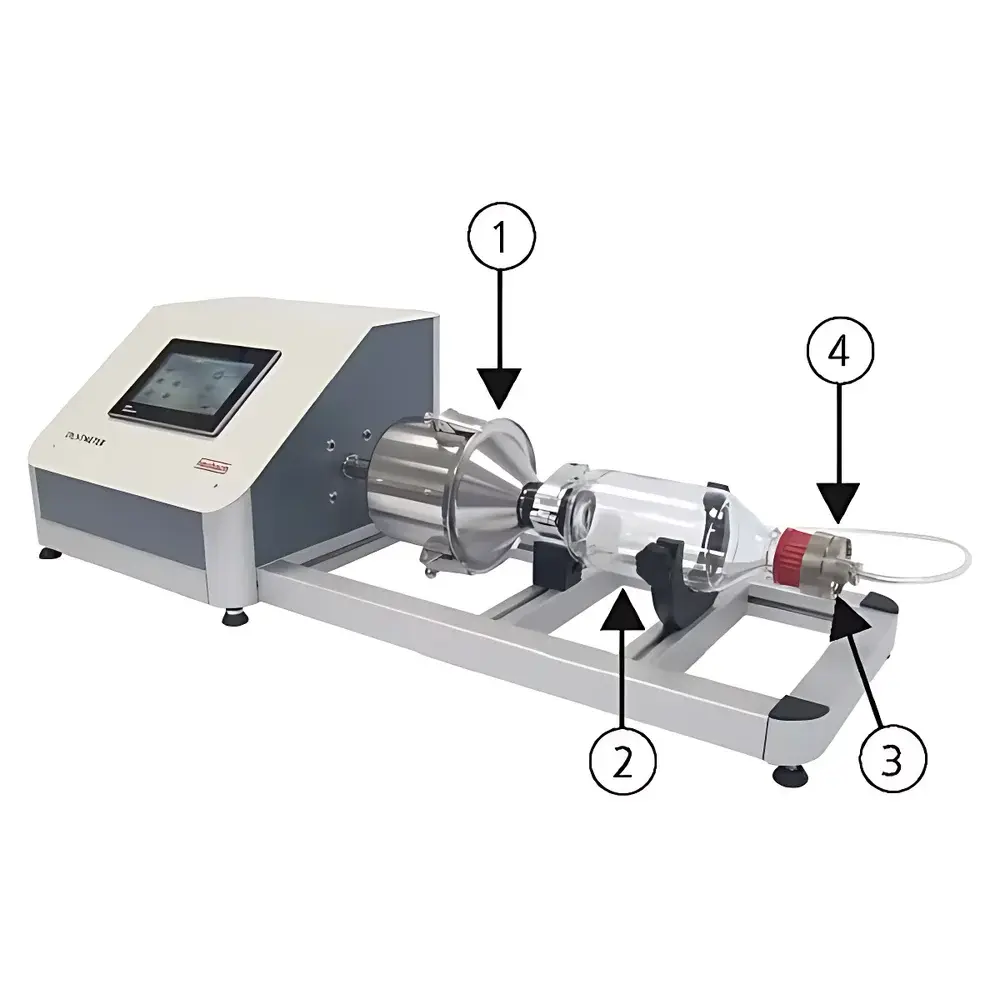
DUSTERTECH Dustmeter for Seed Coating Abrasion and Dust Emission Testing
| Brand | DUSTERTECH |
|---|---|
| Origin | Germany |
| Model | Dustmeter |
| Type | Seed Coating Abrasion & Dust Emission Analyzer |
| Compliance | Designed in accordance with EN 15236, ISO 17127-2, and EU Regulation (EC) No. 85/157 for feed additives |
| Airflow Control Range | 0.5–10 m³/h (adjustable, ±1% accuracy) |
| Rotational Speed | 0–120 rpm (stepless, programmable) |
| Test Duration | 1 s–99 min 59 s (programmable) |
| Sample Chamber Volume | 500 mL (standard stainless steel drum) |
| Filter Compatibility | 47 mm or 90 mm glass fiber or PTFE membrane filters |
| Power Supply | 100–240 V AC, 50/60 Hz |
| Dimensions (W×D×H) | 420 × 510 × 480 mm |
| Weight | 32 kg |
Overview
The DUSTERTECH Dustmeter is a precision-engineered instrument designed for quantitative assessment of dust emission from coated seeds and granular agrochemical formulations during handling, transport, and processing. It operates on the principle of controlled mechanical abrasion combined with standardized airborne particle capture — a methodology aligned with internationally recognized test protocols including ISO 17127-2 (Seed treatment — Determination of dust-off), EN 15236 (Animal feeding stuffs — Methods of sampling and analysis), and EU Regulation (EC) No. 85/157 concerning feed additives. Unlike legacy “fall-tube” methods, which rely on gravity-driven particle release under non-reproducible aerodynamic conditions, the Dustmeter employs a dynamically regulated air stream and programmable rotational agitation to simulate realistic post-coating stress scenarios. This ensures high inter-laboratory reproducibility and traceable measurement uncertainty — critical for regulatory submissions, product registration, and GLP-compliant quality assurance workflows.
Key Features
- Three configurable test modes (Type I, II, III) supporting method flexibility across seed coating, microgranule, and feed additive applications
- Microprocessor-controlled touchscreen interface with pre-loaded standard methods (e.g., ISO 17127-2 Annex A, EU 85/157 Annex II) and customizable parameter sets
- Automated airflow regulation via mass flow controller (MFC), enabling precise volumetric air delivery (0.5–10 m³/h) or time-based operation
- Adjustable drum rotation speed (0–120 rpm, stepless) to replicate conveying, pneumatic transport, or bagging-induced shear
- Modular design permitting field-upgrade from Type I to Type III configuration without hardware replacement of core electronics or chassis
- Stainless steel sample chamber (500 mL capacity) with interchangeable baffles and impeller assemblies for optimized particle liberation kinetics
- Integrated coarse particle separator (Type I/II) and optional vertical cyclonic fractionator (Type II) for size-selective dust classification
- Robust industrial-grade construction compliant with IP54 environmental rating and CE/EMC directives
Sample Compatibility & Compliance
The Dustmeter accommodates a broad spectrum of particulate agricultural materials: film-coated seeds (e.g., maize, soybean, cotton), pelleted biopesticides, micronized active ingredient blends, and animal feed premixes. Its Type I configuration satisfies routine QC requirements for dust-off quantification per ISO 17127-2. Type II implements the vertical separation stage mandated by EU Regulation 85/157 for feed additive registration dossiers, delivering enhanced resolution for respirable fraction (<10 µm) assessment. Type III introduces a dedicated abrasion chamber featuring a rotating impeller and four stainless steel impact balls — engineered specifically for low-dust development of granules and microgranules where surface cohesion and binder integrity are critical performance indicators. All configurations support filter-based gravimetric analysis and downstream characterization (e.g., SEM-EDS, laser diffraction, ICP-MS) of collected dust fractions.
Software & Data Management
The embedded firmware supports full audit trail functionality compliant with FDA 21 CFR Part 11 requirements, including electronic signatures, user access levels (Operator, Supervisor, Administrator), and immutable test log storage. Raw data — including real-time airflow profiles, rotational torque signatures, elapsed time stamps, and filter weight deltas — are exportable in CSV and XML formats. Optional PC-based software (DUST-ANALYZER Suite v3.2) enables statistical process control (SPC) charting, comparative cohort analysis, and automated report generation aligned with ISO/IEC 17025 documentation standards. Data integrity safeguards include checksum validation, cyclic redundancy checks (CRC), and automatic backup to external USB drives or network-attached storage.
Applications
- Formulation optimization of low-dust seed coatings to reduce operator exposure and environmental drift
- Regulatory dossier preparation for EU Plant Protection Product (PPP) and Feed Additive authorizations
- In-process quality control during commercial seed treatment line commissioning and routine operation
- Binder efficacy testing and polymer selection for controlled-release granular systems
- Comparative evaluation of dust suppression agents (e.g., polymeric anti-dust additives, humectants)
- Supporting occupational health risk assessments per EU Directive 2004/37/EC (carcinogens and mutagens)
- Method validation studies under GLP principles for contract research organizations (CROs)
FAQ
What standards does the Dustmeter comply with?
It supports test execution per ISO 17127-2, EN 15236, EU Regulation (EC) No. 85/157, and ASTM D7493 (Standard Test Method for Determination of Dust Generated from Agricultural Granular Products).
Can the same instrument be used for both seed and feed additive testing?
Yes — through hardware reconfiguration (Type I → Type II) and method selection, it meets distinct regulatory endpoints for both seed treatment and feed additive dust-off evaluation.
Is gravimetric analysis the only output option?
No — while filter weighing remains the primary quantification method, collected dust can be recovered for elemental analysis (ICP-OES), organic content (GC-MS), or particle size distribution (laser diffraction or cascade impactor coupling).
Does the system require external vacuum or compressed air?
No — all airflow is generated and regulated internally via an integrated brushless DC blower and MFC; no external utilities are needed.
How is calibration verified?
The airflow subsystem is factory-calibrated against NIST-traceable standards; users perform periodic verification using certified flow checkers (e.g., DryCal® units), with results logged automatically in the audit trail.




