
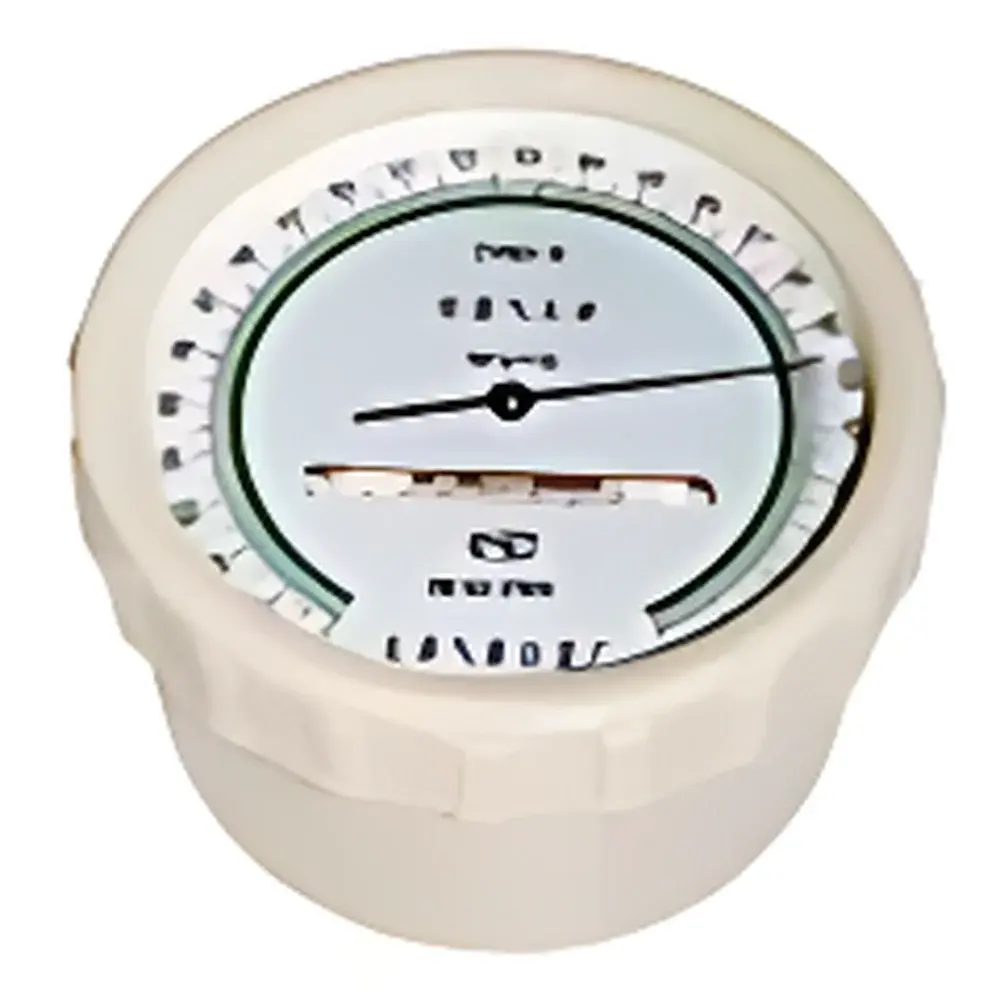
DYM3 Aneroid Barometer
| Origin | Beijing |
|---|---|
| Manufacturer Type | Distributor |
| Origin Category | Domestic |
| Model | DYM3 |
| Pricing | Upon Request |
| Pressure Range | 800–1064 hPa |
| Operating Temperature | −10 to +40 °C |
| Temperature Scale Range | −11 to +41 °C |
| Max. Pressure Error (after correction) | ≤2.0 hPa |
| Pressure Scale Division | 1 hPa |
| Temperature Scale Division | 1 °C |
| Weight | ≤1.5 kg |
| Dimensions | 156 mm × 156 mm × 115 mm |
| Standard Package | 1 unit barometer, 1 instruction manual, 1 certificate of conformity, 1 protective carrying case |
Overview
The DYM3 Aneroid Barometer is a mechanically operated, portable atmospheric pressure measurement instrument engineered for field and station-based meteorological observation. It operates on the fundamental principle of aneroid barometry: atmospheric pressure induces axial deformation in a sealed, evacuated metal capsule (aneroid cell stack), which—through precision linkage, gear train, and cam mechanism—is translated into rotational motion of a calibrated pointer across a circular pressure scale. Unlike mercury or digital barometers, the DYM3 requires no fluid medium or external power source, making it inherently stable, maintenance-light, and suitable for long-term deployment in remote weather stations, educational laboratories, environmental monitoring posts, and civil defense infrastructure. Its design conforms to the functional requirements of national meteorological observation standards for manual barometric reference instruments, and it serves as a primary or secondary standard in settings where traceable mechanical pressure indication is mandated.
Key Features
- High-stability aneroid capsule assembly with temperature-compensated bimetallic linkage to minimize thermal drift across the operating range (−10 °C to +40 °C).
- Dual-scale analog dial: primary pressure scale (800–1064 hPa) with 1 hPa graduation; integrated auxiliary thermometer (−11 °C to +41 °C) with 1 °C resolution for real-time temperature correction.
- Mechanical correction capability: built-in adjustment screw allows zero-point calibration using verified reference pressure sources (e.g., certified digital barometer or mercury standard).
- Robust aluminum alloy housing with anti-corrosive finish and ergonomic dimensions (156 mm × 156 mm × 115 mm) optimized for benchtop use and field portability.
- Maximum total error ≤ ±2.0 hPa after application of manufacturer-supplied temperature and altitude correction tables—meeting national verification criteria for Class II meteorological instruments.
- Self-contained, battery-free operation ensures continuous functionality during extended power outages or off-grid deployments.
Sample Compatibility & Compliance
The DYM3 is designed exclusively for ambient atmospheric pressure measurement at Earth’s surface under standard tropospheric conditions. It is not intended for sealed-vessel, differential, or vacuum applications. The instrument complies with JJG 272–2019 (Chinese Verification Regulation for Aneroid Barometers) and aligns with the metrological principles outlined in ISO 9001:2015 for measurement equipment control. While not certified to IEC 61000 electromagnetic compatibility standards (as it contains no electronics), its passive mechanical architecture ensures immunity to EMI/RFI interference—a critical advantage in lightning-prone or high-noise environments. For regulatory documentation, each unit ships with a factory-issued Certificate of Conformity referencing batch-specific calibration data and traceability to national pressure standards maintained by the China National Institute of Metrology (CNIM).
Software & Data Management
As a purely analog, non-digital instrument, the DYM3 does not interface with software or data acquisition systems. All readings are manually recorded and subject to post-measurement correction using printed correction tables provided in the instruction manual. Users are advised to log observations alongside concurrent temperature, time, and geographic coordinates to support QA/QC procedures in compliance with WMO No. 8 (Guide to Meteorological Instruments and Methods of Observation). For integration into automated weather stations, the DYM3 serves as a field validation reference—its readings may be cross-checked against electronic transducers (e.g., capacitive or piezoresistive sensors) during routine calibration audits per ISO/IEC 17025 requirements.
Applications
- Primary pressure observation at national and regional meteorological observatories where mechanical redundancy is required.
- Educational demonstration of gas laws, atmospheric physics, and classical instrumentation principles in university physics and earth science laboratories.
- Field calibration reference for portable electronic barometers used in environmental impact assessments and air quality monitoring networks.
- Backup pressure reference in aviation ground support facilities, mountain rescue stations, and maritime lighthouses.
- Historical climate data continuity—compatible with legacy observation protocols dating back to mid-20th century synoptic reporting standards.
FAQ
Does the DYM3 require periodic recalibration?
Yes. Annual verification against a traceable pressure standard is recommended per JJG 272–2019. Field zero adjustments may be performed more frequently if mechanical shock or rapid thermal cycling is suspected.
Can the DYM3 be used at high altitudes?
It is rated for operation up to ~3,000 m elevation. Beyond this, reduced ambient pressure may approach the lower limit of its scale (800 hPa); users must apply altitude-specific correction factors from the supplied manual.
Is the integrated thermometer certified independently?
No—the thermometer is a supplementary component calibrated only for correction purposes. It is not a standalone metrological instrument and carries no separate certification.
What maintenance is required?
Routine cleaning of the dial glass and housing; avoidance of exposure to condensation, solvents, or abrasive materials. No lubrication or internal servicing is intended for end users.
How is measurement uncertainty quantified?
Total expanded uncertainty (k=2) is ≤ ±4.0 hPa when including contributions from reading error (±0.5 hPa), temperature correction uncertainty (±1.0 hPa), and long-term stability drift (±0.5 hPa), as documented in the type evaluation report.







