
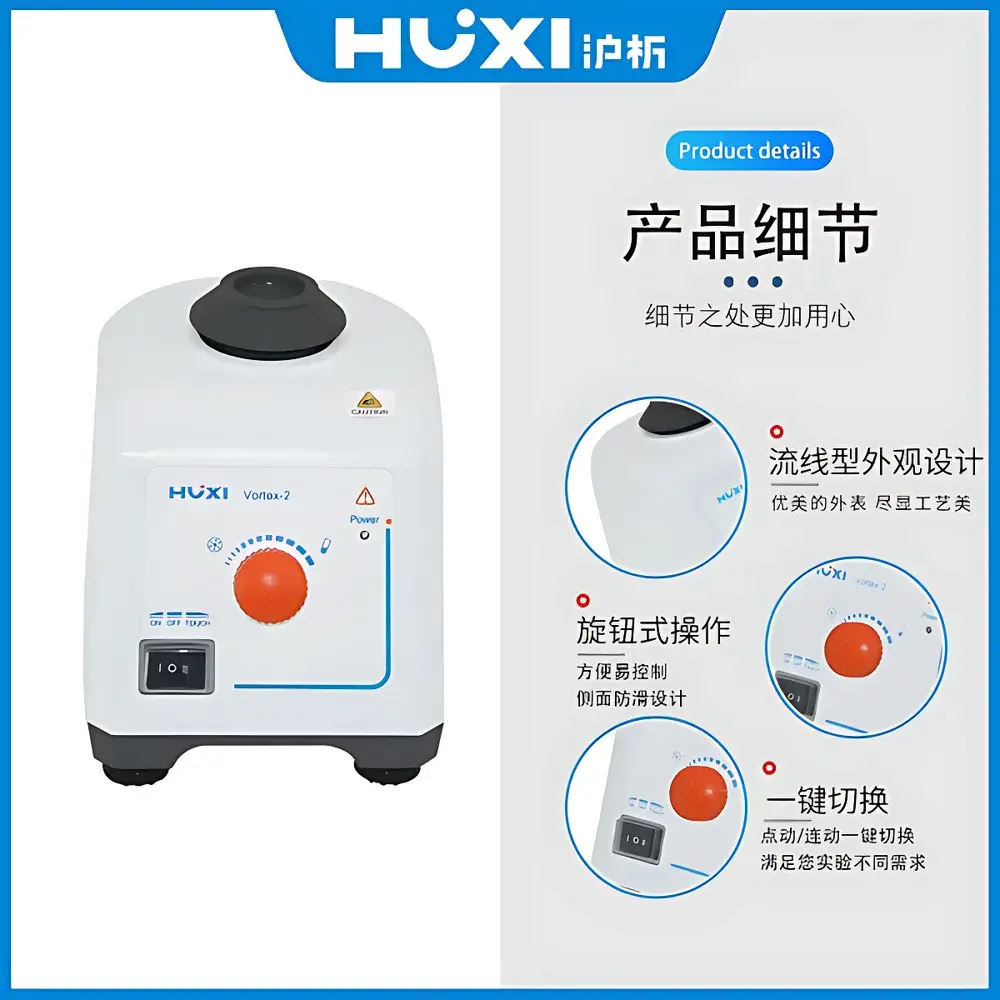
HUXI Vortex-1 Compact Orbital Vortex Mixer
| Brand | HUXI |
|---|---|
| Origin | Shanghai, China |
| Manufacturer Type | Direct Manufacturer |
| Country of Origin | China |
| Model | Vortex-1 |
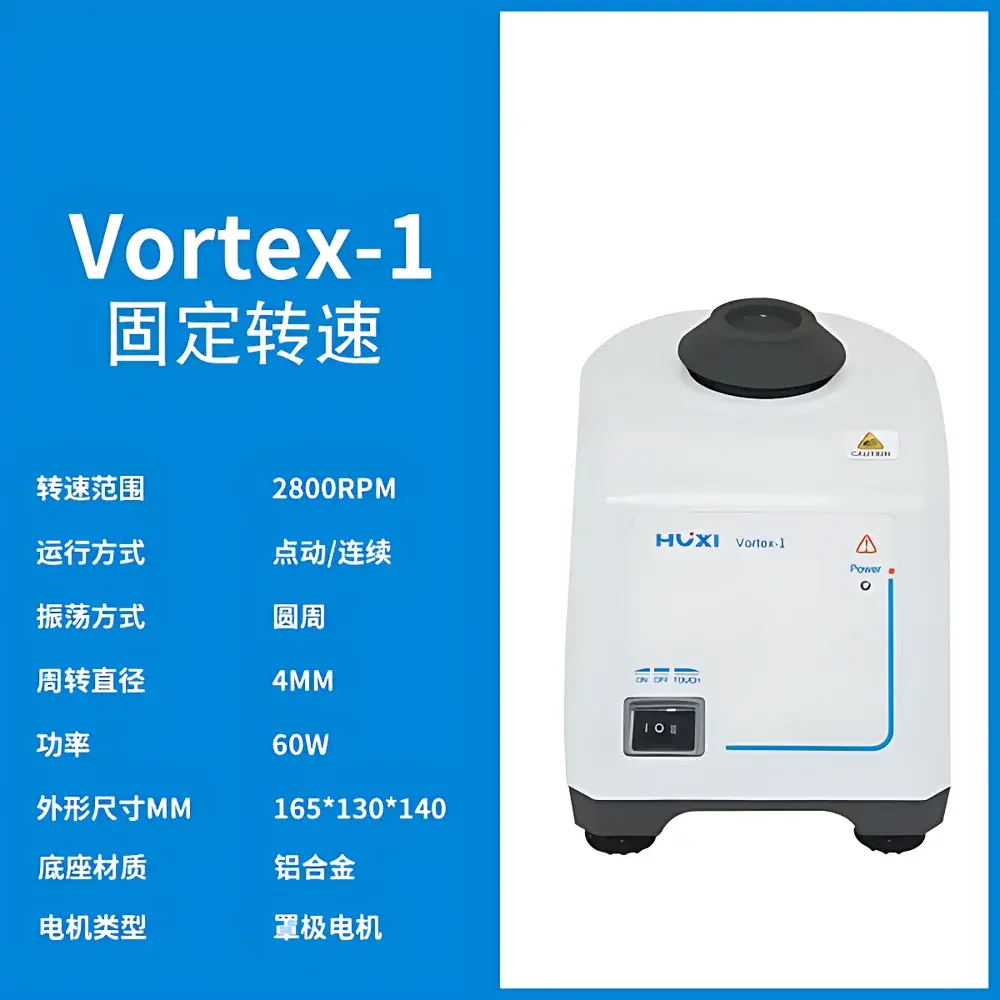
| Operating Mode | Touch-Start / Continuous Operation |
| Speed | 2800 rpm |
| Motion Type | Orbital (Circular) |
| Amplitude | 4 mm orbital diameter |
| Housing Material | Reinforced engineering thermoplastic (paint-free, acid/alkali resistant, impact-resistant) |
| Base Surface Material | TPU-coated corrosion- and wear-resistant platform |
| Foot Design | Silicone anti-slip pads |
| Display | Fixed-speed indication (no digital RPM readout) |
| Voltage | 100–120 V or 200–230 V (configurable) |
| Frequency | 50/60 Hz |
| Power Input | 60 W |
| Motor Type | Shaded-pole motor |
| Motor Output | 11 W |
| Dimensions (W×D×H) | 165 × 130 × 140 mm |
| Net Weight | 2.0 kg |
| Ambient Operating Temperature | 5–40 °C |
| Relative Humidity Limit | ≤80% RH (non-condensing) |
| Ingress Protection Rating | IP21 |
| Standard Accessories | One universal conical cup adapter (TPU-coated, wear-resistant) |
Overview
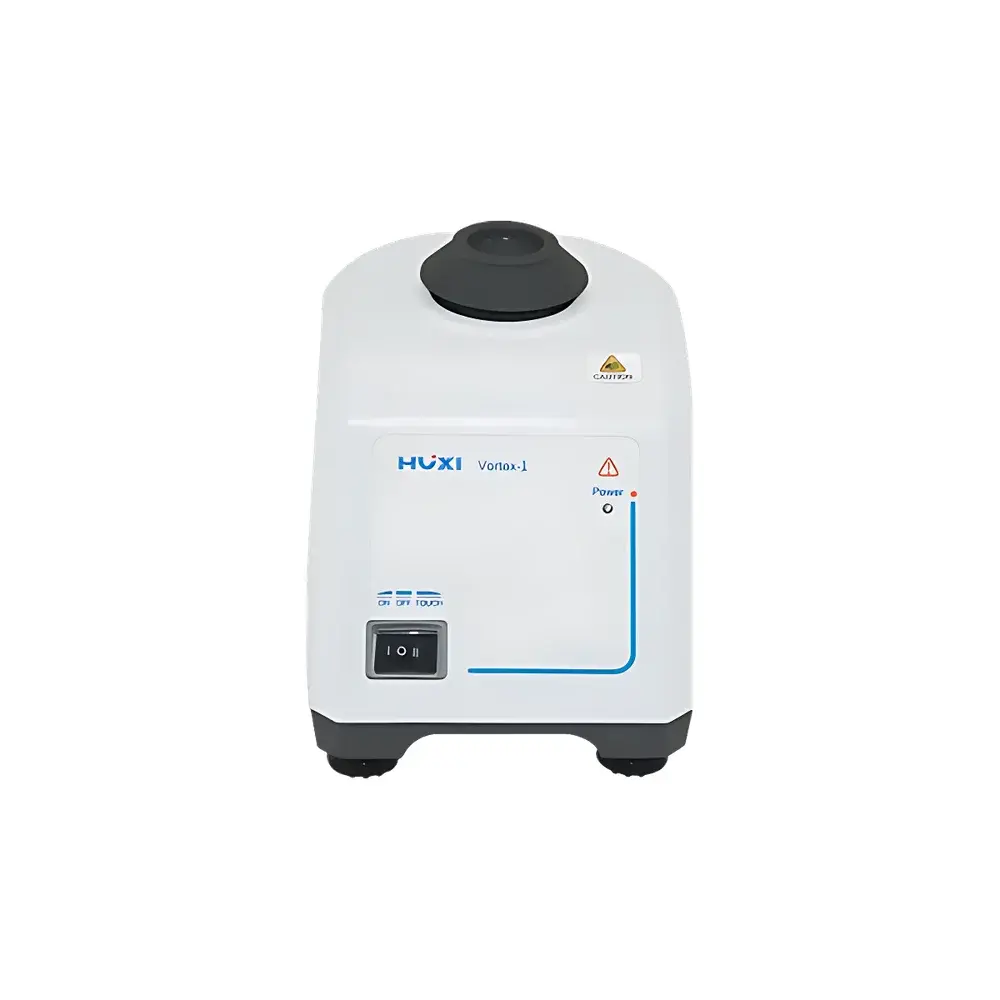
The HUXI Vortex-1 is a compact, fixed-speed orbital vortex mixer engineered for routine sample homogenization in life science, clinical diagnostics, and quality control laboratories. It operates on the principle of orbital eccentric motion—driven by a shaded-pole motor—to generate controlled circular agitation at a precisely maintained 2800 rpm. This mechanical action induces rapid fluidic shearing and particle suspension, enabling efficient mixing of low-viscosity liquid–liquid systems (e.g., reagent dilutions), liquid–solid suspensions (e.g., cell pellet resuspension), and dry powder blends (e.g., lyophilized standards or buffer salts). Its design prioritizes mechanical reliability over programmability: with no variable speed control or microprocessor-based logic, it eliminates firmware dependencies and reduces failure points—making it especially suitable for GLP-aligned environments where operational simplicity, audit trail minimization, and long-term calibration stability are critical.
Key Features
- Fixed 2800 rpm orbital motion ensures consistent energy input across repeated runs—critical for inter-laboratory reproducibility in standardized protocols (e.g., ISO 15197 pre-analytical steps or CLSI EP10 validation procedures).
- Eccentric ball-joint drive mechanism enables rapid attachment/detachment of the universal conical cup adapter without tools—supporting quick transition between tube formats (e.g., 0.5–15 mL conical tubes) while maintaining alignment integrity.
- Paint-free reinforced engineering plastic housing offers inherent chemical resistance to common laboratory solvents, diluted acids (e.g., 10% HCl), and alkaline buffers (e.g., 1 M NaOH), eliminating surface degradation risks associated with coated metal enclosures.
- TPU-coated work surface provides non-porous, abrasion-resistant contact area—resisting pitting from repeated tube impacts and preventing microbial entrapment that may occur with porous elastomeric surfaces.
- Silicone-damped foot pads absorb vibrational energy and prevent lateral displacement during continuous operation—even on stainless steel or laminated countertops—ensuring stable positioning under ISO 17025-compliant vibration-sensitive benchtop conditions.
- IP21-rated enclosure safeguards internal motor and wiring against vertically falling drips and solid objects >12.5 mm—meeting minimum environmental protection requirements for general-purpose lab use per IEC 60529.
Sample Compatibility & Compliance
The Vortex-1 accommodates standard conical centrifuge tubes (0.5–15 mL), PCR strip tubes, and small-volume vials via its integrated universal adapter. It is not intended for high-viscosity samples (>100 mPa·s), sealed pressurized vessels, or applications requiring temperature control. The device complies with IEC 61010-1:2010 for electrical safety in laboratory equipment and meets CE marking requirements for EMC (EN 61326-1) and low-voltage directive (2014/35/EU). While not FDA 21 CFR Part 11–compliant (due to absence of electronic data logging), its deterministic mechanical operation supports ALCOA+ principles—particularly attributable, legible, contemporaneous, original, and accurate recordkeeping—when paired with manual logbooks or LIMS-integrated run documentation.
Software & Data Management
This instrument operates without embedded software, firmware, or connectivity interfaces. No drivers, configuration utilities, or data export functions are provided. All operational parameters—including runtime, mode selection (touch-start vs. continuous), and maintenance history—are recorded externally per institutional SOPs. This architecture inherently satisfies regulatory expectations for “dumb device” classification under EU Annex 11 and FDA guidance on legacy instrumentation: no validation of software functionality is required, and periodic mechanical verification (e.g., rotational speed confirmation via calibrated tachometer per ASTM E2917) suffices for continued use.
Applications
- Resuspension of pelleted mammalian cells prior to viability staining (ISO 20392-compliant workflow preparation).
- Homogenization of DNA extraction lysis buffers with tissue homogenates in molecular biology workflows.
- Pre-analytical mixing of whole blood samples with anticoagulant additives prior to centrifugation (CLSI H20-A2).
- Rapid dispersion of powdered reagents (e.g., BSA, EDTA) into aqueous buffers for QC stock solution preparation.
- Blending of immunoassay conjugate reagents to ensure uniform antibody–enzyme coupling distribution before plate coating.
FAQ
Is the Vortex-1 compatible with 50 mL conical tubes?
No—the universal adapter is optimized for tubes up to 15 mL capacity. Larger vessels require dedicated heavy-duty vortex mixers with extended amplitude and torque output.
Can speed calibration be performed in-house?
Yes—using a non-contact optical tachometer traceable to NIST standards, users may verify rotational speed at intervals defined by internal QA policy (typically every 6 months or after 500 operating hours).
Does the unit support voltage switching between 100 V and 230 V?
No—voltage configuration must be selected at time of order; dual-voltage auto-switching is not supported.
What maintenance is required beyond cleaning?
Annual inspection of motor mounting screws and eccentric shaft play is recommended. No lubrication or belt replacement is needed—shaded-pole motors are sealed and maintenance-free.
Is the TPU work surface autoclavable?
No—TPU degrades above 70 °C; wipe disinfection with 70% ethanol or 0.5% sodium hypochlorite is the approved cleaning method.



