
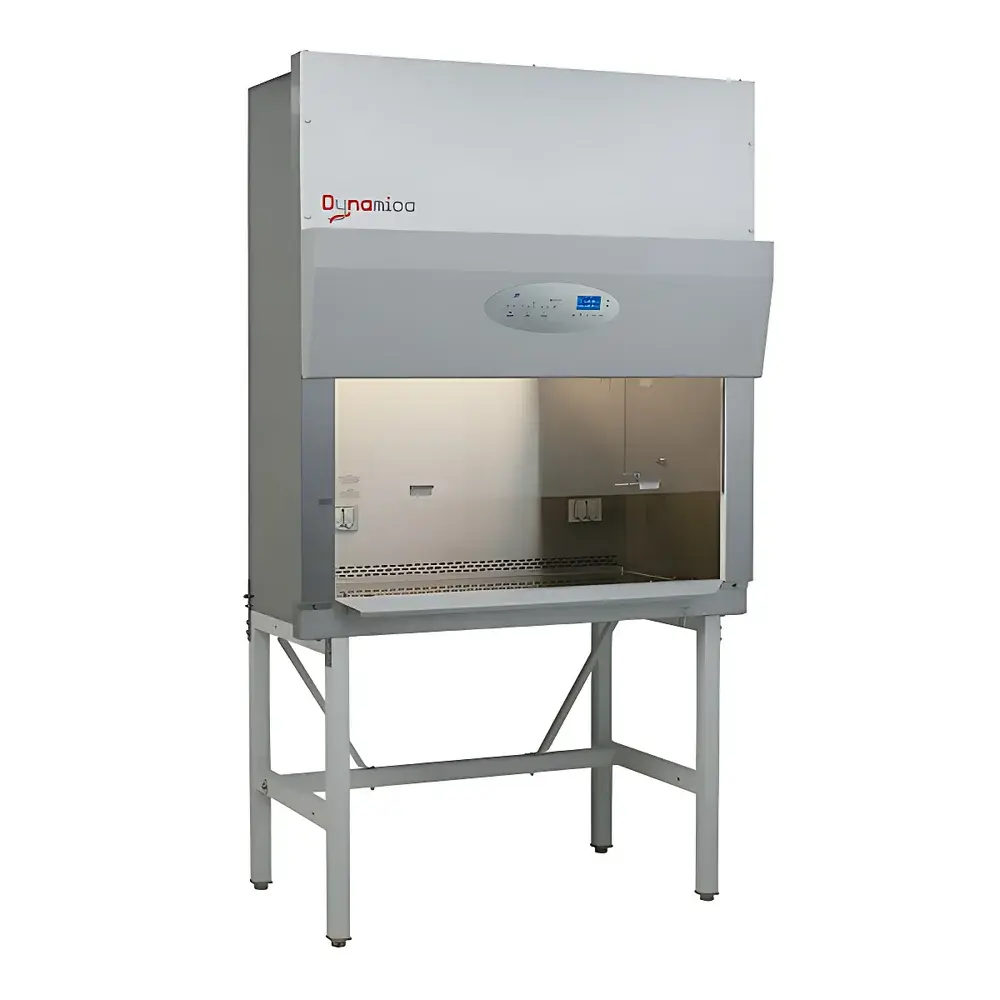
Dynamica NU-437-400S / NU-437-600S Class II A2 Biological Safety Cabinet
| Brand | Dynamica |
|---|---|
| Model | NU-437-400S / NU-437-600S |
| Type | Class II A2 Biological Safety Cabinet |
| External Dimensions (W×D×H) | 1972 × 835 × 1600 mm (NU-437-600S) / 1362 × 835 × 1600 mm (NU-437-400S) |
| Internal Work Area (W×D×H) | 1788 × 597 × 724 mm (NU-437-600S) / 1178 × 597 × 724 mm (NU-437-400S) |
| Inflow Velocity | 0.53 m/s |
| Downflow Velocity | 0.30 m/s |
| HEPA Filtration Efficiency | ≥99.999% for particles 0.1–0.3 µm (H14 grade) |
| Airflow Configuration | 30% exhaust, 70% recirculation |
| Construction | 16-gauge 304 stainless steel, fully welded double-wall chamber |
| Pressure Integrity | Withstands 500 Pa static pressure test |
| Compliance | YY 0569–2011 (China), aligned with NSF/ANSI 49 and EN 12469 principles |
Overview
The Dynamica NU-437 Series Class II A2 Biological Safety Cabinets are engineered for precision containment in biosafety-critical laboratory environments. Operating on the principle of directional laminar airflow combined with dual HEPA filtration—supply air is purified through an H14-grade HEPA filter before entering the work area as downward laminar flow, while contaminated air from the operator’s breathing zone is drawn inward at a controlled inflow velocity and either recirculated (70%) or exhausted (30%) after passing through a second H14 HEPA filter—the cabinet provides simultaneous protection for personnel, product, and environment. Designed to meet the stringent structural and performance requirements of YY 0569–2011, the NU-437 series also demonstrates functional alignment with international benchmarks including NSF/ANSI 49 and EN 12469, supporting applications involving Risk Group 1–3 microorganisms, low-to-moderate volatility chemical agents, and trace quantities of volatile radioactive nuclides.
Key Features
- Double-wall 16-gauge 304 stainless steel construction with full-penetration welding—eliminates crevices and supports long-term corrosion resistance and cleanability under GMP-compliant workflows.
- Monolithic inner chamber design: three-sided seamless forming ensures uniform surface integrity and minimizes microbial harborage points.
- H14-grade HEPA filters (both supply and exhaust) certified to retain ≥99.999% of particles between 0.1 and 0.3 µm; filter media protected by perforated stainless steel support grids.
- Microprocessor-controlled airflow management system with real-time LCD display showing both inflow (0.53 m/s) and downflow (0.30 m/s) velocities, with automatic alarm triggers for deviations beyond ±10% tolerance.
- Integrated safety interlocks: UV lamp activation disabled when sash exceeds 200 mm; sash position sensor initiates audible/visual alerts if opened beyond operational limit (495 mm max).
- Structural pressure integrity validated to 500 Pa differential—ensuring stable containment even during HVAC fluctuations or adjacent equipment operation.
Sample Compatibility & Compliance
The NU-437 series accommodates a broad range of life science workflows requiring concurrent personnel and product protection. It is validated for use with bacterial cultures (e.g., E. coli, Bacillus subtilis), viral vectors (lentiviral, adenoviral), mycobacterial species (including M. tuberculosis under BSL-3-aligned protocols), and low-volatility cytotoxic compounds. The cabinet’s 30% exhaust configuration permits safe handling of minute quantities of volatile radionuclides such as 3H or 14C-labeled reagents when coupled with appropriate external ducting and monitoring. All units are manufactured and tested per YY 0569–2011, with documentation supporting audit readiness for GLP and GMP environments. While not pre-certified to NSF/ANSI 49 or EN 12469, the design architecture, airflow mapping methodology, and filter specification are functionally equivalent and support third-party verification upon installation.
Software & Data Management
The embedded electronic control panel enables configurable parameter logging—including sash height history, airflow deviation events, UV exposure duration, and alarm timestamps—stored locally for ≥30 days. Data export is supported via USB interface in CSV format for integration into LIMS or electronic lab notebooks. The system complies with ALCOA+ data integrity principles: all entries are attributable, legible, contemporaneous, original, accurate, complete, consistent, enduring, and available. Audit trail functionality records user ID, timestamp, and action type for every configuration change, satisfying foundational expectations of FDA 21 CFR Part 11 for non-networked devices operating in regulated laboratories.
Applications
- Cell culture maintenance and transfection (primary cells, stem cells, hybridomas)
- Microbiological assay preparation and inoculation (antibiotic susceptibility testing, PCR setup)
- Handling of recombinant DNA constructs and viral packaging systems
- Preparation of radiolabeled tracers for autoradiography or scintillation counting
- Quality control testing of sterile pharmaceutical intermediates under ISO 14644-1 Class 5 conditions
- Teaching labs requiring robust, repeatable containment for undergraduate microbiology instruction
FAQ
What biosafety level does the NU-437 series support?
It is classified as a Class II A2 cabinet, suitable for work with Risk Group 1–3 agents under BSL-2 or BSL-3 containment conditions when integrated with appropriate facility engineering controls.
Can this cabinet be used for volatile chemical handling?
Yes—within defined limits. It safely accommodates low-volatility chemicals (e.g., ethanol, formaldehyde ≤0.05% v/v) but is not rated for high-vapor-pressure solvents like acetone or ether without supplemental external ventilation.
Is external ducting required?
Optional. The unit operates in recirculating mode by default; ducting is only necessary when exhausting >30% of total airflow or when local regulations mandate 100% exhaust for specific chemical classes.
How often must HEPA filters be replaced?
Under typical usage (8 hrs/day, 5 days/week), supply and exhaust filters maintain rated efficiency for 3–5 years. Replacement intervals should be determined by annual certification testing per YY 0569–2011 Annex D or equivalent ISO 14644-3 protocols.
Does the cabinet support remote monitoring?
No native Ethernet or Wi-Fi capability is included; however, analog voltage outputs (0–10 V) for inflow/downflow velocity signals are available for integration with building management systems (BMS) or custom SCADA interfaces.
Related Products




