
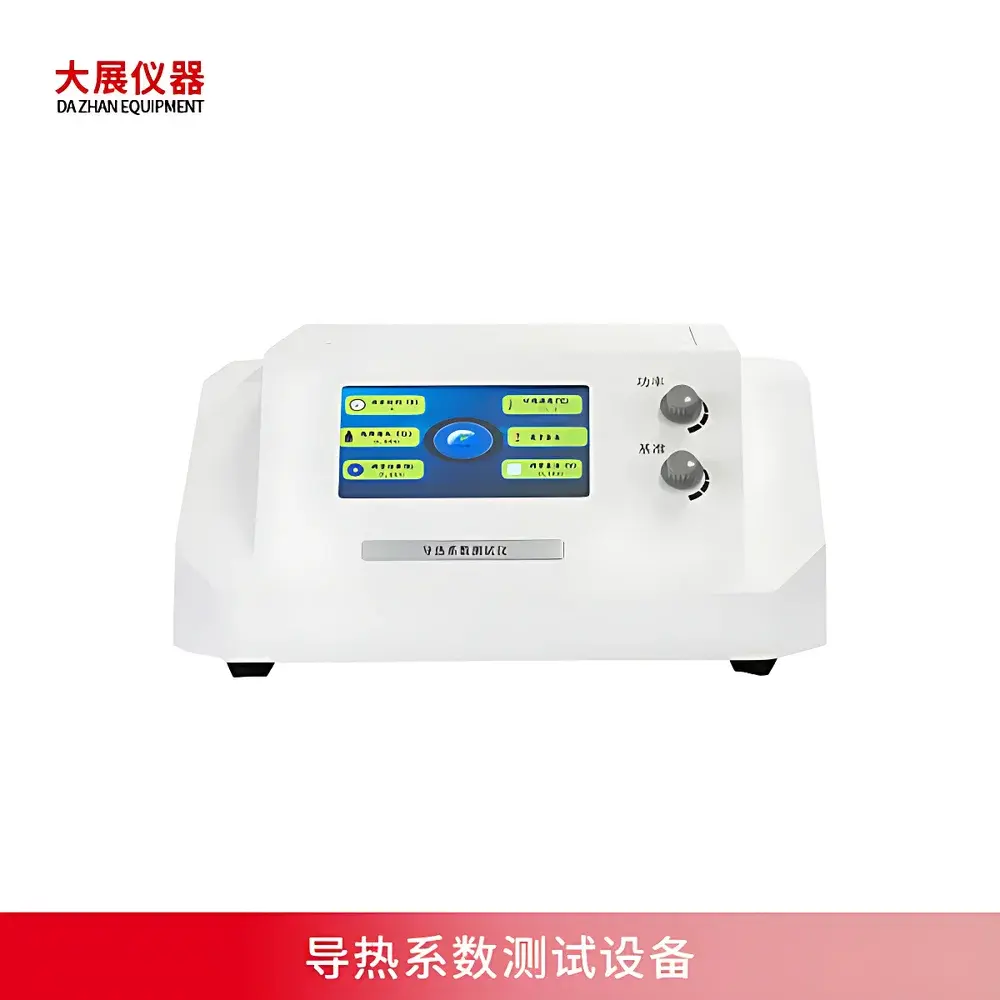
DZDR-S Transient Plane Source (TPS) Thermal Conductivity Analyzer by DAZHAN
| Brand | DAZHAN |
|---|---|
| Origin | Jiangsu, China |
| Manufacturer Type | Authorized Distributor |
| Country of Origin | China |
| Model | DZDR-S |
| Instrument Type | Transient Plane Source (TPS) Method |
| Sample Throughput | Single sample per test |
| Test Environment | Ambient pressure |
| Thermal Conductivity Range | 0.0001–300 W/(m·K) |
| Accuracy | ±3% |
| Dimensions (L×W×H) | 455 × 390 × 200 mm |
| Repeatability | ≤3% |
| Temperature Range | Room temperature to 130 °C (extendable to –40 °C to 300 °C with optional modules) |
| Sample Forms | Solids (bulk, film, powder, paste, gel), Liquids, Coatings, Insulating materials |
Overview
The DZDR-S Transient Plane Source (TPS) Thermal Conductivity Analyzer is an engineered solution for rapid, non-destructive measurement of thermal conductivity across a broad spectrum of material classes. Based on the ISO 22007-2 standard-compliant transient plane source method, the instrument applies a thin, resistively heated sensor—acting simultaneously as heat source and temperature probe—to the surface or interior of a sample. A controlled current pulse induces a transient temperature rise; the resulting thermal response is recorded in real time and analyzed using proprietary inverse modeling algorithms rooted in Fourier heat conduction theory. This principle enables direct determination of thermal conductivity without requiring steady-state equilibrium, eliminating lengthy equilibration delays typical of guarded-hot-plate or comparative cut-bar methods. Designed for laboratory and quality control environments, the DZDR-S delivers reliable data for R&D, material qualification, and process validation—particularly where heterogeneous, soft, or thermally anisotropic samples preclude conventional contact-based techniques.
Key Features
- Three interchangeable TPS sensors (7.5 mm, 15 mm, and 50 mm diameter) optimized for varying sample geometries and thermal diffusivity ranges—enabling consistent measurement fidelity from low-conductivity aerogels (0.0001 W/(m·K)) to high-conductivity metals and composites (up to 300 W/(m·K)).
- ARM-based embedded control system with real-time data acquisition at ≥1 kHz sampling rate, ensuring high temporal resolution during transient response capture and minimizing numerical error in derivative-based thermal parameter extraction.
- Touch-enabled color LCD interface with intuitive navigation—supporting test configuration, live curve visualization, result review, and calibration history access without external PC dependency.
- Non-invasive, geometry-tolerant measurement protocol: requires no specialized sample machining—only nominal surface flatness and minimum lateral dimensions (e.g., ≥2× sensor diameter) for solid specimens; powders and pastes are accommodated via dedicated containment fixtures.
- Thermal stability architecture: integrated PID-controlled temperature chamber (standard range: 25–130 °C; optional extension to –40 °C and 300 °C) ensures isothermal testing conditions compliant with ASTM E1530 and ISO 22007 series requirements.
- Low-power sensor excitation (≤1 W, ≤20 W, ≤22 W per probe size) minimizes self-heating artifacts and preserves sample integrity—critical for temperature-sensitive polymers, biological gels, and phase-change materials.
Sample Compatibility & Compliance
The DZDR-S accommodates diverse physical states without phase alteration or destructive preparation: rigid and flexible solids (including foams, ceramics, and composites), liquids (oils, solvents, nanofluids), semi-solids (greases, adhesives, thermal interface materials), particulates (metallic powders, ceramic granules), thin films (<50 µm), and multi-layered coatings. Its compliance framework supports traceable metrology workflows: measurement uncertainty budgets align with ISO/IEC 17025 guidelines; software audit trails satisfy FDA 21 CFR Part 11 requirements for electronic records; and calibration protocols reference NIST-traceable reference materials (e.g., SRM 1470a, certified graphite). Optional GLP/GMP mode enables user-defined electronic signatures, test batch logging, and report watermarking for regulated environments.
Software & Data Management
Bundled DZDR-Analysis Suite v3.2 provides full-cycle data handling—from automated test sequencing and real-time curve fitting (Levenberg-Marquardt optimization) to statistical reporting (mean, SD, CV%, confidence intervals). Raw time-temperature datasets export in CSV and HDF5 formats for third-party analysis (MATLAB, Python SciPy, OriginLab). The software enforces version-controlled method templates, configurable pass/fail thresholds per material class, and customizable PDF/Excel reports—including metadata (operator ID, ambient RH/T, sensor serial number, calibration date). Network-enabled operation allows centralized instrument monitoring via secure HTTPS API, supporting integration into LIMS and MES platforms under IEEE 802.3 Ethernet standards.
Applications
- Thermal interface material (TIM) qualification for electronics cooling—validating performance under compressive load and thermal cycling.
- Insulation material certification (aerogels, mineral wool, vacuum panels) per EN 12667 and ASTM C518.
- Pharmaceutical excipient characterization—assessing thermal transport in lyophilized cakes, hydrogels, and transdermal patches.
- Automotive battery pack R&D—mapping anisotropic conductivity in electrode coatings and separator membranes.
- Geopolymer and cementitious composite development—quantifying hydration-induced thermal property evolution.
- Food science applications—measuring thermal diffusivity in emulsions, dairy gels, and frozen matrices for predictive shelf-life modeling.
FAQ
What standards does the DZDR-S comply with for thermal conductivity measurement?
The instrument implements the transient plane source method in accordance with ISO 22007-2 and ASTM D5930, and supports validation against reference materials certified per ISO 17034 and NIST SRMs.
Can the DZDR-S measure anisotropic materials?
Yes—by orienting the sensor normal to principal axes and comparing orthogonal measurements, directional thermal conductivity tensors can be inferred for composites and layered structures.
Is sample contact resistance compensation included in the algorithm?
The embedded inversion model incorporates interfacial thermal resistance estimation via dual-sensor configuration or iterative boundary-condition refinement, reducing systematic bias in high-contact-resistance systems.
How is calibration traceability maintained?
Each sensor undergoes factory calibration using five NIST-traceable reference materials spanning 0.01–200 W/(m·K); users receive calibration certificates with uncertainty budgets and expiry dates.
Does the system support automated temperature ramping during measurement?
Yes—the optional high-temperature module enables programmable isothermal holds and linear ramps (0.1–5 °C/min) with synchronized thermal conductivity acquisition at defined setpoints.



