
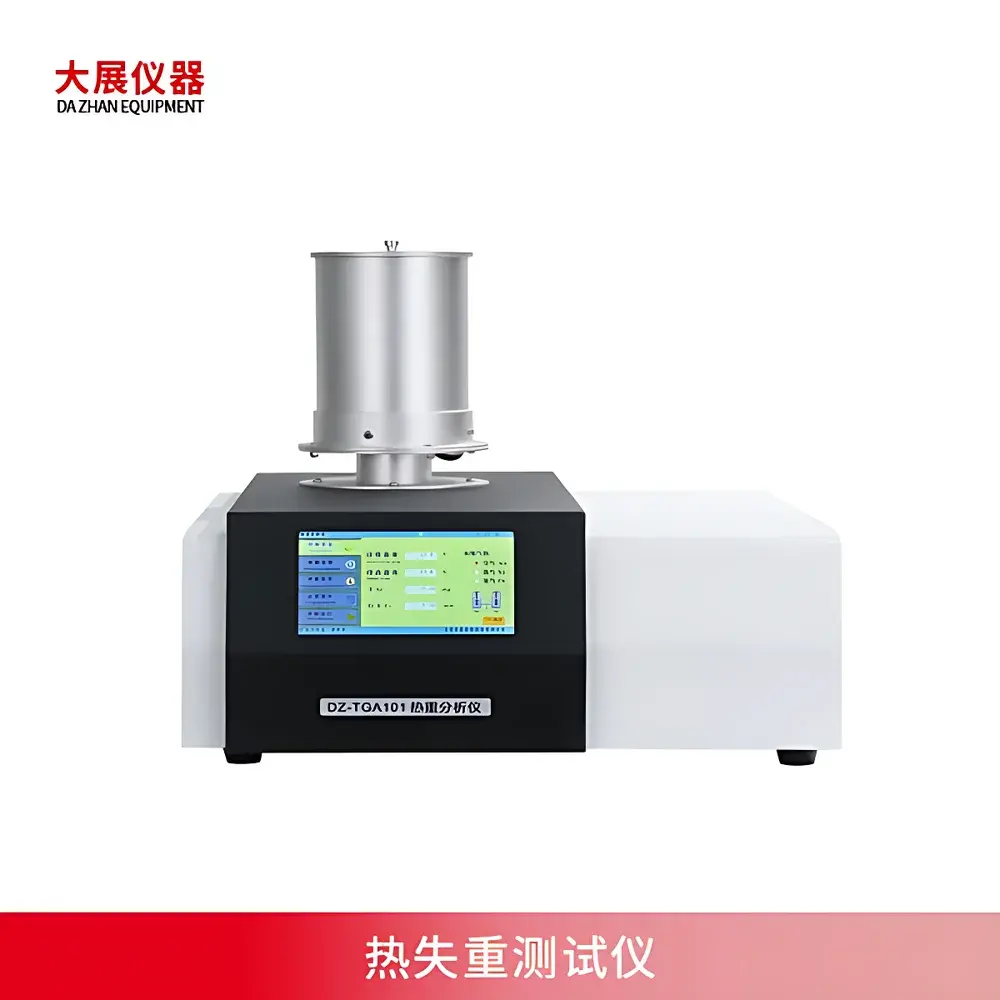
DZHAN DZ-TGA101 Thermogravimetric Analyzer
| Brand | DAZHAN |
|---|---|
| Origin | Jiangsu, China |
| Model | DZ-TGA101 |
| Temperature Range | Ambient to 1200 °C |
| Heating/Cooling Rate | 0.1–100 K/min |
| Maximum Sample Mass | 30 g |
| Atmosphere Control | Dual-gas inlet with mass flow regulation (inert, oxidizing, reducing, static, dynamic) |
| Balance Sensitivity | 0.01 mg |
| Balance Range | 0.01 mg–3 g (extendable to 30 g) |
| Temperature Resolution | 0.01 °C |
| Temperature Stability | ±0.1 °C |
| Programmable Stages | Up to 5 temperature segments |
| Isothermal Hold Duration | 0–300 min per segment (configurable up to 72 h total) |
| Display | 7-inch Chinese-language LCD |
| Interface | USB 2.0 |
| Power Supply | AC 220 V, 50 Hz |
Overview
The DZHAN DZ-TGA101 Thermogravimetric Analyzer is a precision benchtop instrument engineered for quantitative measurement of mass change as a function of temperature or time under controlled atmospheric conditions. Based on the fundamental principle of thermogravimetry—monitoring real-time sample mass loss or gain during thermal treatment—the DZ-TGA101 delivers high-fidelity data essential for characterizing thermal stability, decomposition kinetics, oxidative degradation, dehydration behavior, and solid-state reaction pathways. Its robust furnace architecture supports operation from ambient temperature up to 1200 °C, enabling analysis across a broad spectrum of inorganic oxides, polymers, pharmaceuticals, catalysts, coal, ceramics, and metallurgical precursors. The system employs a dual-wound nickel-chromium heating element housed within an optimized metallic furnace cavity, ensuring uniform thermal distribution, low thermal inertia, and minimal electromagnetic interference—critical attributes for reproducible baseline stability and high signal-to-noise ratio in low-mass-change events.
Key Features
- High-resolution microbalance with 0.01 mg sensitivity and extended 30 g capacity, calibrated across full range using NIST-traceable standards.
- Programmable multi-segment thermal protocol: up to five independent heating/cooling/isothermal steps per run, supporting complex kinetic studies and stepwise decomposition profiling.
- Dual-channel gas delivery system with integrated digital mass flow controllers (MFCs), permitting seamless switching between inert (N₂, Ar), oxidizing (air, O₂), and reducing (H₂, CO) atmospheres—both static and dynamic modes supported.
- Intelligent temperature control algorithm with active feedback compensation, achieving ±0.1 °C stability during isothermal holds and linear ramp fidelity within ±1% of set rate across 0.1–100 K/min.
- USB-based bidirectional communication interface enabling full remote operation—including real-time parameter adjustment, run initiation/termination, and live TG/DTG curve acquisition—via dedicated Windows-compatible software.
- Thermally shielded furnace design with high-efficiency insulation minimizes ambient thermal drift and external vibration coupling, enhancing long-term measurement repeatability (>99.5% RSD over 10 replicate runs on certified reference material).
Sample Compatibility & Compliance
The DZ-TGA101 accommodates standard ceramic crucibles (Al₂O₃, Pt, or graphite) with capacities ranging from 10 µL to 1 mL, supporting solid powders, granules, thin films, and small-volume pastes. Its modular sample pan holder permits rapid exchange without tooling. While not certified to ISO/IEC 17025 calibration requirements out-of-box, the instrument meets foundational metrological criteria aligned with ASTM E1131 (Standard Test Method for Compositional Analysis by Thermogravimetry) and ISO 11358-1 (Plastics — Thermogravimetry of polymers — Part 1: General principles). Temperature calibration is performed at multiple points (e.g., Cu, Ag, Al melting transitions) using built-in multi-point correction routines. Data integrity complies with basic GLP documentation practices; optional audit trail and electronic signature modules may be added to satisfy 21 CFR Part 11 readiness in regulated environments.
Software & Data Management
The included TGA Control Suite provides native support for real-time visualization of TG (mass % vs. temperature/time), DTG (derivative mass loss rate), and d²m/dt² curves. All raw data are stored in vendor-neutral CSV format; processed results export directly to Excel (.xlsx), PDF report templates (with customizable header/footer, lab logo, and metadata fields), and image files (PNG, SVG). Curve fitting tools include derivative peak identification, onset/endpoint determination (tangent, intersection, 5% mass loss), and isoconversional kinetic analysis (Friedman, Ozawa-Flynn-Wall). Software updates are delivered free of charge via secure HTTPS portal and require no hardware modification. Data security protocols include user-level access permissions, automatic timestamping, and local database backup scheduling.
Applications
- Quantification of moisture, volatiles, filler content, and ash residue in polymer composites per ISO 3451 and ASTM D3172.
- Thermal decomposition profiling of metal-organic frameworks (MOFs), coordination polymers, and battery cathode materials.
- Oxidation induction time (OIT) assessment of stabilized polyolefins under accelerated air aging protocols.
- Coal proximate analysis (moisture, volatile matter, fixed carbon, ash) in accordance with ASTM D3172 and ISO 1171.
- Decomposition kinetics modeling of pharmaceutical hydrates and amorphous solid dispersions.
- Catalyst thermal stability screening and coke formation analysis in petrochemical feedstock processing.
- Thermal aging studies of refractory ceramics and sintering aids under controlled oxygen partial pressure.
FAQ
What types of atmospheres can be used with the DZ-TGA101?
The system supports inert (N₂, Ar), oxidizing (air, O₂), reducing (H₂, CO), static, and dynamic gas environments via two independently regulated MFC channels.
Is the balance calibration traceable to international standards?
Yes—internal calibration uses factory-applied NIST-traceable weights; users may perform routine verification with certified reference masses at any point in the operating range.
Can the instrument operate unattended overnight?
Absolutely—programmable isothermal holds up to 72 hours and automated shutdown after completion enable fully autonomous extended-duration experiments.
Does the software support kinetic modeling beyond basic DTG analysis?
Yes, the suite includes Friedman, Ozawa-Flynn-Wall, and Kissinger methods for activation energy estimation from multi-heating-rate datasets.
Are platinum or alumina crucibles included with purchase?
A set of high-purity Al₂O₃ crucibles is supplied standard; Pt and graphite options are available as configurable accessories.



