
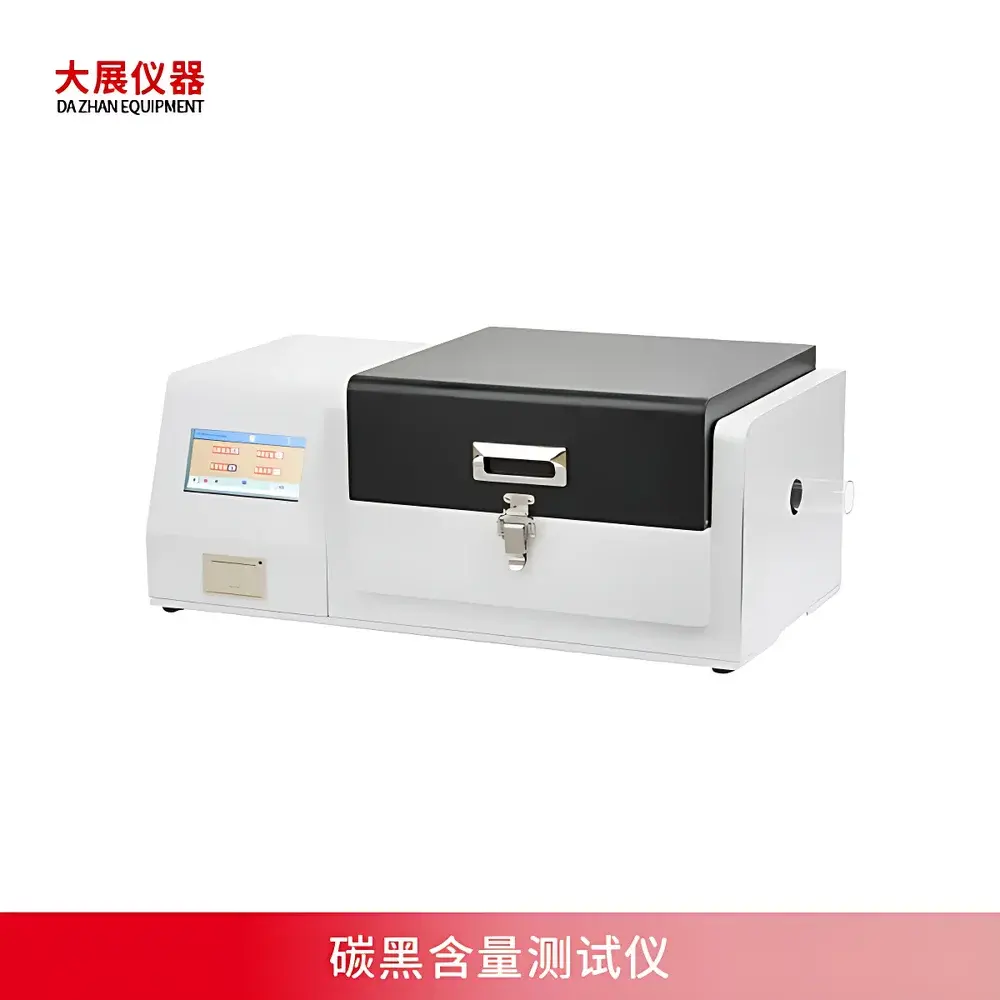
DZHAN DZ3500S Carbon Black Content Analyzer
| Brand | DAZHAN |
|---|---|
| Origin | Jiangsu, China |
| Model | DZ3500S |
| Display | 7-inch capacitive touchscreen |
| Quartz tube dimensions | Φ44 × 600 ± 5 mm |
| Furnace chamber | Φ45 × 300 ± 5 mm |
| Heating zone length | 350 mm |
| Operating temperature range | Ambient to 1200 °C |
| Temperature control | Intelligent programmable multi-segment controller |
| Temperature resolution | 0.1 °C |
| Power supply | AC 220 V / 50 Hz or 60 Hz |
| Gas flow control | Dual-channel, program-automated switching |
| Cooling method | Forced open-lid rapid cooling (≤20 min from 900 °C to ambient) |
| Sample capacity | 4 positions per run |
| Data processing | Built-in calculation engine for carbon black content and ash content |
| Optional accessories | Exhaust filtration unit, thermal printer |
Overview
The DZHAN DZ3500S Carbon Black Content Analyzer is a dedicated thermal gravimetric instrument engineered for precise quantification of carbon black and residual ash in polyolefin-based polymer matrices—primarily polyethylene (PE), polypropylene (PP), and polybutene (PB). It operates on the principle of controlled thermal decomposition under inert or oxidative atmospheres, following standardized thermogravimetric analysis (TGA) protocols. Unlike generic TGA systems, the DZ3500S integrates application-specific hardware—including a high-uniformity vertical furnace, dual-gas-path manifold, and quartz-tube sample containment—to ensure compliance with ASTM D1606 (historical basis), ISO 6964, and key Chinese national standards including GB/T 3515–2005, GB/T 13021–2023, and GB/T 13663.2–2018. Its design prioritizes repeatability in industrial QC environments where batch-to-batch consistency of carbon black loading (typically 2–3 wt% in PE pipe compounds) directly impacts UV resistance, mechanical longevity, and regulatory conformity.
Key Features
- Four-position simultaneous sample processing—enabling throughput scalability without sacrificing inter-sample thermal uniformity.
- Open-lid furnace architecture with forced convective cooling, reducing post-run cooldown time to ≤20 minutes (from 900 °C to ambient), thereby minimizing total cycle time per batch.
- Programmable multi-segment temperature ramping: users define independent heating rates, dwell times, and gas-switching points across up to six user-defined segments.
- High-stability quartz tube reactor (Φ44 × 600 mm) housed within a uniformly heated alloy-sheathed furnace zone (350 mm active length), ensuring ±2 °C axial temperature homogeneity at 900 °C.
- Capacitive 7-inch touchscreen interface with embedded firmware logic for direct calculation of carbon black content (% w/w) and ash residue (% w/w) using preloaded mass-loss algorithms aligned with GB/T 13021–2023 Annex A.
- Dual independent gas lines with solenoid-controlled automatic switching between N2 (for pyrolysis) and synthetic air (for ash oxidation), supporting sequential thermal degradation and combustion steps per ASTM D5630–22.
Sample Compatibility & Compliance
The DZ3500S is validated for use with granular or pelletized polyolefin samples weighing 0.5–2.0 g per crucible, compatible with standard alumina or platinum crucibles (not included). It meets essential requirements for routine testing in pipe manufacturing QA labs, compound formulation centers, and third-party certification bodies. Instrument compliance extends to GLP-aligned data integrity: all temperature profiles, gas events, mass readings, and calculated results are timestamped and stored locally with audit-trail capability. The system supports traceability per ISO/IEC 17025:2017 clause 7.7 (uncertainty estimation) when operated with calibrated analytical balances and certified reference materials (e.g., NIST SRM 3050b for ash validation).
Software & Data Management
No external PC dependency is required—the DZ3500S executes full data acquisition, real-time mass monitoring, and final report generation onboard. Raw thermogravimetric curves (mass vs. time/temperature) are viewable during operation and exportable via USB to CSV format. Calculation logic adheres strictly to GB/T 13021–2023 Equation (1): CCB = [(m1 − m2) / m0] × 100, where m0 = initial sample mass, m1 = mass after pyrolysis in N2, and m2 = mass after oxidation in air. Optional thermal printer output provides hard-copy reports containing operator ID, sample ID, date/time stamp, raw masses, and final percentages—all compliant with internal QA documentation workflows.
Applications
- Quality control of carbon black dispersion and loading in PE100/PE100-RC pressure pipe compounds.
- Verification of pigment stability during extrusion-grade PP compound development.
- Regulatory conformance testing for ISO 4427, EN 12201, and AS/NZS 4130 pipe certification.
- Failure analysis of UV-degraded geomembranes and cable jacketing materials.
- Research into char-forming behavior of flame-retardant polyolefins under controlled atmospheres.
FAQ
What standards does the DZ3500S directly support?
It implements test sequences and calculation methods defined in GB/T 3515–2005, GB/T 13021–2023, GB/T 13663.2–2018, and ISO 6964. Method equivalence to ASTM D5630–22 and ISO 11357–5 is achievable via custom program configuration.
Can the instrument operate unattended overnight?
Yes—its programmable controller supports delayed start, multi-step ramps with auto-hold, and safety cutoffs (over-temperature, lid-open detection, gas failure). All runs generate timestamped logs.
Is the quartz tube replaceable by the user?
Yes—quartz reactor tubes are field-replaceable consumables with standardized dimensions (Φ44 × 600 mm); spare parts are available with traceable lot documentation.
Does the system meet FDA 21 CFR Part 11 requirements?
While not validated for regulated pharmaceutical use, its audit-trail logging, electronic signature-ready reporting, and password-protected method editing align with foundational Part 11 expectations for non-GxP industrial labs.
What maintenance is required for long-term accuracy?
Annual calibration of the temperature sensor (Pt100) and verification of gas flow rates using a certified mass flow meter are recommended. No routine vacuum pump servicing is needed—operation is atmospheric-pressure only.






