
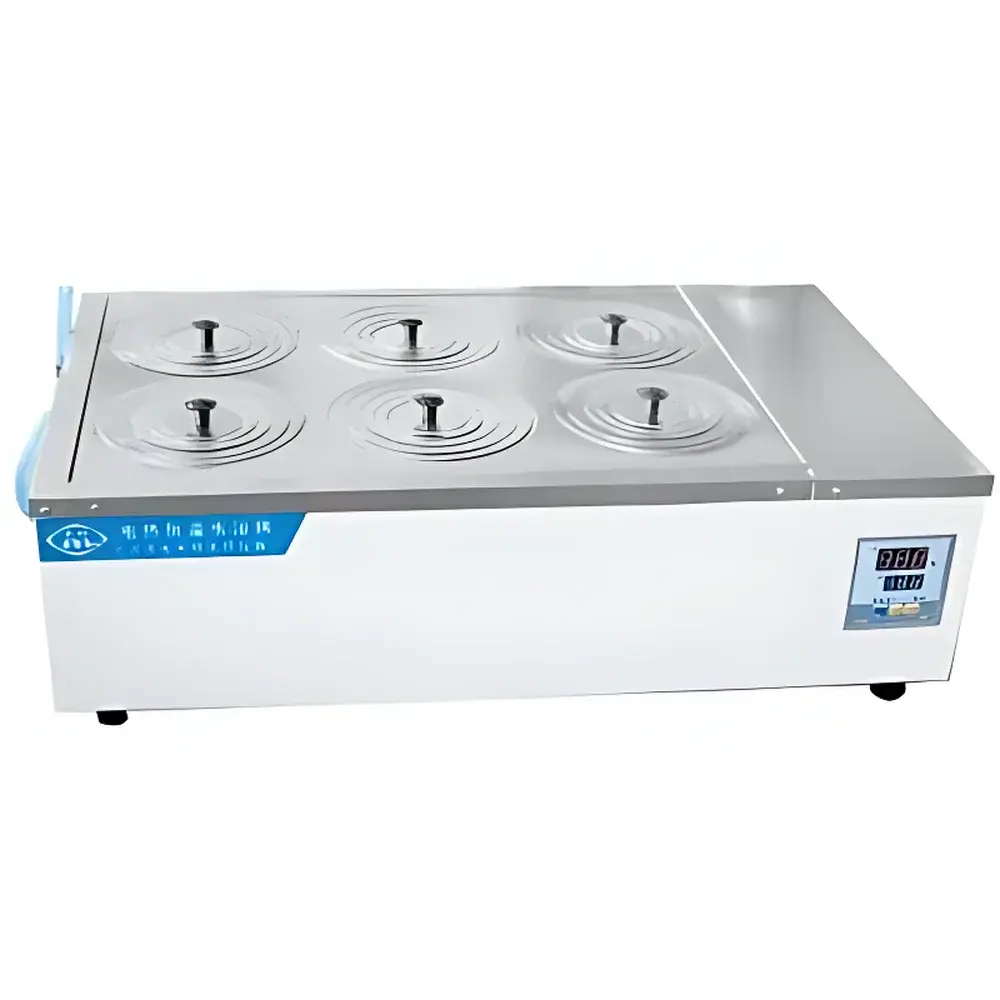
DZKW Digital Display Electric Constant-Temperature Water Bath (Dual-Row 4-Hole / 6-Hole / 8-Hole Configuration)
| Origin | Shanghai, China |
|---|---|
| Manufacturer Type | Authorized Distributor |
| Origin Category | Domestic (China) |
| Model | DZKW |
| Price | USD 110 (FOB Shanghai) |
| Power Rating | 1000 W (4-hole), 1500 W (6-hole), 2000 W (8-hole) |
| Chamber Dimensions (W×D×H) | 325×330×90 mm (4-hole), 480×330×90 mm (6-hole), 650×330×90 mm (8-hole) |
| Temperature Range | Ambient +5°C to 100°C |
| Control Accuracy | ±0.5°C |
| Construction | 304 Stainless Steel Inner Tank & Lid, Electrostatically Powder-Coated Exterior |
Overview
The DZKW Digital Display Electric Constant-Temperature Water Bath is a precision-engineered laboratory thermal platform designed for reliable, uniform heat transfer via liquid-phase conduction. Operating on the principle of resistive heating with PID-controlled immersion circulation, it maintains stable bath temperatures across its stainless steel chamber—enabling consistent thermal conditions essential for sample incubation, enzymatic reactions, solvent evaporation, concentration protocols, and temperature-sensitive reagent equilibration. Its dual-row multi-hole configuration (4-, 6-, or 8-position) accommodates standardized glassware—including test tubes, flasks, and beakers—while supporting parallel processing in clinical diagnostics, pharmaceutical QC labs, academic research, and industrial R&D environments. Engineered for long-term operational integrity, the unit features a fully sealed heating element, over-temperature cut-off protection, and a robust chassis optimized for continuous duty cycles under GLP-compliant workflows.
Key Features
- High-stability digital PID temperature controller with ±0.5°C accuracy across the full operating range (ambient +5°C to 100°C)
- Corrosion-resistant 304 stainless steel inner tank and lid, ensuring chemical compatibility with aqueous buffers, saline solutions, and mild organic solvents
- Electrostatically applied powder-coated exterior finish for mechanical durability and resistance to lab-grade cleaning agents
- Modular dual-row well layout—configurable as 4-hole (325×330×90 mm), 6-hole (480×330×90 mm), or 8-hole (650×330×90 mm)—optimized for standard borosilicate glassware diameters (16–35 mm)
- Independent power rating per configuration: 1000 W (4-hole), 1500 W (6-hole), 2000 W (8-hole), enabling rapid thermal recovery after sample loading
- Integrated safety systems including automatic thermal cutoff at 110°C and grounded chassis design compliant with IEC 61010-1
Sample Compatibility & Compliance
The DZKW water bath supports routine use with common laboratory vessels such as Pyrex® test tubes (13×100 mm to 25×150 mm), Erlenmeyer flasks (50–500 mL), and round-bottom flasks (up to 250 mL). Its flat-bottomed, uniformly heated chamber minimizes thermal gradients—critical for applications requiring reproducible kinetics, such as DNA denaturation studies, cell culture media warming, or ASTM D129 specification testing for petroleum products. The device meets general-purpose electrical safety requirements per IEC 61010-1 and is suitable for installation in ISO/IEC 17025-accredited laboratories when operated within documented SOPs. While not intrinsically certified for hazardous location use, it is routinely deployed in non-explosive ambient settings aligned with USP guidance on analytical instrument qualification.
Software & Data Management
This analog-digital hybrid platform operates without embedded firmware or network connectivity; temperature setpoint and real-time display are managed via a front-panel LED interface with tactile push-button controls. For regulated environments, external data logging is supported through optional analog voltage output (0–5 V DC proportional to temperature) compatible with third-party DAQ systems (e.g., National Instruments USB-6009) or chart recorders. Audit trails and calibration records must be maintained manually per FDA 21 CFR Part 11 Annex A expectations for non-computerized systems—requiring documented procedures for operator training, daily verification checks, and biannual thermometric calibration using NIST-traceable reference thermometers.
Applications
- Pre-warming of diagnostic reagents and culture media prior to microbiological assays
- Controlled evaporation of solvent fractions in natural product isolation workflows
- Constant-temperature hydrolysis of ester-based prodrugs during pharmaceutical stability testing
- Enzyme activity assays requiring precise thermal stabilization (e.g., alkaline phosphatase kinetics at 37°C)
- DNA/RNA hybridization steps in molecular biology protocols
- Calibration of liquid-in-glass thermometers against reference standards
FAQ
What is the maximum recommended operating temperature?
The unit is rated for continuous operation up to 100°C. Exceeding this limit may compromise seal integrity and accelerate heater degradation.
Can the DZKW water bath be used with corrosive solutions such as strong acids or alkalis?
It is compatible with neutral and mildly acidic/basic aqueous solutions (pH 4–10). Prolonged exposure to HCl, HNO₃, or NaOH above 1 mol/L is not advised without supplemental containment (e.g., secondary polypropylene trays).
Is the temperature sensor calibrated at the factory?
Each unit undergoes functional verification at 37°C and 60°C using traceable reference probes; however, end-user calibration validation is required before first use and at defined intervals per internal quality policy.
Does the DZKW series support external temperature probe input for chamber monitoring?
No—the system relies solely on its built-in PT100 sensor located near the heater base. External probe integration requires aftermarket signal conditioning hardware.
What maintenance is required to ensure long-term performance?
Monthly descaling with 5% citric acid solution (followed by thorough rinsing), quarterly inspection of heater insulation resistance (>2 MΩ), and annual verification of over-temperature cutoff functionality are recommended practices.



