
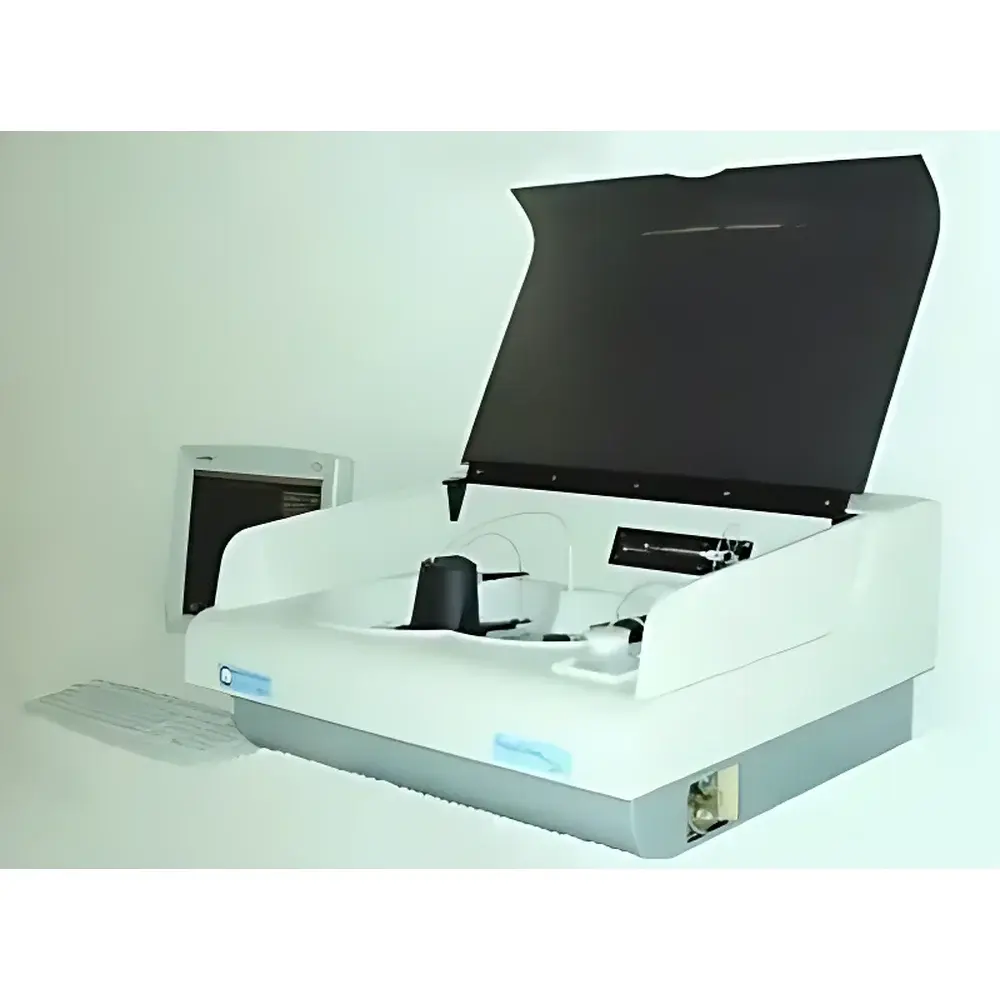
EasyChem Plus Fully Automated Discrete Chemical Analyzer
| Origin | Italy |
|---|---|
| Manufacturer Type | Distributor |
| Origin Category | Imported |
| Model | EasyChem Plus |
| Price | Upon Request |
Overview
The EasyChem Plus Fully Automated Discrete Chemical Analyzer is an advanced benchtop system engineered for high-precision, multi-parameter quantitative analysis of inorganic and organic analytes in environmental, agricultural, food & beverage, and industrial matrices. Unlike continuous-flow or segmented-flow analyzers, the EasyChem Plus employs discrete (batch-mode) analysis: each sample and reagent are aspirated independently via precision micro-syringes into a dedicated reaction cuvette, where controlled stoichiometric reactions occur under programmable temperature and timing conditions. This architecture eliminates cross-contamination from carryover or diffusion between adjacent samples—a critical advantage for trace-level determinations in complex matrices such as seawater, wastewater, soil extracts, plant digests, and wine. The system integrates photometric detection across a broad spectral range (340–880 nm), enabled by a 10-position filter wheel with ±2 nm bandpass interference filters and a stabilized 6 V/10 W halogen lamp with optional UV extension. Measurement principles include endpoint, dual-beam endpoint, kinetic (dynamic), timed, differential, and blank-differential photometry—supporting both classical colorimetric methods (e.g., phenol red for alkalinity, Nesslerization for ammonia) and enzymatic or redox-based assays.
Key Features
- Discrete Reaction Architecture: Independent micro-syringe aspiration of samples and reagents ensures zero inter-sample diffusion, delivering superior reproducibility (RSD < 1.5% at mid-range concentrations) and long-term calibration stability.
- High-Density Sample Processing: 60-position sample carousel accommodates blanks, standards, unknowns, and quality controls—including reserved positions for on-board dilution of low-volume samples.
- Temperature-Controlled Reagent Management: 18-position Peltier-cooled reagent tray maintains thermal stability within ±0.1 °C, critical for enzyme-based assays (e.g., nitrate reductase) and pH-sensitive reactions.
- Flexible Photometric Detection: Standard 35 µL flow-through cuvette (10 mm pathlength); optional 20 mm and 40 mm cells available for enhanced sensitivity in low-absorbance applications (e.g., sulfate, silicate).
- Precision Microdispensing: 1000 µL syringe with 0.3 µL mechanical resolution enables accurate serial dilutions, standard curve generation, and low-volume sample handling without external pipetting.
- Intelligent Fluidics: Peristaltic pump-driven liquid handling with programmable flow rates and automatic air-gap separation—eliminating bubble formation, pressure dependency, and pulsation artifacts common in peristaltic-only systems.
- Self-Diagnostic Hardware: External modules perform automated functional checks during startup and idle cycles, logging diagnostic codes for predictive maintenance and GLP-compliant audit trails.
Sample Compatibility & Compliance
The EasyChem Plus supports a wide range of solid and liquid sample types following standardized pretreatment protocols: filtered or digested water (fresh, marine, effluent), acid-extracted soils and sediments, microwave-digested plant tissues, clarified wine and juice filtrates, and industrial process liquors. Method validation aligns with established regulatory frameworks including ISO 15681 (phosphorus), ISO 7150-1 (ammonia), ASTM D3867 (nitrate/nitrite), USP (total organic carbon—via persulfate oxidation adaptation), and EPA Methods 353.2, 365.2, and 365.4. All photometric calibrations support linear and polynomial regression (up to 4th order), with up to 16 certified reference standards per method. The system meets essential requirements for ISO/IEC 17025-accredited laboratories and provides full traceability for FDA 21 CFR Part 11-compliant electronic records when deployed with validated software configuration and user access controls.
Software & Data Management
Operated under Microsoft Windows, the EasyChem Control Software offers three-tiered user authentication (Operator, Supervisor, Administrator) with role-based permissions for method editing, calibration management, and audit log access. Analytical workflows are defined via intuitive drag-and-drop method editors: users assign parameters (e.g., “Total Phosphorus – Ascorbic Acid Reduction”), select wavelength, define reaction kinetics, configure dilution logic, and set QC acceptance criteria—all without scripting. The software automatically generates calibration curves from stored standards or fresh preparations, applies matrix-matched blank correction, and flags outliers using Westgard multirule QC logic. Integrated reporting includes customizable PDF certificates of analysis, raw absorbance/time traces, calibration history logs, and real-time Levey-Jennings control charts. All data files are stored in encrypted SQLite databases with immutable timestamps, supporting retrospective audit and electronic signature compliance per ALCOA+ principles.
Applications
- Environmental monitoring: Alkalinity, hardness, chloride, sulfate, nitrate + nitrite, total nitrogen, orthophosphate, total phosphorus, ammonia, cyanide, hexavalent chromium, soluble iron, silica, volatile phenols.
- Water safety compliance: Drinking water (WHO/EPA/EC Directive parameters), wastewater discharge verification, desalination brine characterization.
- Agricultural & food chemistry: Acetic, citric, lactic, and malic acids in wine; glucose/fructose ratio in must; polyphenol index (OD280) in grape extracts; nitrate in leafy vegetables.
- Soil & plant analysis: Mehlich-3 extractable P/K/Ca/Mg, DTPA-extractable micronutrients, ammonium-nitrogen in root-zone solutions.
- Industrial QA/QC: Electroplating bath composition (chromium, nickel), boiler feedwater contaminants (silica, phosphate), fermentation broth nutrient profiling.
FAQ
What distinguishes discrete analysis from flow injection or segmented flow methods?
Discrete analysis isolates each reaction in a dedicated optical cell, eliminating reagent/sample stream segmentation, mixing coil memory effects, and dispersion-related imprecision—resulting in higher accuracy for heterogeneous or particulate-laden samples.
Can the EasyChem Plus perform simultaneous multi-analyte measurements on a single sample aliquot?
No—it performs sequential analysis per parameter, but leverages shared sample/reagent positions and automated reconfiguration to minimize turnaround time; typical throughput is 40–60 determinations per hour across mixed-parameter batches.
Is method validation support included with the system?
Yes: pre-validated application notes covering >30 parameters are provided, including linearity ranges, LOD/LOQ estimates, spike recovery data, and interlaboratory comparison summaries compliant with ISO 5725.
How is data integrity ensured for regulated environments?
The software supports electronic signatures, audit trail logging (user actions, method changes, result modifications), and export to LIMS via ASTM E1394 or HL7-compliant interfaces—fully configurable for 21 CFR Part 11 enforcement scenarios.
What maintenance is required beyond routine cleaning?
No consumable replacement parts are mandatory; only periodic verification of syringe seal integrity, filter wheel alignment, and photometer baseline stability is recommended—typically every 6 months under normal use.





