
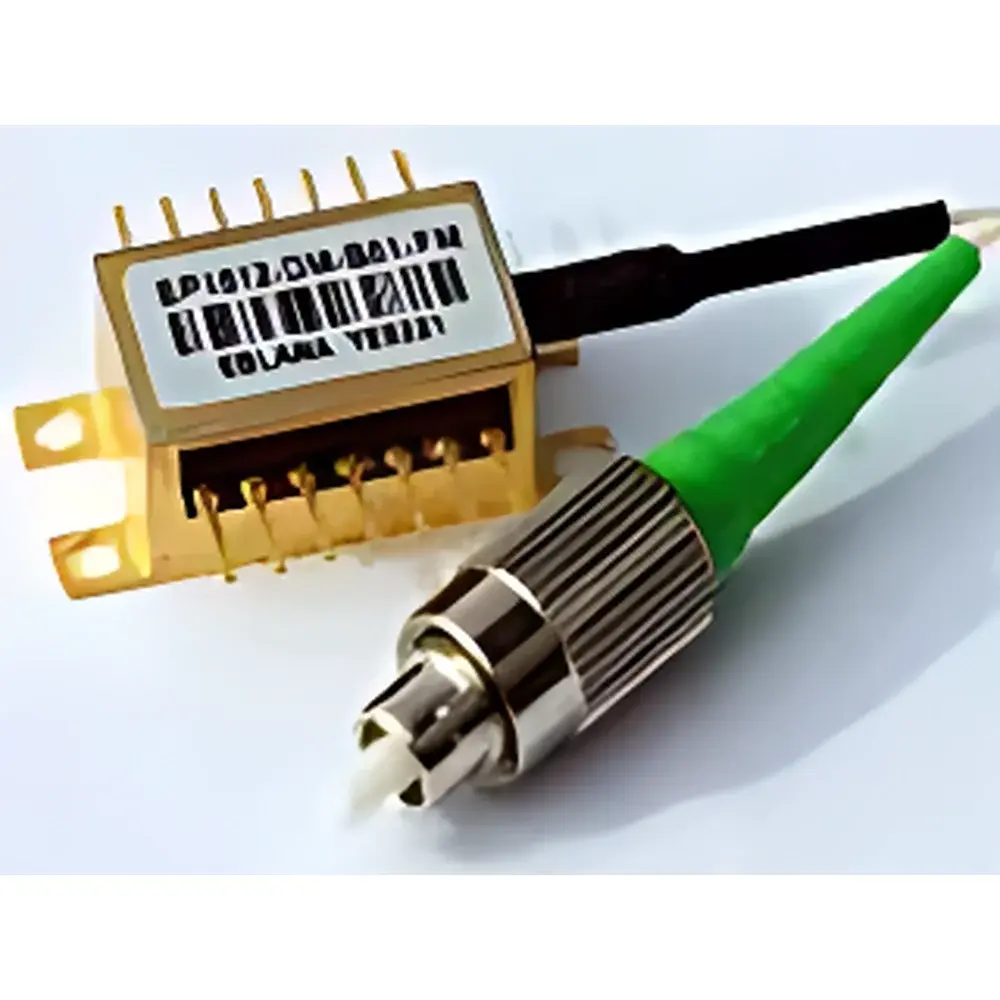
Eblana EP Series Semiconductor Laser Diodes
| Origin | Ireland |
|---|---|
| Manufacturer Type | Authorized Distributor |
| Origin Category | Imported |
| Model | EP Series |
| Pricing | Available Upon Request |
| Core Component | Semiconductor Laser Diodes and Integrated Laser Modules |
Overview
The Eblana EP Series Semiconductor Laser Diodes are precision-engineered distributed feedback (DFB) and discrete-mode (DM) laser diodes designed for high-stability, narrow-linewidth operation across a broad infrared and near-infrared spectral range—from 689 nm to 2108 nm. Built on Eblana Photonics’ proprietary strained-layer quantum-well epitaxy and advanced grating fabrication processes, these lasers operate on the principle of single longitudinal mode (SLM) emission with inherent wavelength selectivity and thermal/mechanical robustness. Unlike conventional Fabry–Pérot (FP) devices, EP-series diodes integrate monolithically defined Bragg gratings that suppress side modes and deliver exceptional spectral purity—critical for applications demanding sub-MHz linewidths, ppm-level wavelength stability, and low relative intensity noise (RIN). Their hermetically sealed butterfly or TO-can packages ensure long-term reliability under laboratory, industrial, and field-deployable conditions.
Key Features
- Single-frequency output with intrinsic narrow linewidth (< 1 MHz typical for DFB/DM variants)
- Wavelength options spanning 689 nm to 2108 nm—including atomic transition lines for Sr (689 nm), Rb (780 nm), O₂ (760 nm), HF (1278 nm), H₂O (1392 nm, 1854 nm), NH₃ (1512 nm), CO (1571 nm), CH₄ (1654 nm), HCl (1742 nm), CO₂ (2004 nm), N₂O (2020 nm), and others
- High wavelength stability: < ±5 pm over 8–12 h (with TEC control and optical isolation)
- Low frequency noise and high side-mode suppression ratio (SMSR > 50 dB)
- Available in multiple configurations: FP (10G/2.5G datacom-grade), DM (discrete-mode), and ultra-narrow linewidth DFB variants (e.g., 1550 nm < 100 kHz linewidth)
- Compliant with Telcordia GR-468-CORE for reliability under accelerated aging tests
Sample Compatibility & Compliance
The EP Series is compatible with standard fiber-pigtailed (SMF-28, PMF, or HI1060) and free-space collimated modules. Devices meet RoHS 2015/863/EU and REACH SVHC compliance requirements. For regulated environments—including pharmaceutical process analytical technology (PAT), environmental monitoring, and defense-grade LIDAR—the lasers support integration into systems compliant with ISO/IEC 17025 calibration traceability frameworks. When deployed in gas sensing platforms, they align with ASTM E2910–22 (standard guide for tunable diode laser absorption spectroscopy) and EN 15267–3 for continuous emissions monitoring system (CEMS) validation.
Software & Data Management
While the EP Series operates as a hardware component, it is fully interoperable with industry-standard laser controllers (e.g., ILX Lightwave LDC-3900, Wavelength Electronics QCL series) supporting analog/digital modulation, temperature ramping, and current sweep protocols. Integration with LabVIEW, Python (via PyVISA), or MATLAB enables automated wavelength tuning, lock-in detection, and real-time absorption line fitting. For GxP environments, third-party controller firmware can be configured to log timestamped operational parameters (current, TEC setpoint, photodiode feedback) with audit-trail capability—supporting alignment with FDA 21 CFR Part 11 electronic record requirements when embedded in validated instrument architectures.
Applications
- Trace gas detection via tunable diode laser absorption spectroscopy (TDLAS) for environmental, industrial safety, and combustion diagnostics
- Atomic physics experiments: laser cooling and trapping of alkaline-earth (Sr) and alkali (Rb) atoms; optical lattice clocks
- Coherent LIDAR and FMCW ranging systems requiring high coherence length and low phase noise
- Fiber-optic gyroscopes (FOGs) and interferometric sensing where polarization-maintaining and low back-reflection performance are essential
- Dense wavelength division multiplexing (DWDM) test instrumentation and coherent communications transceivers
- Calibration sources for FTIR spectrometers and wavelength meters (NIST-traceable line references)
FAQ
Are Eblana EP-series lasers qualified for use in medical device OEM applications?
Yes—devices shipped in hermetic TO-56 or 14-pin butterfly packages comply with IEC 60825-1:2014 Class 1/Class 3R laser safety classifications when integrated with appropriate optical limiting and interlock architecture.
Can these lasers be operated in external cavity configuration?
While optimized for standalone DFB/DM operation, selected EP-series chips (e.g., uncoated AR/HR facets) support external cavity diode laser (ECDL) integration with diffraction gratings or MEMS-tuned cavities—subject to facet damage threshold verification.
What thermal management is required for stable CW operation?
All EP-series devices require active thermoelectric cooling (TEC) with ±0.01 °C setpoint stability and heat sinking capable of dissipating ≥2.5 W at full drive current—per datasheet-specified junction temperature limits.
Is wavelength calibration traceable to NIST standards?
Yes—wavelength verification is performed using calibrated wavemeters (e.g., Bristol 621A) referenced to NIST-traceable iodine and methane absorption lines; calibration certificates available upon request.
Do you offer custom wavelength or packaging options?
Eblana supports custom epitaxial design and grating engineering for non-standard wavelengths (±2 nm tolerance) and specialized packaging (e.g., PM-fiber coupling, integrated isolators, or dual-wavelength monolithic chips)—lead time and MOQ apply.




