
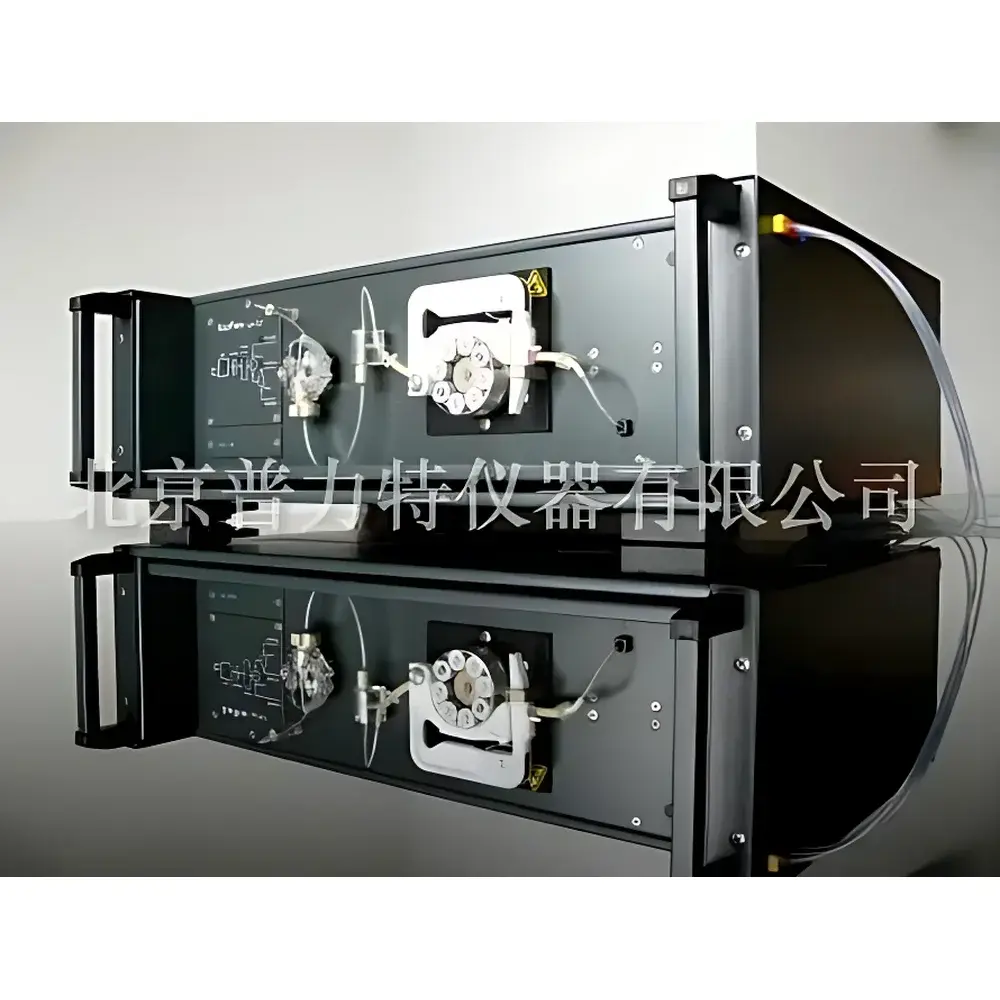
EcaFlow Microtrace Elemental Analyzer
| Origin | Germany |
|---|---|
| Manufacturer Type | Authorized Distributor |
| Origin Category | Imported |
| Model | EcaFlow |
| Instrument Type | Benchtop Laboratory Analyzer |
| Detection Principle | Anodic Stripping Voltammetry (ASV) |
| Analyte Scope | Multi-Parameter Heavy Metals & Inorganic Ions |
| Analysis Time | ≤3 min per sample |
| Detection Limit | 0.1 ppb (Cd, Pb, Hg) |
| Resolution | 0.1 ppb |
Overview
The EcaFlow Microtrace Elemental Analyzer is a benchtop, computer-controlled flow-based electrochemical analyzer engineered for trace-level quantification of heavy metals and inorganic anions in aqueous and digested matrices. It operates primarily on the principle of anodic stripping voltammetry (ASV), augmented by coulometric titration, chronoamperometry, and potentiometric detection modes. Unlike conventional batch-mode ASV systems, EcaFlow integrates a continuous-flow electrochemical detection cell with disposable working electrodes—enabling high reproducibility, minimal memory effects, and rapid electrode replacement without system disassembly. Its design complies with fundamental requirements for trace metal analysis under ISO 17294-2 (water quality — determination of elements by inductively coupled plasma mass spectrometry and atomic emission spectrometry) and supports method validation in accordance with EPA Method 7000B (anodic stripping voltammetry for metals) and ASTM D3559 (lead in water). The instrument delivers sub-ppb detection limits across a broad elemental spectrum while maintaining full compliance with GLP data integrity standards via audit-trail-enabled software.
Key Features
- Fully automated flow-through electrochemical detection cell with disposable inert-material working electrodes (e.g., mercury-film or bismuth-film coated carbon); electrode replacement requires only one screw loosening and takes <15 seconds
- Three-electrode configuration (working, reference, counter) with physical separation of counter-electrode reaction products to prevent cross-contamination
- Computer-controlled solenoid valve manifold enabling seamless switching between sample, supporting electrolyte, and standard addition solutions
- Integrated high-stability potentiostat/galvanostat module (12 V / 20 mA output) with real-time current/voltage feedback and digital filtering
- Luer-lock fluidic interface for rapid, leak-free connection of detection cells, tubing, and sample lines
- Modular architecture supporting optional AS-150 autosampler (42-position + blank + calibrant)
- Multi-mode electrochemical operation: ASV, coulometry, chronoamperometry, potentiometry, and conductometric titration
- No nitrogen purging required—optimized for direct analysis of oxygenated or aerated samples including wastewater and surface water
Sample Compatibility & Compliance
EcaFlow accommodates a wide range of sample types following appropriate pretreatment (e.g., acid digestion, filtration, pH adjustment). Validated applications include drinking water, groundwater, wastewater, seawater, wine, beer, biological fluids (urine, serum), digested soils/sediments, geological extracts, pharmaceuticals, and food leachates. All methods adhere to regulatory frameworks governing environmental and food safety testing—including EU Directive 2020/2184 (drinking water), US EPA Clean Water Act requirements, and ISO/IEC 17025 accreditation criteria for testing laboratories. Data acquisition and reporting comply with FDA 21 CFR Part 11 requirements for electronic records and signatures when used with validated software configurations.
Software & Data Management
The EcaFlow Control Suite provides intuitive, menu-driven operation with preloaded application methods for over 70 analyte–matrix combinations. It supports automatic calibration curve generation (linear, quadratic, or weighted), standard addition mode, and multi-point verification. Each analysis session logs full metadata—including timestamp, operator ID, electrode lot number, calibration history, raw voltammograms, and peak integration parameters—with encrypted storage and configurable export (CSV, PDF, XML). Audit trails record all user actions, parameter modifications, and report generations. The software supports LIMS integration via ODBC and includes built-in tools for uncertainty estimation per ISO/IEC Guide 98-3 (GUM).
Applications
- Simultaneous quantification of Cd, Pb, Cu, Zn, Hg, As, Se, Sb, Bi, Sn, Cr(VI), Mn, Ni, Fe, and I⁻ in environmental waters
- Speciation analysis: As(III)/total As, Cr(III)/Cr(VI), S²⁻/SO₃²⁻/SO₄²⁻ in wastewater and industrial effluents
- Trace metal monitoring in beverages (wine, beer, spirits) and food extracts per EU Regulation (EC) No 1881/2006
- Electroplating bath control: Zn, Ni, Cr, Cl⁻, H₃BO₃, and cyanide in real time
- Phosphate (PO₄³⁻), nitrate (NO₃⁻), sulfide (S²⁻), and ammonia (NH₃/NH₄⁺) determination in municipal and agricultural runoff
- Low-level Au detection in geological digests and Ti in TiO₂ pigments
- Validation of digestion efficiency for EPA SW-846 Methods 3015A, 3050B, and 3051A
FAQ
What detection principle does EcaFlow use?
EcaFlow primarily employs anodic stripping voltammetry (ASV), supported by coulometric titration and chronoamperometric detection modes.
Can it analyze turbid or particulate-containing samples?
Yes—when coupled with inline filtration (e.g., 0.45 µm PTFE syringe filters) and appropriate digestion protocols, EcaFlow reliably quantifies metals in suspended-solids-laden waters and digested sludges.
Is method validation support available?
Yes—the instrument includes templates aligned with ISO/IEC 17025 and EPA method validation guidelines, covering linearity, LOD/LOQ, precision, recovery, and robustness testing.
How is electrode lifetime managed?
Disposable flow-cell working electrodes are serialized and tracked in software; each electrode’s usage count and performance history are logged automatically.
Does EcaFlow meet regulatory requirements for environmental labs?
Yes—it supports full audit trail, electronic signature, and data integrity features required for ISO/IEC 17025 and EPA-certified laboratories.







