
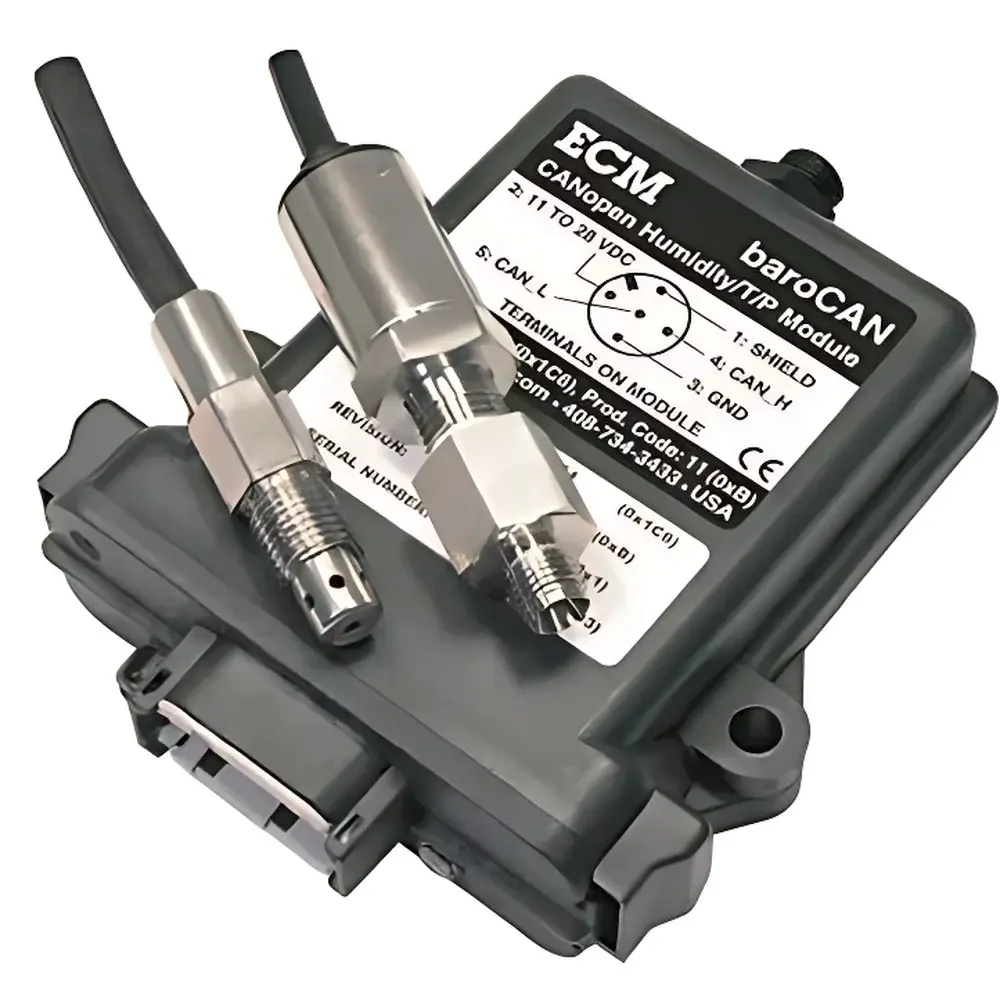
ECM baroCAN Environmental Condition Monitoring Module for Engine Intake and Ambient Air Analysis
| Brand | ECM |
|---|---|
| Origin | USA |
| Model | baroCAN |
| Sensor Inputs | 1× RH/T, 1× Absolute Pressure, 1× O₂ |
| Measurement Parameters | Relative Humidity (0–100% RH), Temperature (−40 to +125 °C), Absolute Pressure (0–500 kPa), Dew Point (0–125 °C), Water Vapor Pressure, Oxygen Concentration (0–20.946% vol), Accuracy: ±2% RH, ±0.3 °C, ±0.2 kPa, ±0.88 °C dew point, ±0.02% O₂ |
| Response Time | 1 s (RH/T/dew point/O₂), 25 ms (pressure) |
| Communication | High-Speed CAN 2.0B, ISO 11898 compliant |
| Enclosure Rating | IP67 |
| Operating Temp | −55 to +125 °C |
| Power | 6–32 VDC |
| Dimensions | 145 × 120 × 40 mm |
| Weight | 234 g |
| Threaded Ports | 1/4″ NPT/ISO for RH/T and pressure sensors |
| Configuration & Data Logging | Dedicated PC software via CAN interface |
Overview
The ECM baroCAN Environmental Condition Monitoring Module is an engineered solution for high-fidelity, real-time measurement of critical ambient and intake air parameters in engine development, calibration, and emissions testing environments. Designed specifically to address the thermodynamic and compositional dependencies of internal combustion engines—particularly naturally aspirated and turbocharged gasoline and diesel powertrains—the baroCAN delivers synchronized, traceable measurements of relative humidity, temperature, absolute pressure, dew point, water vapor pressure, and oxygen concentration. These parameters are essential inputs for correcting mass airflow calculations, stoichiometric ratio estimations, and combustion efficiency modeling under variable environmental conditions. Unlike standalone or loosely integrated sensor assemblies, the baroCAN integrates all sensing elements into a single, compact, CAN-enabled module with embedded calibration memory, ensuring metrological continuity across test cycles and vehicle platforms. Its architecture adheres to SAE J1939 and ISO 11898-2 physical layer specifications, enabling seamless integration into modern ECU-in-the-loop (HIL), dynamometer, and on-road RDE (Real Driving Emissions) test setups.
Key Features
- Multi-parameter fusion: Simultaneous acquisition of six interdependent air-condition variables—RH, temperature, absolute pressure, dew point, water vapor pressure, and O₂—within a single calibrated hardware unit.
- Embedded calibration memory: Each sensor retains its unique NIST-traceable calibration coefficients in onboard non-volatile memory, eliminating manual coefficient entry and reducing configuration errors during field deployment.
- High-speed CAN 2.0B interface: Compliant with ISO 11898-2, supporting data transmission at up to 1 Mbit/s with configurable message IDs and periodic broadcast intervals (10–100 Hz typical).
- Ruggedized industrial packaging: IP67-rated aluminum housing rated for continuous operation from −55 °C to +125 °C and 100% RH, validated per MIL-STD-810G for shock, vibration, and thermal cycling.
- Low-latency response: Sub-25 ms pressure sampling and ≤1 s response for all other parameters ensures dynamic capture of transient air-condition changes during load sweeps, cold starts, and altitude transitions.
- Flexible mounting and connectivity: Dual 1/4″ NPT/ISO threaded ports accommodate standard RH/T and pressure probes; factory-terminated 1 m CAN cable included (2 m optional); 6–32 VDC wide-range input supports direct vehicle battery or bench power supply integration.
Sample Compatibility & Compliance
The baroCAN is compatible with intake manifolds, charge air ducts, ambient air sampling lines, cabin air intakes, and environmental test chambers. It supports both dry and condensing humid air streams without sensor degradation. All measurements conform to ISO 7726 (Ergonomics of the thermal environment — Instruments for measuring physical quantities), ASTM D2200 (Standard Practice for Calculating Dew Point), and ISO 8573-3 (Compressed air — Part 3: Test methods for oil content). For regulated emissions testing, the module meets the metrological requirements outlined in EU Regulation (EU) 2017/1151 Annex III C (RDE testing) and U.S. EPA 40 CFR Part 1065 subpart D (engine test procedures), particularly regarding environmental correction factors for NOx, CO, and hydrocarbon emission calculations. The device supports audit-ready data logging with timestamping and CAN message CRC validation, facilitating GLP/GMP-aligned documentation workflows.
Software & Data Management
ECM provides the baroCAN Configuration & Acquisition Suite—a Windows-based application that enables full parametric setup, real-time visualization, binary-to-physical-unit conversion, and export to CSV, MATLAB (.mat), or ASAM MDF 4.x formats. The software supports automatic detection of connected modules via CAN bus enumeration and allows user-defined scaling, filtering (moving average, low-pass), and alarm thresholds. All configuration changes—including CAN ID assignment, measurement range selection, and zero/span adjustment—are stored directly in module memory and persist through power cycles. For integration into third-party test automation platforms (e.g., ETAS INCA, dSPACE ControlDesk, NI VeriStand), ECM supplies a documented CAN database (DBC file) and DLL-based API with source code examples in C/C++ and Python. Audit trails—including firmware version, calibration date, and last configuration change timestamp—are accessible programmatically and logged alongside measurement data.
Applications
- Engine calibration and ECU development: Correction of MAF sensor output, lambda control, and volumetric efficiency maps using real-time ambient and intake air condition data.
- Regulatory emissions testing: Application in WLTP, RDE, and FTP-75 cycles where environmental corrections are mandatory per UN/ECE R83 and EPA 40 CFR Part 1065.
- Altitude and climate simulation: Integration into environmental test chambers to monitor and validate chamber condition stability during hot/cold soak, humidity ramping, and barometric pressure modulation.
- On-board diagnostics (OBD-II) validation: Correlation of vehicle-reported ambient conditions against reference-grade baroCAN measurements during field trials.
- Cabin air quality monitoring: Deployment in HVAC development for passenger compartment air composition tracking, including O₂ depletion and moisture accumulation analysis.
- Aftertreatment system optimization: Input to SCR and GPF models requiring precise knowledge of inlet O₂ concentration and water vapor partial pressure.
FAQ
Is the baroCAN module certified for use in type-approval testing?
Yes—when used in accordance with ISO 16183 and configured per OEM-specific calibration protocols, the baroCAN meets the metrological traceability and uncertainty requirements for regulatory emissions testing under EU and U.S. frameworks.
Can multiple baroCAN modules be daisy-chained on a single CAN bus?
Yes—each module supports configurable CAN identifiers and can operate concurrently on the same high-speed CAN network without arbitration conflict.
Does the module support automatic compensation for sensor drift over time?
No—it relies on initial factory calibration with NIST-traceable references; however, the embedded calibration memory allows for field recalibration using ECM’s portable reference station (sold separately), with updated coefficients written directly to module EEPROM.
What is the maximum recommended cable length between the baroCAN and the CAN controller?
For reliable 1 Mbit/s operation, total bus length should not exceed 40 m with proper termination; for longer runs, use CAN repeaters or lower bit rates as defined in ISO 11898-2.
Is firmware update capability available remotely via CAN?
Yes—firmware updates are delivered as signed binary packages and applied via the Configuration & Acquisition Suite using secure bootloader mode, preserving all user calibration and configuration settings.







