
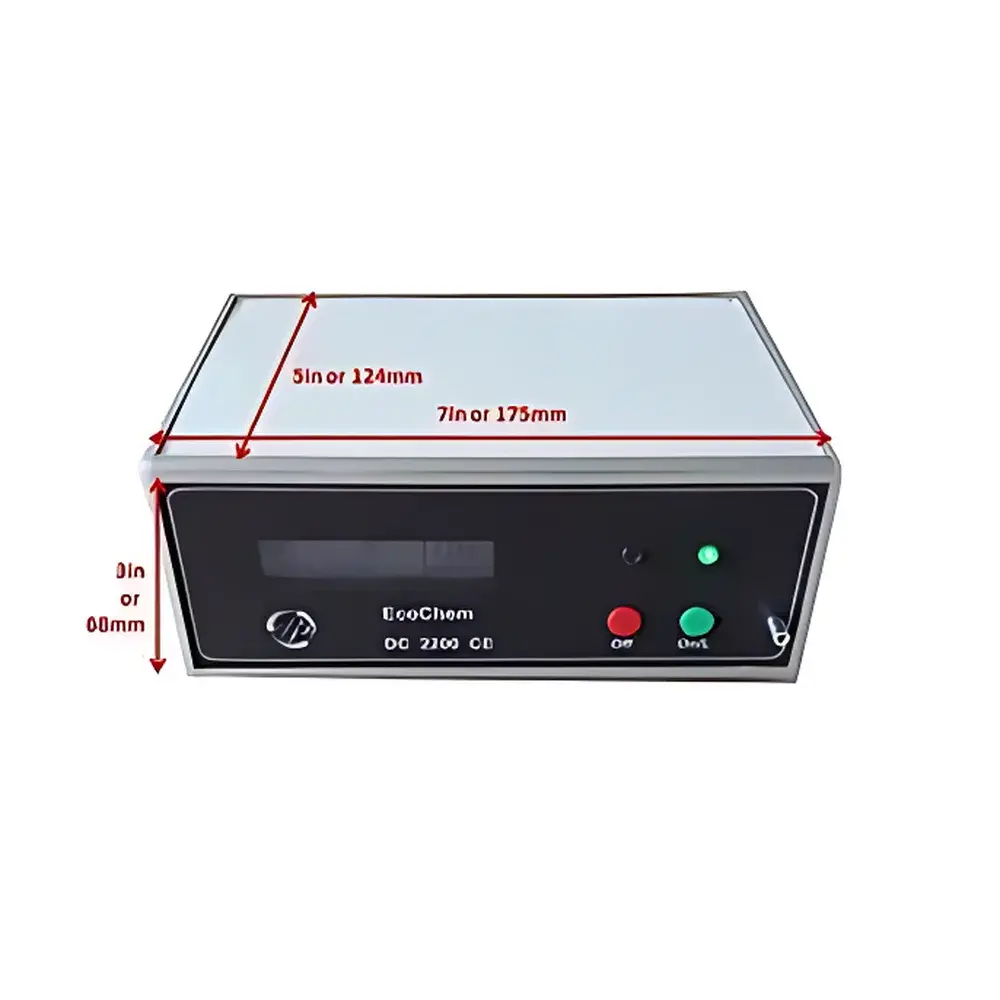
EcoChem DC-2200CE Portable Aerosol Surface Area Analyzer
| Brand | EcoChem |
|---|---|
| Origin | USA |
| Manufacturer Type | Authorized Distributor |
| Origin Category | Imported |
| Model | DC-2200CE |
| Instrument Type | Aerosol Detector |
| Power Supply | 15 V Rechargeable Li-ion Battery |
| Display | 2-line × 16-character LED |
| Weight | 1.5 kg |
| Dimensions | 68 mm × 175 mm × 124 mm |
| Operating Temperature | 5–40 °C |
| Storage Capacity | 8,000 data points (timestamp + surface area value) |
| Flow Rate | 1 LPM |
| Measurement Range | 0–1000 µm²/cm³ |
| Detection Limit | 0–10 µm²/cm³ |
| Sensitivity | 0–10 µm²/cm³ |
| Response Time | <10 s (adjustable) |
| Data Output | RS232 |
| Software Compatibility | PC-based charting utility with Excel export |
Overview
The EcoChem DC-2200CE Portable Aerosol Surface Area Analyzer is a field-deployable instrument engineered for real-time, quantitative assessment of the total aerosol surface area concentration (µm²/cm³) in ambient and occupational environments. Unlike mass- or number-based metrics, surface area is a physiologically relevant dosimetric parameter—strongly correlated with oxidative stress potential and pulmonary deposition efficiency of ultrafine and fine particulate matter (PM). The DC-2200CE implements the single-electrode diffusion charging principle: a controlled corona discharge generates unipolar negative ions in the sample airstream; these ions diffuse to and adhere to aerosol particles across a broad size range (≈2 nm to >10 µm), imparting a charge proportional to particle surface area. Charged particles are then collected on an insulating filter, and the resulting current—measured via a high-resolution femtoampere (fA)-capable electrometer—is converted into a stable DC voltage output linearly related to surface area concentration. This method offers rapid response (<10 s), chemical independence (unaffected by composition, volatility, or hygroscopicity), and low operational cost—making it uniquely suited for personal exposure monitoring in dynamic microenvironments.
Key Features
- True portable architecture: integrated 1 L/min sampling pump, rechargeable 15 V Li-ion battery (≥8 h continuous operation), and ruggedized housing rated for field use.
- Real-time surface area quantification with adjustable response time (default <10 s), enabling tracking of transient exposure events such as vehicle exhaust plumes or indoor cooking emissions.
- Dual-sensor capability: co-located DC (diffusion charging) and PAS (photoacoustic soot) sensors allow orthogonal characterization—DC responds to total surface area regardless of composition, while PAS responds selectively to light-absorbing carbonaceous aerosols (e.g., black carbon), enabling source apportionment in combustion-dominated settings.
- Onboard data logging: stores up to 8,000 timestamped measurements (surface area, flow rate, battery status) with no external hardware required.
- Intuitive 2×16-character LED display for immediate field readout; full dataset export via RS232 to Windows-compatible software with graphical visualization and Excel-compatible CSV output.
- Compact form factor (68 × 175 × 124 mm) and low mass (1.5 kg) facilitate belt-mounted or handheld deployment during mobility-intensive exposure assessments.
Sample Compatibility & Compliance
The DC-2200CE is validated for use with ambient air, indoor air, vehicular cabin air, tunnel air, and other non-corrosive, non-explosive gas matrices. It requires no consumables beyond routine filter replacement and exhibits minimal drift under ISO 17025-aligned calibration conditions. While not certified to a specific regulatory standard (e.g., EPA, EN), its measurement principle aligns with research-grade methodologies referenced in ISO/TS 11997-2 (nanoparticle surface area determination) and ASTM D7520 (standard practice for assessing nanoparticle surface area in workplace air). Data integrity supports GLP-compliant workflows when paired with audit-trail-enabled software; raw RS232 logs retain native timestamps and sensor diagnostics for traceability.
Software & Data Management
The included PC application provides real-time telemetry visualization, configurable averaging intervals (1 s to 60 min), and automated report generation. Export formats include .csv (compatible with Excel, R, Python pandas), .txt, and .pdf summary plots. All logged files contain embedded metadata: instrument ID, firmware version, calibration date, operator ID (user-entered), and GPS coordinates (if interfaced with optional external module). Software architecture adheres to FDA 21 CFR Part 11 principles for electronic records—supporting user authentication, audit trail review, and electronic signatures where required by quality systems.
Applications
- Personal exposure assessment in occupational hygiene studies (e.g., construction, welding, printing, nanomaterial handling).
- Indoor air quality surveys across residential, office, school, and healthcare settings—particularly for evaluating ultrafine particle sources (e.g., laser printers, frying pans, candle burning).
- Mobile monitoring campaigns: vehicle-based mapping of roadside aerosol surface area gradients; pedestrian-level exposure profiling in urban canyons.
- Validation of HVAC filtration efficiency using surface-area-weighted penetration metrics—more biologically relevant than gravimetric or optical particle counter (OPC) data alone.
- Field calibration support for fixed-site networks deploying complementary instrumentation (e.g., SMPS, APS, TEOM).
FAQ
How does surface area differ from particle number or mass concentration in health risk assessment?
Surface area better predicts reactive oxygen species (ROS) generation and alveolar macrophage activation than mass or count metrics—especially for nanoparticles where surface reactivity dominates toxicity pathways.
Can the DC-2200CE distinguish between diesel soot and secondary organic aerosol (SOA)?
Not directly via DC alone—but when used concurrently with the integrated PAS sensor, differential response patterns (PAS-active vs. PAS-inert surface area signals) enable empirical classification of carbon-rich vs. non-carbonaceous aerosols.
What maintenance is required for long-term field reliability?
Routine cleaning of the corona electrode and inlet nozzle every 40–60 hours of operation; annual electrometer zero-check and flow calibration using NIST-traceable rotameter or bubble meter.
Is the instrument suitable for outdoor use in rain or high humidity?
It is IP54-rated for dust and splash resistance but not submersion or sustained condensation exposure; use with a weather shield or sheltered mounting is recommended above 80% RH.
Does the device require factory recalibration before each study?
No—field verification using a reference aerosol (e.g., monodisperse PSL or DEHS) is sufficient; full factory recalibration is recommended annually or after impact damage or extended storage (>6 months).







