
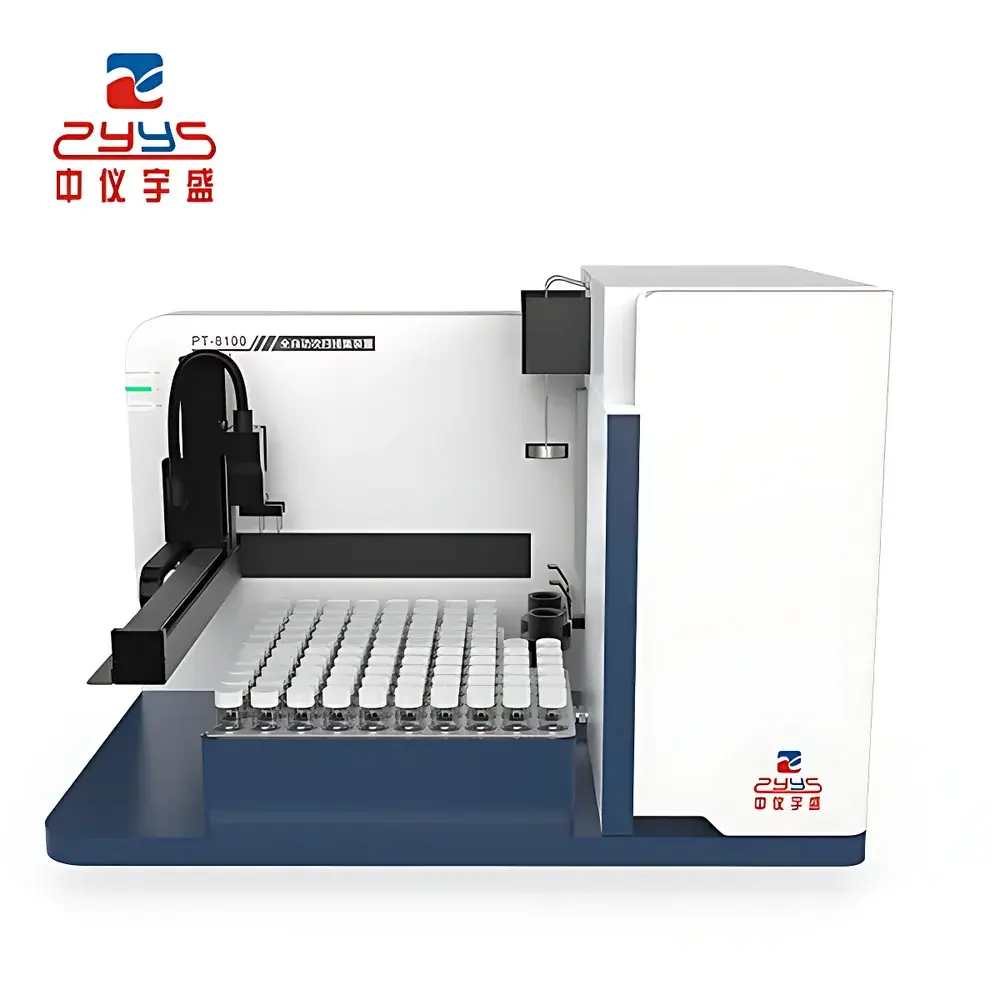
Zhongyi Yusheng PT-8100 Automated Purge and Trap Concentrator
| [Brand | Zhongyi Yusheng |
|---|---|
| Origin | Beijing, China |
| Manufacturer Type | Direct Manufacturer |
| Instrument Category | Domestic |
| Model | PT-8100 |
| Sample Tray Capacity | 100 positions |
| Sample Type Compatibility | Aqueous and Solid (Soil/Sediment) |
| Dual-Needle Architecture | Independent aqueous & solid sample pathways |
| Cryogenic Sample Cooling Option | Available |
| Automated Trap Bake-Out & Desorption | Yes |
| Automated Line Cleaning & Blank Analysis | Yes |
| Calibration Curve Automation | Up to 10 concentration levels |
| Methanol Extraction Module | Integrated for soil samples |
| Soil Heating Range | Up to 90 °C with variable-speed magnetic stirring |
| GC Trigger Interface | Configurable TTL/relay signal output |
| Software Control | PC-based method editor, queue management, real-time status monitoring, audit-trail-enabled logging] |
Overview
The Zhongyi Yusheng PT-8100 Automated Purge and Trap Concentrator is an integrated, laboratory-grade sample preparation system engineered for high-throughput, trace-level volatile organic compound (VOC) and semi-volatile organic compound (SVOC) analysis in environmental matrices. It operates on the principle of dynamic headspace extraction: inert gas purging displaces analytes from aqueous or solid-phase samples into a cooled adsorbent trap; subsequent thermal desorption transfers concentrated analytes directly into a gas chromatograph (GC) or GC–mass spectrometer (GC–MS) inlet. Designed specifically for compliance-driven environmental testing laboratories, the PT-8100 supports fully unattended operation across heterogeneous sample types—including drinking water, surface water, groundwater, soil, sediment, and solid waste—without cross-contamination risk between aqueous and solid workflows.
Key Features
- 100-position automated sample carousel with positional indexing and barcode-read capability (optional), enabling overnight batch processing without manual intervention.
- Dual independent sample introduction paths: Dedicated stainless-steel needles and fluidic circuits for aqueous and solid samples eliminate carryover and ensure regulatory-compliant separation of water and soil analytical streams.
- Cryogenic sample cooling option (–10 °C to +4 °C) maintains sample integrity during standby and purge phases, minimizing loss of highly volatile compounds (e.g., vinyl chloride, chloromethane).
- Programmable thermal management: Independent temperature and flow control for purge, dry-purge, bake-out, and desorption stages—each stage configurable per method with ramp/soak profiles.
- Integrated methanol-assisted extraction module for high-concentration soil samples, including automated solvent addition, vortex-assisted mixing, centrifugation (optional add-on), and post-extraction dilution—all under software-defined protocol.
- Soil-specific conditioning: Variable-speed magnetic stirring (0–1200 rpm) combined with programmable heating (ambient to 90 °C) ensures reproducible analyte release kinetics from heterogeneous solid matrices.
- Full system maintenance automation: Scheduled trap bake-out (up to 350 °C), carrier gas line cleaning with solvent vapor, and diagnostic desorption cycles—each executable as standalone routines or embedded within method sequences.
- Zero-bottle blank analysis: Internal standard spiking and blank runs executed without consuming sample vial positions, preserving throughput and supporting EPA Method 524/8260B data quality requirements.
- Modular inert flow path: PEEK and electropolished stainless-steel tubing throughout gas and liquid manifolds; all wetted surfaces passivated or SilcoNert®-treated to minimize adsorption and catalytic degradation.
Sample Compatibility & Compliance
The PT-8100 meets the mechanical and procedural specifications required by major international and national environmental standards. Its hardware architecture and software logic are validated against HJ 605-2011, HJ 639-2012, HJ 735-2015, HJ 1020-2019, and GB/T 5750.8-2023. The system supports full traceability per ISO/IEC 17025:2017 and aligns with GLP principles through time-stamped, user-attributed method logs, error event recording, and automated shutdown on critical fault detection. Optional 21 CFR Part 11-compliant software configuration provides electronic signature support, audit trail export (CSV/XML), and role-based access control for regulated environments.
Software & Data Management
Control is executed via Windows-based PT-Link software, featuring a method-centric interface with drag-and-drop queue builder, multi-method library storage, and real-time instrument status dashboard. Users define complete analytical workflows—including purge time, desorption temperature ramps, trap conditioning cycles, and GC trigger parameters—via intuitive parameter grids. All method edits, run executions, warnings, and hardware alerts are logged with UTC timestamps and operator IDs. Raw log files are immutable and exportable for QA/QC review or regulatory submission. Remote monitoring and alerting (email/SNMP) are supported via optional network integration modules.
Applications
The PT-8100 delivers robust performance in routine and research-grade applications: determination of BTEX (benzene, toluene, ethylbenzene, xylenes), chlorinated solvents (PCE, TCE), fuel oxygenates (MTBE, ETBE), haloacetonitriles, volatile petroleum hydrocarbons (C6–C9), acrylonitrile, acrolein, and halogenated pesticides in regulatory environmental monitoring programs. It is routinely deployed in municipal water quality labs, third-party environmental testing facilities, and academic research centers conducting fate-and-transport studies of emerging contaminants such as 1,4-dioxane and vinyl chloride in complex soil–water systems.
FAQ
Does the PT-8100 support both aqueous and solid sample analysis in a single sequence?
Yes. Its dual-needle architecture and independent fluidic routing allow interleaved or grouped analysis of water and soil samples within one unattended batch—without manual reconfiguration or risk of cross-contamination.
Can the system perform quantitative calibration curve generation automatically?
Yes. The software supports automated serial dilution and spiking of up to 10 calibration standards, including internal standard addition at each level, with full documentation in the audit trail.
Is the trap bake-out function programmable independently of sample analysis?
Yes. Bake-out can be scheduled as a standalone routine before or after a batch, or triggered conditionally (e.g., after every 10th sample), with customizable temperature profiles and inert gas flow rates.
What GC interfaces are supported for synchronization?
The system provides configurable TTL-level and relay-contact outputs compatible with Agilent, Thermo Fisher, Shimadzu, and PerkinElmer GC models. Signal polarity, pulse width, and delay timing are user-adjustable without hardware modification.
How is data integrity ensured during long-duration unattended operation?
All operational events—including method start/stop, temperature deviations, pressure faults, and trap desorption failures—are timestamped, attributed, and stored locally with cyclic overwrite protection. Logs are exportable in tamper-evident formats compliant with ISO 17025 documentation requirements.






