
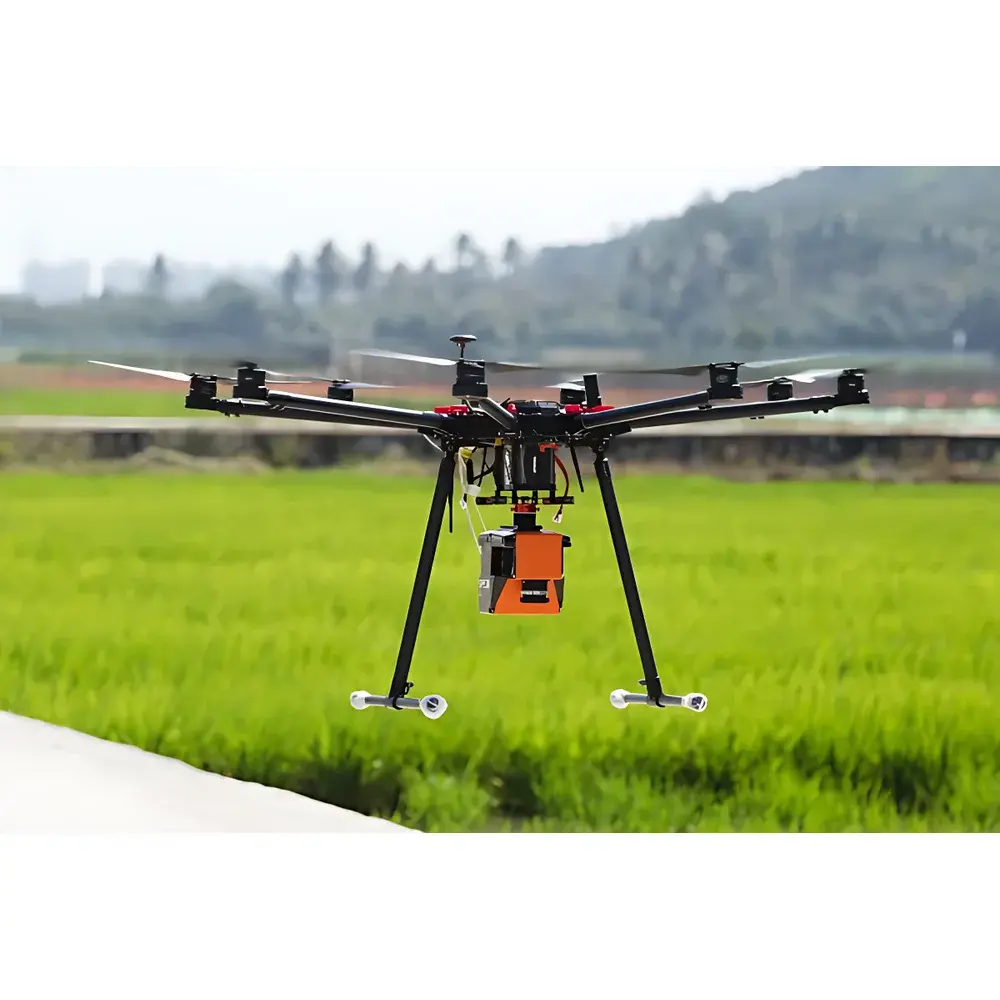
Ecodrone® UAS-8 High-Spectral UAV Remote Sensing Platform
| Origin | Shaanxi, China |
|---|---|
| Manufacturer Type | Authorized Distributor |
| Origin Category | Domestic |
| Model | Ecodrone® UAS-8 |
| Pricing | Available Upon Request |
Overview
The Ecodrone® UAS-8 High-Spectral UAV Remote Sensing Platform is a turnkey, compact, and high-throughput airborne hyperspectral imaging system engineered for low-altitude remote sensing in ecological and environmental monitoring applications. Built upon a purpose-designed octocopter airframe, the platform integrates a Specim AFX visible–near-infrared (VNIR) hyperspectral imager (400–1000 nm), a Trimble APX-15 high-accuracy Position and Orientation System (POS), an embedded onboard processing unit, and a synchronized RGB camera—without requiring a mechanical gimbal. Its core measurement principle relies on push-broom hyperspectral scanning, where spatial and spectral data are acquired simultaneously along flight lines with precise georeferencing enabled by real-time kinematic (RTK)-capable GNSS and inertial navigation. This architecture ensures geometric fidelity, minimal image distortion, and high radiometric consistency—critical for quantitative reflectance modeling, spectral unmixing, and time-series change detection across large-scale field deployments.
Key Features
- Octocopter-based UAS platform with >30 minutes endurance under standard payload configuration (AFX + POS + RGB + onboard PC)
- VNIR hyperspectral imager (Specim AFX): 400–1000 nm spectral range, 224 bands (binning ×2), 5.5 nm spectral resolution, 1024-pixel spatial resolution per line
- Trimble APX-15 POS system providing centimeter-level horizontal positioning accuracy (RTK-enabled) and sub-degree attitude stability
- Embedded processing unit with web-based UI (Web UI) for real-time telemetry monitoring, mission planning, and raw data pre-processing (e.g., dark current correction, radiometric calibration)
- Ground sampling distance (GSD) of 7 cm at 100 m AGL and 2 cm at 30 m AGL—enabling canopy-level structural and biochemical trait quantification
- Single-pass swath width of 72 m at 100 m altitude, supporting rapid coverage of hectare-scale plots with consistent illumination geometry
- Modular sensor expansion capability: optional SWIR (900–1700 nm) hyperspectral module, dual-band Thermo-RGB thermal/visible imaging, or MWIR (3–5 µm) mid-wave infrared spectral imaging
Sample Compatibility & Compliance
The Ecodrone® UAS-8 is designed for non-contact, non-destructive remote sensing of heterogeneous natural surfaces—including crop canopies, forest stands, wetland vegetation, soil exposures, and anthropogenic land cover. Its VNIR spectral response aligns with established vegetation indices (e.g., NDVI, PRI, MCARI) and supports inversion of biophysical parameters such as chlorophyll content, leaf area index (LAI), water stress indicators, and nitrogen status—consistent with ISO 11146 (laser beam characterization), ASTM E2795 (hyperspectral data acquisition standards for agriculture), and FAO-recommended protocols for agro-ecological monitoring. All onboard firmware and data logging modules comply with IEC 61508 functional safety principles for embedded avionics, and raw data formats adhere to HDF5 and ENVI-compatible BIL/BIP conventions to ensure interoperability with open-source (e.g., Python-scikit-image, GDAL) and commercial (ENVI, ERDAS IMAGINE, QGIS) processing environments.
Software & Data Management
Data acquisition, georeferencing, and preliminary radiometric correction are managed via the integrated Web UI, accessible through any modern browser over local Wi-Fi or Ethernet. Raw hyperspectral cubes are stored in lossless format on ruggedized SSDs and automatically tagged with precise timestamp, GPS coordinates, and IMU-derived roll/pitch/yaw metadata. Post-flight processing leverages the Ecodrone® Data Processing Suite (EDPS), which includes orthorectification using rational polynomial coefficients (RPCs), atmospheric correction (DOS and QUAC models), spectral library matching (USGS, ECOSTRESS), and batch export to GeoTIFF or NetCDF. The system supports audit-trail logging per GLP/GMP-aligned workflows and exports metadata compliant with ISO 19115-2 for long-term archival and FAIR (Findable, Accessible, Interoperable, Reusable) data management.
Applications
- Forest ecology: Canopy species classification, LAI mapping, early detection of pest/disease stress, biomass estimation
- Precision agriculture: In-season crop phenotyping, nutrient deficiency mapping, yield prediction, irrigation optimization
- Environmental monitoring: Wetland health assessment, invasive species detection, post-fire regeneration tracking, mine spoil rehabilitation evaluation
- Geoscience: Lithological mapping, mineral alteration zone identification, soil organic carbon estimation
- Pollution impact studies: Heavy metal bioaccumulation proxies (via spectral red-edge shifts), oil spill delineation, algal bloom characterization
FAQ
What is the typical data throughput during flight?
At full resolution, the AFX sensor generates >50 GB of raw hyperspectral data per 10-minute flight segment—requiring ≥512 GB onboard storage for extended missions.
Is ground control point (GCP) surveying required for georeferencing?
Not strictly necessary when using the APX-15 with RTK-GNSS; however, GCPs are recommended for sub-pixel absolute accuracy validation in scientific-grade studies.
Can the system be operated beyond visual line of sight (BVLOS)?
BVLOS operation is subject to national aviation authority regulations (e.g., CAAC Part 92 in China, FAA Part 107 in the U.S.) and requires certified pilot training, detect-and-avoid (DAA) integration, and airspace coordination—not included in base configuration.
What spectral calibration standards are supported?
Factory-calibrated using NIST-traceable integrating sphere sources; users may perform field-based radiometric calibration using portable reference panels (e.g., Spectralon® 99% reflectance) prior to each campaign.
Is software development kit (SDK) access available for custom algorithm integration?
Yes—EDPS provides documented RESTful APIs and Python bindings for integration with machine learning pipelines (e.g., scikit-learn, TensorFlow Lite) and automated analytics workflows.
Related Products







