
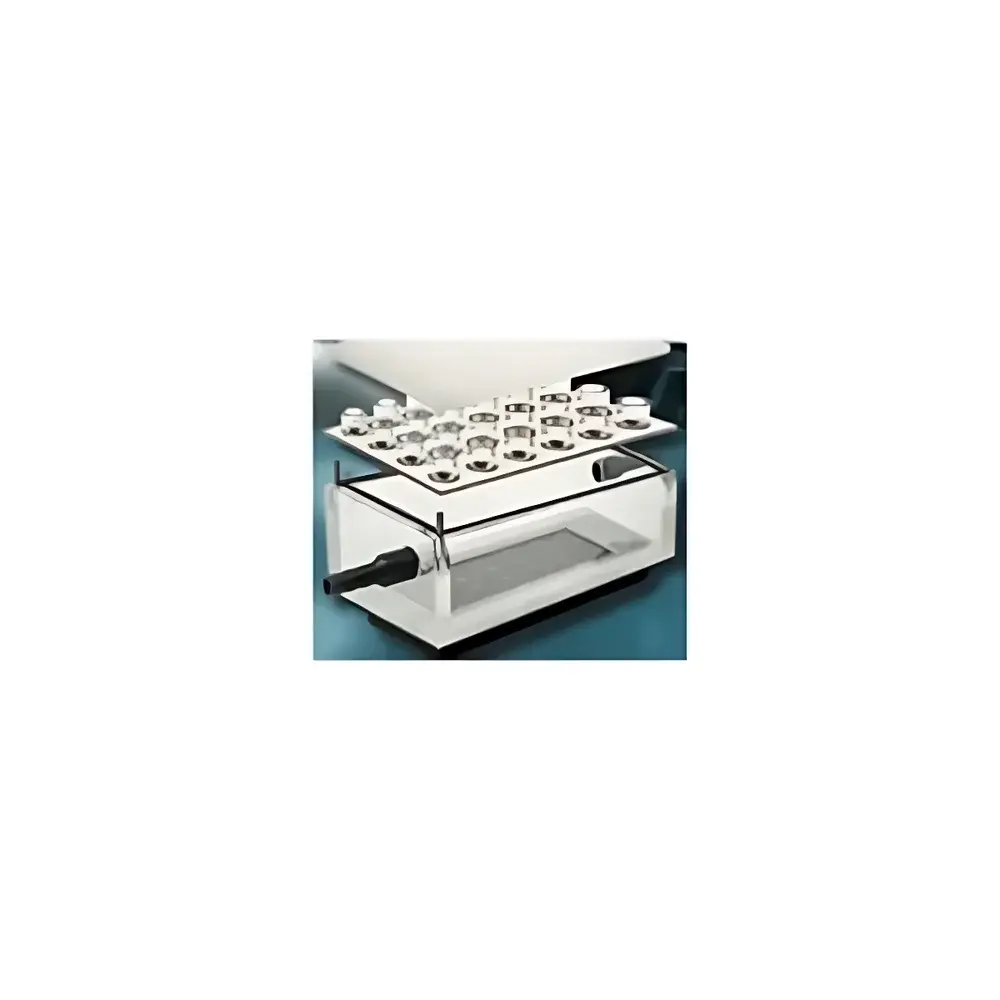
EcoTech PhenoTron® High-Throughput Seed Respiration & Viability Measurement System
| Brand | EcoTech |
|---|---|
| Origin | Beijing, China |
| Manufacturer Type | Authorized Distributor |
| Country of Origin | China |
| Model | PhenoTron® High-Throughput |
| Pricing | Upon Request |
| Oxygen Sensing Technology | REDFLASH Fluorescence-based Optical Sensing |
| Excitation Wavelength | Red Light (~630 nm) |
| Emission Detection | Near-Infrared (NIR, ~780–820 nm) |
| Oxygen Range (Gas Phase) | 0–50% O₂ |
| Oxygen Range (Aqueous Phase) | 0–44 mg/L |
| Resolution (Gas) | 0.1% O₂ @ 20% O₂ |
| Resolution (Liquid) | 0.05 mg/L @ 8.8 mg/L |
| Accuracy (Gas) | ±0.6% O₂ @ 20% O₂ |
| Accuracy (Liquid) | ±0.3 mg/L @ 8.8 mg/L |
| Drift (Gas) | <0.5% O₂/month |
| Drift (Liquid) | <0.20 mg/L/month |
| Response Time (t₉₀) | <30 s |
| Sensor Lifetime | ≥1 million measurements |
| Microplate Format | 96-well PS plate (round-bottom: 270 µL |
| flat-bottom | 350 µL), EtO-sterilizable |
| Software | Integrated acquisition & analysis suite supporting up to 3 devices simultaneously, with OCR-based well mapping, real-time respiration rate calculation, and drift-compensated kinetic modeling |
Overview
The EcoTech PhenoTron® High-Throughput Seed Respiration & Viability Measurement System is an optical, non-invasive platform engineered for quantitative assessment of seed metabolic activity via real-time oxygen consumption kinetics. It operates on the principle of fluorescence quenching of a proprietary REDFLASH sensor material—excited by red light (~630 nm) and emitting in the near-infrared (NIR, 780–820 nm) range—where molecular oxygen modulates fluorescence lifetime and intensity in a concentration-dependent manner. This dual-wavelength optical design eliminates interference from autofluorescent biological matrices and ambient light, enabling stable, long-term monitoring inside controlled environments such as incubators, growth chambers, and orbital shakers. Unlike electrochemical or Clark-type sensors, the system requires no electrolyte, membrane replacement, or polarization time, and delivers high reproducibility across repeated assays without sample perturbation. The platform is calibrated for both gaseous (0–50% O₂) and aqueous-phase (0–44 mg/L) oxygen quantification, making it suitable for sealed microplate-based respirometry under defined atmospheric or submerged conditions.
Key Features
- REDFLASH optical oxygen sensing technology with red excitation and NIR emission for minimal photobiological interference and robust signal-to-noise performance
- Non-contact, non-destructive measurement—no electrode insertion, gas sampling, or media exchange required
- Integrated 96-well microplate with factory-installed, center-positioned oxygen-sensing films (1–1.5 mm diameter) or optional nanoparticle-based coatings
- Compact, modular hardware architecture compatible with standard incubators (4–40 °C), CO₂-controlled chambers, and orbital shakers (up to 300 rpm)
- High temporal resolution: response time (t₉₀) <30 seconds, enabling dynamic respiration profiling during germination onset or stress induction
- Long-term stability: oxygen measurement drift <0.5% O₂/month (gas) or 12 months of continuous operation
- Low-power, solid-state electronics with embedded temperature compensation (±0.1 °C resolution) and humidity-insensitive optical path design
Sample Compatibility & Compliance
The PhenoTron® system supports a broad range of seed types—including cereals (wheat, barley, rice), legumes (soybean, pea), oilseeds (canola, sunflower), and horticultural species (tomato, lettuce)—across varying moisture contents (5–18% w.b.) and storage histories. Each 96-well plate accommodates single seeds or small seed cohorts (n = 1–5) in either round-bottom (270 µL) or flat-bottom (350 µL) configurations, fabricated from optically clear, EtO-sterilizable polystyrene. The system complies with ISO 20723:2019 (Seed testing — Determination of seed viability by tetrazolium test and related methods) and aligns with ASTM E2554-22 guidelines for optical biosensor validation. Data integrity meets GLP/GMP-aligned requirements through software-enforced audit trails, user access controls, electronic signatures, and full 21 CFR Part 11 compliance for regulated seed certification labs.
Software & Data Management
The bundled acquisition and analysis suite provides synchronized multi-device control (up to three PhenoTron® units per workstation), automated well identification via OCR-assisted plate mapping, and real-time visualization of dissolved or headspace O₂ decay curves. The analysis engine computes standardized respiration rates (nmol O₂·seed⁻¹·h⁻¹ or µmol O₂·g⁻¹·min⁻¹) using first-order kinetic fitting with built-in drift correction algorithms. Export formats include CSV, Excel (.xlsx), and HDF5 for integration with Python/R-based phenotyping pipelines (e.g., PlantCV, R/phenofit). All raw sensor signals, calibration logs, environmental metadata (temperature, humidity), and operator annotations are stored in a relational SQLite database with immutable timestamps and SHA-256 hash verification for data provenance.
Applications
- High-throughput seed viability screening for breeding programs and germplasm banks
- Accelerated aging studies and vigor index derivation (e.g., correlation with ISTA-standardized germination %)
- Pre-germination metabolic phenotyping under abiotic stress (drought, salinity, low temperature)
- Quality control of primed, coated, or bio-primed commercial seeds
- Respiratory phenotyping of dormant vs. after-ripened seeds
- Cross-species comparative respirometry in ecological seed bank research
- Secondary applications: microbial respiration in soil slurries, microalgal O₂ evolution, enzymatic O₂ consumption (e.g., oxidase assays), and small-volume bioreactor monitoring
FAQ
Can the system measure oxygen consumption in liquid-phase assays, such as imbibed seeds or suspension cultures?
Yes—the system is calibrated for both gas-phase (headspace) and aqueous-phase (dissolved O₂) measurements, with validated accuracy down to 0.05 mg/L in buffered solutions.
Is sterilization of the microplates supported for aseptic seed assays?
All 96-well plates are pre-validated for EtO (ethylene oxide) sterilization and maintain optical and sensor integrity post-sterilization.
How is temperature controlled during long-term assays?
The compact sensor head and plate holder are designed for direct integration into standard laboratory incubators or climate-controlled shakers, with onboard temperature logging synchronized to O₂ readings.
Does the software support custom kinetic modeling beyond default respiration rate calculation?
Yes—raw fluorescence decay files (time-stamped .csv) can be exported for advanced modeling in external platforms (e.g., MATLAB, OriginLab) using user-defined differential equations.
What is the recommended maintenance interval for the optical sensors?
No routine maintenance is required; the REDFLASH film exhibits >1 million measurement cycles and negligible photobleaching under standard operating conditions.




