
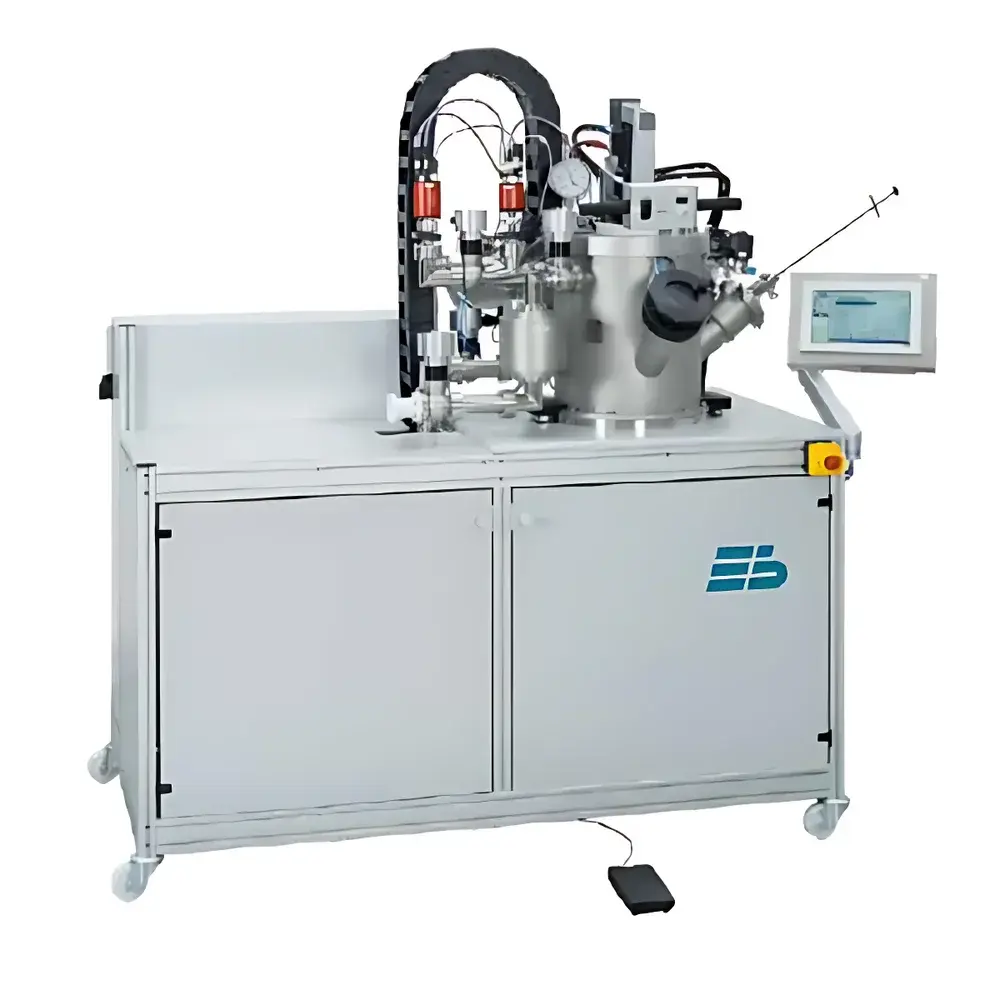
Edmund Bühler AM A500 Arc Melting Furnace
| Brand | Edmund Bühler |
|---|---|
| Origin | Germany |
| Model | AM A500 |
| Melting Capacity | 100–500 g (temperature-dependent) |
| Casting Capacity | up to 300 g at ≤1800°C |
| Max Melting Temperature | 3500°C |
| Vacuum Level | <10⁻² to 10⁻⁵ mbar |
| Max Pressure | 1300 mbar abs. |
| Arc Current Range | 10–1000 A |
| Power Supply | 400 V, 3-phase, 50/60 Hz and 230 V, single-phase, 50/60 Hz |
| Dimensions (W×D×H, excl. power supply) | 1680 × 1000 × 2000 mm |
Overview
The Edmund Bühler AM A500 Arc Melting Furnace is a high-precision, vacuum-compatible metallurgical synthesis system engineered for reproducible arc melting and controlled casting of refractory and reactive metals and alloys under inert or reduced-pressure atmospheres. Operating on the principle of direct-current (DC) arc discharge between a water-cooled tungsten electrode and a conductive sample—typically held in a copper crucible—the AM A500 generates localized plasma temperatures exceeding 3500°C, enabling full melting of high-melting-point elements including tungsten, molybdenum, niobium, tantalum, and titanium-based alloys. Its modular design integrates vacuum generation, gas handling, real-time process monitoring, and programmable logic control into a single robust platform compliant with laboratory-scale metallurgical R&D requirements in academia, national labs, and advanced materials development centers.
Key Features
- High-vacuum melting chamber with double-walled, water-cooled stainless steel construction and integrated vacuum sealing; ultimate pressure down to 10⁻⁵ mbar.
- Motor-driven, vertically adjustable tungsten electrode assembly with precise positional control above the copper mold—enabling optimal arc initiation and stable plasma column formation.
- PLC-based control system with 10-inch industrial touchscreen interface supporting full automation of vacuum pumping, gas purging (Ar, He, N₂), arc ignition, current ramping, and casting sequence.
- Non-contact arc ignition system eliminating electrode wear during startup and ensuring repeatable plasma initiation without physical triggering.
- Real-time current visualization via dynamic bar-graph display; integrated current limiting for low-melting-point samples to prevent splashing or uncontrolled vaporization.
- Integrated safety architecture including arc current monitoring, interlocked viewport shielding, emergency stop circuitry, and automatic shutdown upon vacuum loss or coolant flow interruption.
- Optional in-situ manipulator arm for post-melting sample repositioning or sequential multi-step processing within the same vacuum cycle.
Sample Compatibility & Compliance
The AM A500 accommodates diverse sample geometries—including button, rod, and disk forms—with crucible and mold configurations tailored to alloy composition and thermal expansion behavior. It supports preparation of homogeneous master alloys, calibration standards for XRF and ICP-OES, and prototype ingots for subsequent thermomechanical testing. The system meets essential safety and operational standards relevant to high-energy laboratory equipment, including IEC 61000-6-2 (EMC immunity), IEC 61000-6-4 (EMC emission), and EN 60204-1 (electrical safety). Its vacuum and gas-handling subsystems are designed to comply with ISO 27425 (vacuum practice) and ASTM E144 (standard practices for arc melting of metals), while data logging functionality supports GLP-aligned documentation when paired with validated software protocols.
Software & Data Management
The embedded PLC controller records time-stamped operational parameters—including arc current, chamber pressure, cooling water temperature, and elapsed process time—at user-defined intervals (default: 1 Hz). All logs are exportable in CSV format for traceability and post-processing. Optional software modules provide waveform visualization of current profiles, overlay of vacuum curves against temperature estimates (via empirical correlation), and color-coded status alerts (e.g., green = nominal operation, amber = pressure drift, red = interlock activation). Audit trails meet basic FDA 21 CFR Part 11 readiness criteria when deployed with password-protected user roles and electronic signature configuration—though formal validation remains site-specific per institutional QA policy.
Applications
- Synthesis of high-purity refractory metal alloys (e.g., W–Re, Mo–Nb, Ta–HfC) for aerospace and nuclear applications.
- Preparation of certified reference materials (CRMs) requiring matrix homogeneity and minimal contamination from crucible interaction.
- Rapid prototyping of novel intermetallic compounds and HEAs (high-entropy alloys) under controlled stoichiometric conditions.
- Production of small-volume castings for subsequent microstructural analysis (SEM/EBSD), mechanical testing (microhardness, tensile mini-bars), or neutron irradiation screening.
- Reductive melting of oxide precursors in combination with reactive metal getters (e.g., Ca, Mg) for oxygen-sensitive systems.
FAQ
What vacuum level is required for reactive metal melting?
For Ti, Zr, or Nb-based alloys, a base pressure of ≤5×10⁻⁴ mbar is recommended prior to backfilling with high-purity argon (99.999%) to minimize oxide inclusion formation.
Can the AM A500 perform directional solidification?
No—it is optimized for static casting into fixed copper molds. Directional solidification requires supplemental furnace modifications (e.g., active chill plates or gradient heating zones), which are not part of the standard configuration.
Is remote operation supported?
Local touchscreen control is standard; Ethernet connectivity enables optional remote monitoring (read-only mode) via secure VPN, but full remote actuation requires additional cybersecurity assessment per site IT policy.
What maintenance is required for the tungsten electrode?
Electrode tip dressing (light grinding) is advised after every 10–15 melts involving high-vapor-pressure elements (e.g., Mn, Al); routine inspection for pitting or deformation should occur before each use.
Does the system include a water chiller?
A recirculating water cooler is available as an optional accessory; standard operation assumes connection to facility-supplied deionized water at ≥3 bar and ≤25°C inlet temperature.



