
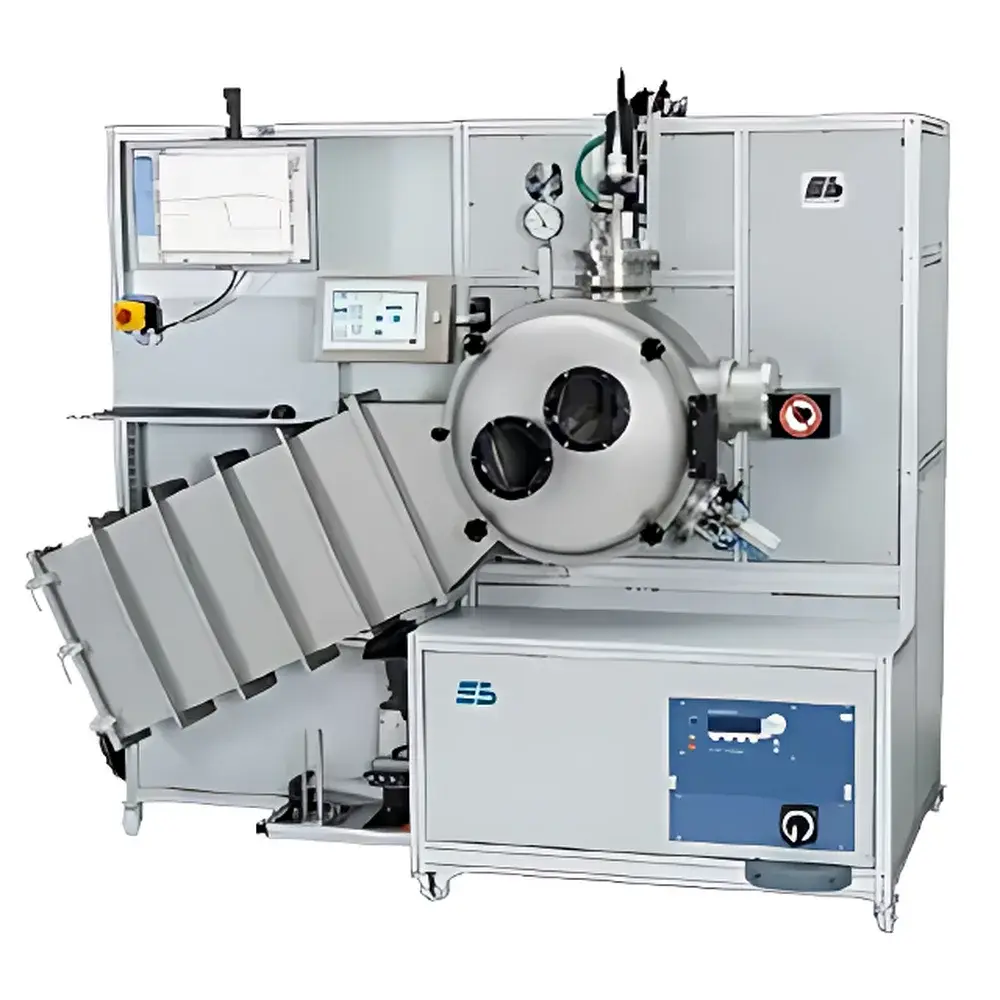
Edmund Bühler PA500 Melt Spinning System
| Brand | Edmund Bühler |
|---|---|
| Origin | Germany |
| Model | PA500 |
| Dimensions (L×W×D) | 2205 × 2002 × 1305 mm |
| Melting Capacity | 100–500 g |
| Max. Temperature | up to 1500 °C |
| Generator Power | 30 kW |
| Vacuum Level | < 10⁻² – 10⁻⁵ mbar |
| Copper Wheel Diameter × Width | Ø250 × 60 mm |
| Max. Wheel Surface Velocity | 40 m/s |
| Strip Width | 10–28 mm (adjustable) |
| Strip Thickness | 20–60 µm |
| Cooling Rate | ~10⁵ K/s |
| Power Supply | 400 V, 3-phase, 50/60 Hz |
| Crucible Material | Boron Nitride or Quartz |
| Nozzle Type | Slit or Circular |
| Wheel Cooling | Water-cooled |
Overview
The Edmund Bühler PA500 Melt Spinning System is a high-precision, vacuum- or inert-atmosphere-compatible rapid solidification apparatus engineered for the reproducible fabrication of metallic and intermetallic ribbons, amorphous strips, and metastable phase materials. Operating on the principle of planar flow casting (PFC), the system delivers controlled melt ejection onto a rapidly rotating, water-cooled copper wheel—enabling ultra-high cooling rates (~10⁵ K/s) essential for suppressing crystallization and stabilizing non-equilibrium microstructures. Designed and manufactured in Germany, the PA500 integrates industrial-grade thermal management, real-time process monitoring, and programmable parameter sequencing to support both R&D-scale alloy development and pre-qualification of ribbon-based functional materials for magnetic, soft-magnetic, catalytic, or additive manufacturing feedstock applications.
Key Features
- High-vacuum or inert-gas (Ar/N₂) processing chamber with ultimate pressure down to 10⁻⁵ mbar, ensuring minimal oxidation during high-temperature melting (up to 1500 °C)
- Water-cooled copper wheel (Ø250 × 60 mm) with surface velocity programmable from 5 to 40 m/s, enabling precise tuning of solidification kinetics and ribbon morphology
- Motorized, software-controlled crucible positioning system with sub-millimeter resolution for repeatable nozzle-to-wheel gap adjustment (critical for uniform strip thickness and edge quality)
- Dual-mode crucible holder accommodating boron nitride or fused quartz crucibles with interchangeable slit or circular nozzles (widths 0.3–1.2 mm), supporting both continuous ribbon and discrete flake production
- Integrated 30 kW medium-frequency induction generator with closed-loop power regulation and real-time display of delivered power, melt time, and wheel speed
- Touchscreen HMI control panel managing vacuum pumping sequence, inert gas purging, wheel rotation, crucible actuation, pyrometric temperature feedback (via calibrated high-speed pyrometer), and optional in-situ polishing module
- Modular tooling design: fully removable crucible assembly and quick-release wheel mount allow for in-chamber wheel surface conditioning without disassembly or realignment
Sample Compatibility & Compliance
The PA500 accommodates a broad range of metallic systems—including Fe-, Co-, Ni-, Al-, Mg-, and Zr-based alloys—as well as refractory and reactive compositions requiring strict atmospheric control. Crucible compatibility with BN and quartz enables processing of both oxidizable and highly corrosive melts. All operational sequences—including vacuum ramping, gas flushing, heating profiles, and wheel acceleration—are logged with timestamped metadata, supporting compliance with GLP and GMP documentation requirements. The system architecture permits integration into laboratory-wide electronic lab notebook (ELN) environments and satisfies foundational traceability criteria aligned with ISO/IEC 17025 and ASTM E2915 for rapid solidification process validation.
Software & Data Management
The proprietary PA500 Control Suite provides deterministic, deterministic real-time process orchestration via deterministic state-machine logic. Users define multi-step recipes including vacuum hold times, gas partial pressure setpoints, ramp/soak temperature profiles, and synchronized wheel acceleration/deceleration ramps. Pressure, temperature, power, and rotational speed are sampled at ≥100 Hz and archived in HDF5 format for post-processing interoperability with MATLAB, Python (NumPy/Pandas), and commercial data analysis platforms. Audit trails record all operator actions, parameter modifications, and system alarms—fully compliant with FDA 21 CFR Part 11 requirements when deployed with qualified user authentication and electronic signature modules.
Applications
- Development of amorphous and nanocrystalline soft-magnetic ribbons (e.g., Fe-Si-B, Co-Fe-Nb-B) for high-efficiency transformers and inductors
- Synthesis of metastable intermetallic phases for hydrogen storage, thermoelectric conversion, or high-entropy alloy precursors
- Production of master alloy ribbons for powder metallurgy feedstock in laser powder bed fusion (LPBF) and binder jetting
- Fundamental studies of undercooled melt dynamics, nucleation suppression, and interface stability under extreme thermal gradients
- Process qualification of ribbon geometry (thickness uniformity ±1.5 µm, width tolerance ±0.3 mm) and microstructural homogeneity across >50 m continuous lengths
FAQ
What atmosphere options are supported during melt spinning?
The PA500 operates under high vacuum (<10⁻⁵ mbar) or controlled inert gas (Ar or N₂) environments, with programmable purge cycles and residual gas analysis capability.
Can the copper wheel be refurbished inside the chamber?
Yes—the wheel mount is designed for in-situ mechanical polishing using the optional integrated polishing fixture, eliminating the need for removal, reinstallation, or realignment.
Is remote operation or integration with lab automation systems possible?
The system supports TCP/IP-based communication via Modbus TCP and OPC UA protocols, enabling integration with SCADA, MES, and centralized facility control networks.
What safety certifications does the PA500 meet?
It complies with CE marking requirements (2006/42/EC Machinery Directive, 2014/30/EU EMC Directive, 2014/35/EU Low Voltage Directive) and conforms to EN 61000-6-2/6-4 for electromagnetic compatibility.
How is temperature monitored during melting?
A calibrated two-color pyrometer continuously measures melt surface temperature with ±5 °C accuracy; optional secondary thermocouple input is available for crucible base monitoring.



